
How To Avoid Analysis Paralysis In Critical Situations

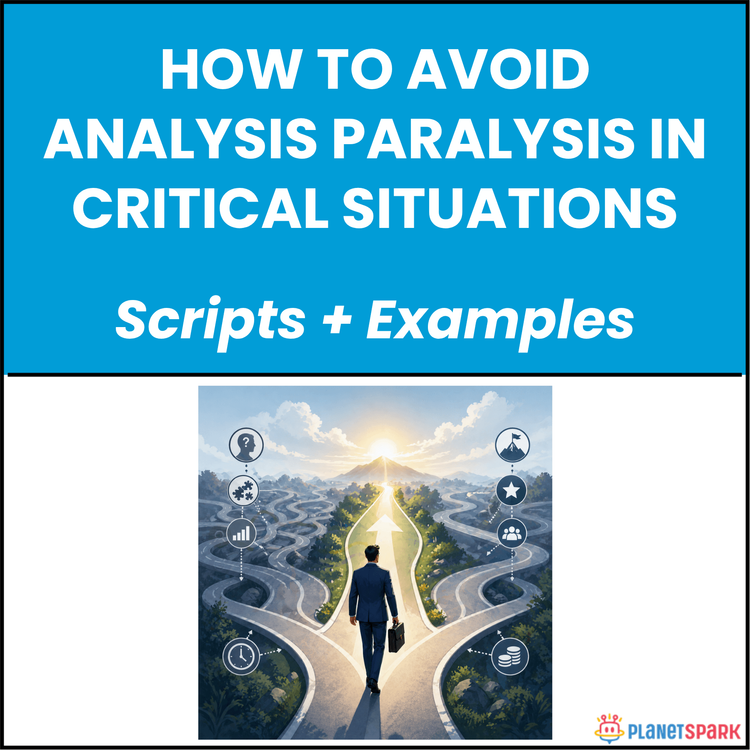
How To Avoid Analysis Paralysis In Critical Situations
How to Avoid Analysis Paralysis in Critical Situations: A Practical Guide to Faster, Confident, and Decisive Action
If you’ve ever found yourself stuck thinking, rethinking, and overthinking—while a decision keeps getting delayed—you’re not alone.
Analysis paralysis is one of the most common (and costly) challenges working professionals face today. You want to make the right decision, so you gather more data, explore more options, and wait for more clarity.
But instead of improving your decision—you delay it.
Opportunities pass. Deadlines tighten. Confidence drops.
That’s exactly why the resource “How to Avoid Analysis Paralysis in Critical Situations” exists. It’s designed to help you break out of overthinking loops and make clear, timely decisions—even when information is incomplete.
Instead of getting stuck in analysis, you learn how to move forward with structure and confidence.
Who Is This Resource For?
This resource is especially valuable if you are:
- A working professional with 0–15 years of experience
- A manager or team lead making frequent decisions under pressure
- A consultant or analyst dealing with complex problem-solving
- A career switcher evaluating multiple opportunities
- A professional who tends to overthink or delay decisions
- Someone who wants to act faster without compromising quality
If you often feel “I need more time or data before deciding,” this guide is built for you.
What Does This Resource Contain?
This is not just a mindset guide—it is a practical system to break analysis paralysis.
Inside the resource, you’ll find:
- A clear explanation of what analysis paralysis is and why it happens
- The key triggers: fear of failure, perfectionism, too many options, and lack of structure
- A breakdown of how over-analysis reduces decision quality instead of improving it
- A structured decision-making framework to move from thinking to action
- Techniques to limit options and reduce cognitive overload
- Practical methods to define “good enough” decisions instead of perfect ones
- The concept of decision thresholds—knowing when you have enough information
- The 70% rule to avoid waiting for complete certainty
- Time-bound decision techniques to force clarity and momentum
- Tools to prioritise speed vs accuracy depending on the situation
- A simple system to separate reversible vs irreversible decisions
- Methods to reduce stakeholder noise and external pressure
- Real-world examples showing how professionals overcome overthinking
- Reflection exercises to identify your personal decision patterns
- Worksheets to apply these techniques to current decisions
Everything is designed for immediate action—not passive learning.
Summary of the Resource
“How to Avoid Analysis Paralysis in Critical Situations” is a practical execution guide for decision-making.
It helps you:
- Recognise when you are overthinking
- Reduce unnecessary analysis and complexity
- Make decisions faster without losing clarity
- Build confidence in incomplete-information scenarios
- Create a repeatable system for action
If you want to stop delaying decisions and start moving forward consistently, this resource gives you the framework.
How Will This Resource Be Useful?
This resource helps you move from hesitation to action.
You’ll gain:
- Faster decision-making without constant doubt
- Reduced mental fatigue from overthinking
- Clear structure for evaluating options efficiently
- Confidence in acting without perfect information
- Better momentum in your work and career
- Stronger professional presence as a decisive individual
Most importantly, it helps you stop waiting for perfect clarity—and start making progress.
How Should You Use This Resource?
To get the best results, treat this as a practical playbook.
Start with awareness:
- Identify situations where you tend to overanalyse
- Recognise your triggers (fear, uncertainty, perfectionism)
Then apply structure:
- Limit your options to a manageable number
- Define clear decision criteria
Set boundaries:
- Decide your time limit for the decision
- Use the 70% rule—don’t wait for full certainty
Take action:
- Make the decision within the defined timeframe
- Commit to execution instead of revisiting constantly
Reflect and improve:
- Review the outcome after execution
- Learn what worked and what didn’t
Use the worksheets to practise this on real decisions immediately.
Action Steps
After accessing this resource, take these steps immediately:
1. Identify one decision you are currently delaying
2. Set a clear deadline for making that decision
3. Limit your options to 2–3 choices only
4. Define 3 criteria that matter most
5. Make the decision at 70% confidence
6. Take the first action step within 24 hours
Momentum breaks overthinking.
The professionals who grow fastest are not the ones who always make perfect decisions—they are the ones who make timely decisions and learn quickly.
Analysis has value—but only until it delays action.
When you learn to balance thinking with execution, you don’t just make better decisions—you move faster, grow faster, and lead better.
Book your free session today!