
How to Avoid Energy Depletion from Constant Context Switching

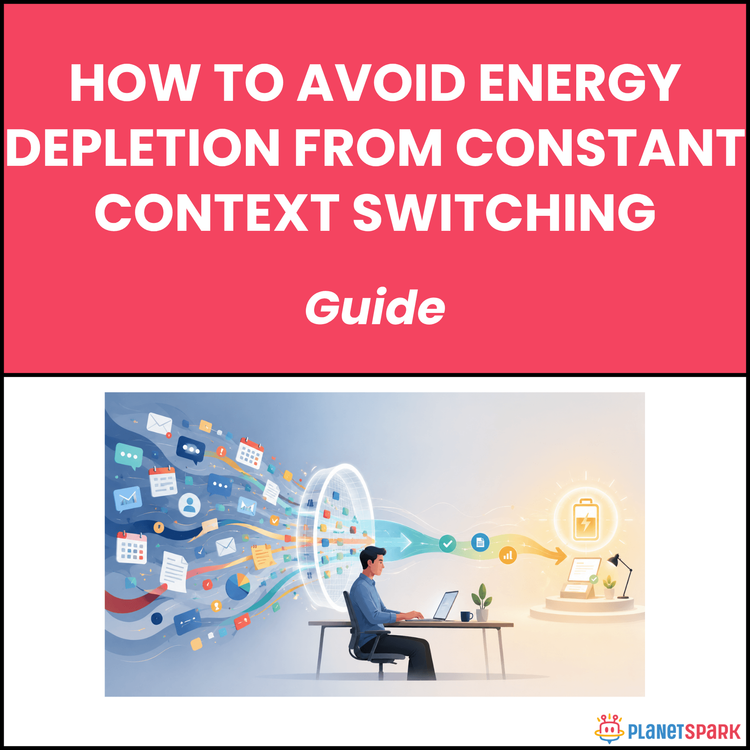
How to Avoid Energy Depletion from Constant Context Switching
Avoid Energy Depletion from Constant Context Switching: A Practical Guide for Working Professionals
You start the day with a clear plan. You want to finish an important document, respond to your team, review a few updates, and finally make progress on the work that actually matters.
Then the switching begins.
A message pops up. A meeting reminder appears. You check one email, open another tab, reply to a quick question, and return to your original task only to realize you have lost your flow.
This is the problem of constant context switching. It does not just take away time. It drains your mental energy, breaks your focus, and leaves you feeling busy but unproductive.
The resource “How to Avoid Energy Depletion from Constant Context Switching” is a practical guide for working professionals who feel scattered, drained, and constantly behind. It helps you understand why switching between tasks is so tiring and gives you simple systems to protect your focus, reduce interruptions, and work with more clarity.
Who Is This Resource For?
This resource is useful for professionals who regularly move between tasks, tools, meetings, messages, and priorities.
It is especially helpful for:
* Managers who balance team communication, planning, and decision-making
* Consultants working across multiple clients or projects
* Product managers, analysts, marketers, and operations professionals managing deep work and collaboration
* Job seekers and career switchers trying to stay focused while learning, applying, and networking
* Remote and hybrid workers dealing with constant digital interruptions
* Team leads who want to reduce unnecessary switching for themselves and their teams
* Early- to mid-career professionals who want to improve productivity without burning out
If you often feel mentally tired by the afternoon, struggle to complete deep work, or end the day wondering where your time went, this guide is designed for you.
What Does This Resource Contain?
A clear explanation of context switching
The guide explains why switching between tasks is so mentally expensive. Every time you move from one task to another, your brain has to rebuild focus, remember where you were, and adjust to the new task.
It also explains the idea of **attention residue**, where part of your mind stays stuck on the previous task even after you have moved on.
The four types of context switching
The resource breaks context switching into four types:
Tool switching: Moving between apps, tabs, platforms, and systems
Domain switching: Moving between different types of thinking, such as writing, analysis, meetings, and planning
Stakeholder switching: Moving between different people, teams, clients, or conversations
Priority switching: Being pulled away from important work by something that feels urgent
This makes it easier to understand what is actually draining your energy.
Personal Context-Switching Audit
The guide includes a worksheet to help you review your current workday.
You are asked to reflect on:
* How many tools you use daily
* When you feel most mentally sharp
* How often you are interrupted
* What your biggest switching trigger is
* How drained you feel during the day
* Whether you have protected deep-work time
This audit helps you identify your top switching triggers before trying to fix everything at once.
The 3-Block Day Template
One of the most useful tools in the guide is the 3-Block Day Template.
It helps you structure your day around your energy instead of only following your calendar.
The three blocks are:
Deep Work: 90–120 minutes for your most demanding task
Collaboration: Meetings, calls, emails, and team communication
Close-Out: A short end-of-day block to process notes, update tasks, and plan tomorrow
This structure helps you use your best mental energy for your most important work.
The 2-Minute Close Protocol
The guide introduces a simple transition ritual to reduce mental carryover between tasks.
Before switching contexts, you:
1. Write where you paused and what the next step is
2. Close tabs or documents from the previous task
3. Take three slow breaths
4. State what you are doing next
This helps your brain close one task before starting another.
Notification Management Tools
The resource also helps you take control of notifications.
Instead of reacting to every alert, the guide recommends:
* Turning off unnecessary badges and sounds
* Using Focus Mode during deep work
* Checking email and messages at fixed times
* Deciding whether something is truly urgent before responding
This helps you stop treating every notification as an immediate priority.
Task Batching Planner
The guide explains how to group similar work together so your brain does not have to keep switching mental modes.
Tasks are grouped into modes such as:
Creative: Writing, strategy, ideation
Analytical: Data, finance, problem-solving
Communicative: Meetings, email, feedback
Administrative:Scheduling, filing, updating records
This helps you plan your week more intentionally and reduce unnecessary mental friction.
Daily Context-Switching Defence Checklist
The guide includes a daily checklist that can be used in the morning and at the end of the day.
It helps you:
* Choose your top deep-work tasks
* Block focus time
* Set communication check-in times
* Prepare a parking lot for interruptions
* Close open loops before ending the day
The checklist is short, practical, and easy to repeat.
Weekly Task Batching Planner
The weekly planner helps you organize tasks by mental mode and place them into the right time blocks.
This is useful for reducing reactive work and making your week feel more structured.
Transition Ritual Design Sheet
The resource also includes a worksheet to personalize your transition ritual.
You can choose:
* Your written close statement
* Your physical reset signal
* Your breathing or reset method
* Your intention statement
* Your realistic time target
This makes the system easier to follow because you can adapt it to your own work style.
Self-Assessment Tool
The guide includes a self-assessment to measure progress across five areas:
* Structured daily blocks
* Transition rituals
* Notification control
* Task batching
* Open loop management
You can complete it before starting and again after a few weeks to see what has improved.
Real-World Case Study
The resource includes the example of Priya, a senior product manager who struggled with meetings, Slack messages, and deep strategy work.
After applying the system, she protected deep-work time, used transition rituals, batched communication, and felt more in control by the end of the day.
This case study shows that the solution is not always about reducing workload. Often, it is about changing the structure of attention.
Guidance for Managers
The guide also includes a section for managers and team leads.
It explains how leaders can unintentionally create context switching for their teams through quick messages, sudden meetings, and unclear communication expectations.
It recommends:
* Shared focus hours
* Async-first communication
* Batched check-ins
* Clear response expectations
This makes the resource useful not only for individuals but also for teams.
21-Day Implementation Roadmap
The guide ends with a practical 21-day plan.
The roadmap is divided into three phases:
Days 1–7:Use the Morning Setup checklist and protect one deep-work block
Days 8–14:Add the 2-Minute Close Protocol, notification schedule, and weekly batching planner
Days 15–21: Refine your system, review switching patterns, and communicate focus expectations
This helps you build the habits gradually instead of trying to change everything in one day.
Summary of the Resource
“How to Avoid Energy Depletion from Constant Context Switching” is a practical playbook for professionals who want to feel less scattered and more in control of their workday.
It helps you understand why context switching drains your energy and gives you tools to reduce interruptions, protect focus time, batch similar tasks, and close mental loops.
The main message is simple: **you are not the problem; your system is.**
Instead of relying on willpower, the guide helps you build a better work structure that supports focus, clarity, and sustainable productivity.
How Will This Resource Be Useful?
It helps you protect your best focus time
The guide teaches you to schedule your most demanding work during your peak energy window. This helps improve the quality of your thinking, writing, planning, and decision-making.
It reduces mental exhaustion
By cutting down unnecessary switching and using simple transition rituals, you can reduce the mental load that builds up throughout the day.
It helps you make fewer mistakes
When your attention is constantly interrupted, small mistakes become more likely. The checklists and protocols in this guide help you move between tasks more cleanly.
It gives you control over notifications
The guide helps you stop reacting to every alert and start checking messages at planned times.
It makes your workday more intentional
The 3-Block Day Template and batching planner help you organize your day based on energy, focus, and task type.
It supports better team habits
For managers, the guide offers practical ways to reduce interruptions and create a healthier focus culture across the team.
It builds habits slowly
The 21-day roadmap makes the system realistic. You can start with one habit, build consistency, and then add more over time.
How Should You Use This Resource?
Start with the audit
Begin by completing the Personal Context-Switching Audit. This will help you understand what is causing the most distraction and energy loss in your day.
Pick one habit first
Do not try to use every tool at once. Start with one high-impact habit, such as the Morning Setup checklist or one protected deep-work block.
Protect one deep-work block
Choose a 90-minute focus window during your best energy period. Turn off notifications and use that time for one important task.
Use the 2-Minute Close Protocol
Before switching tasks, write where you paused and what comes next. This helps your brain let go of the previous task and enter the next one more clearly.
Create a notification schedule
Choose fixed times to check messages and email. This helps you stay responsive without being constantly interrupted.
Use the weekly planner
At the start of the week, group your tasks by mental mode. Place creative and analytical work during your stronger energy windows.
Review after 21 days
Use the self-assessment to measure your progress. Notice whether you feel less scattered, more focused, and less drained at the end of the day.
Action Steps
Use these steps after accessing the resource:
1. Complete the Personal Context-Switching Audit.
2. Identify your top two switching triggers.
3. Block one 90-minute deep-work session for tomorrow.
4. Turn on Focus Mode during that block.
5. Create a parking lot note for interruptions.
6. Use the 2-Minute Close Protocol before your next task switch.
7. Set three fixed times to check email or team messages.
8. Write tomorrow’s top three priorities before ending your day.
9. Use the Morning Setup checklist for five working days.
10. Complete the Weekly Task Batching Planner at the start of next week.
Context switching is one of the biggest hidden reasons professionals feel tired, distracted, and behind.
This resource helps you solve that problem with structure, not self-blame.
By using the worksheets, checklists, planning tools, and transition rituals inside the guide, you can protect your attention, reduce unnecessary mental load, and end your workday with more clarity.
You do not need a perfect schedule to make progress. Start with one focus block. Close one loop before switching tasks. Turn off one unnecessary notification. Build from there.
Small changes, repeated consistently, can help you reclaim your energy and do better work without feeling constantly drained.