
How To Avoid Overconfidence In Decision-Making
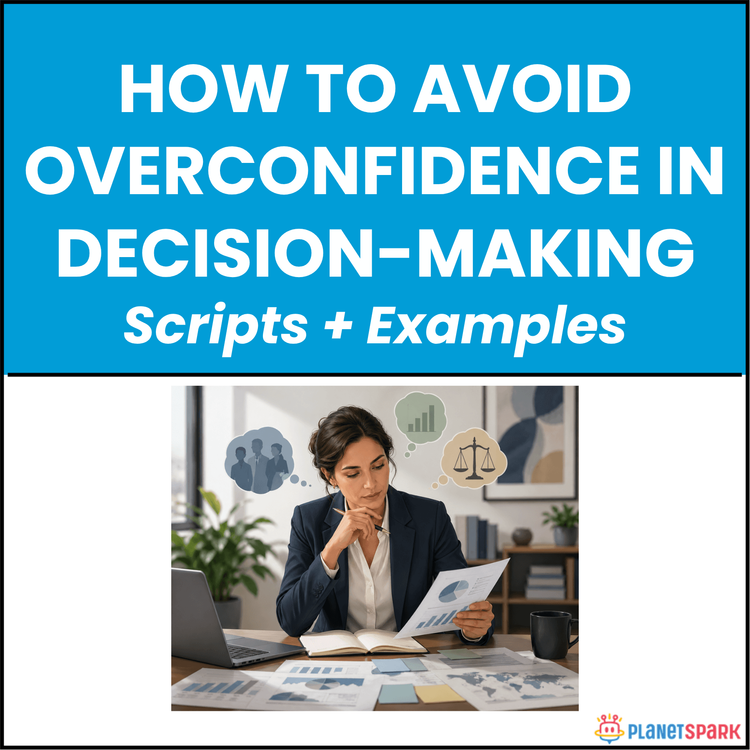
How To Avoid Overconfidence In Decision-Making
How to Avoid Overconfidence in Decision-Making: A Practical Guide to Making Sharper, More Grounded Decisions
If you’ve ever made a decision you felt completely confident about—only to realise later that you missed something important—you’re not alone.
In fact, that’s exactly how overconfidence works.
It doesn’t feel like a mistake in the moment.
It feels like clarity.
It feels like experience.
It feels like “I’ve seen this before.”
And that’s what makes it dangerous.
Most professionals don’t struggle because they lack knowledge. They struggle because they stop questioning too early.
That’s exactly why the resource “How to Avoid Overconfidence in Decision-Making” exists. It gives you a structured, practical system to calibrate your confidence, challenge your assumptions, and make decisions that actually hold up in the real world.
Instead of being confidently wrong, you learn how to be deliberately right.
Who Is This Resource For?
This resource is especially valuable if you are:
- A working professional with 0–15 years of experience
- A manager, consultant, or decision-maker handling high-stakes choices
- A career switcher evaluating unfamiliar opportunities
- A professional who relies heavily on past experience
- Someone who wants to improve judgment and credibility
- A professional who wants to avoid costly decision mistakes
If you’ve ever thought, “I was so sure—but I still got it wrong,” this guide is built for you.
What Does This Resource Contain?
This is not a theoretical psychology guide—it is a real-world decision calibration system.
Inside the resource, you’ll find:
- A clear explanation of overconfidence as a “calibration error” (page 2), not arrogance
- A practical awareness system (page 3) to detect overconfidence early, including signals like:
- “I already know this” thinking
- Skipping information gathering
- Dismissing disagreement
- Seeking confirmation instead of truth
- A Pre-Decision Calibration Checklist (page 4), covering:
- Information audit (what you know vs don’t know)
- Assumption stress-testing
- Stakeholder perspective checks
- Decision reversibility analysis
- Ready-to-use communication scripts (page 5) to express calibrated confidence, such as:
- “Based on what we know right now…”
- “This recommendation rests on these assumptions…”
- “Let’s treat this as a working hypothesis…”
- The THINK Framework (page 6) for high-stakes decisions:
- Test assumptions
- Hunt for disconfirming evidence
- Invite dissent
- Name your confidence level
- Know your reversal plan
- A structured Decision Debrief Worksheet (page 7) to learn from past decisions
- Real-world case scenarios (page 8) showing how overconfidence leads to costly mistakes—and how to fix it
- The 6 most common overconfidence traps (page 9), including:
- Anchoring
- Survivorship bias
- Planning fallacy
- Echo chamber effect
- Commitment escalation
- A personal Overconfidence Risk Profile (page 10) to identify where you are most vulnerable
- A concise decision calibration cheat sheet (page 11)
Everything is designed to help you think better under real pressure—not just understand bias.
Summary of the Resource
“How to Avoid Overconfidence in Decision-Making” is a practical framework that helps professionals identify hidden bias, test their thinking, and make decisions with calibrated confidence.
It ensures that your decisions are:
- Not rushed
- Not assumption-driven
- Not blindly confident
If you want to improve decision accuracy and avoid costly mistakes, this resource gives you the system.
How Will This Resource Be Useful?
This resource helps you move from instinct-driven confidence to evidence-based judgment.
You’ll gain:
- Awareness of when overconfidence is influencing you
- A structured way to challenge your own thinking
- Better decision quality under pressure
- Improved ability to handle uncertainty
- Stronger credibility in professional environments
- More balanced, data-backed confidence
- A repeatable system for high-stakes decisions
As highlighted in the introduction (page 2), overconfidence is one of the most expensive biases in professional environments—especially because it feels like strength, not risk.
Most importantly, it helps you stop trusting your first answer—and start validating it.
How Should You Use This Resource?
To get the best results, use this as a real-time decision framework.
Start with awareness:
- Notice early signals of overconfidence
- Pause when you feel “too certain”
Run the checklist:
- Use the Pre-Decision Calibration Checklist
- Identify missing information
- Stress-test your assumptions
Apply the THINK framework:
- Especially for high-stakes decisions
- Challenge your own viewpoint actively
Use calibrated communication:
- Avoid absolute language
- Acknowledge assumptions and uncertainty
Debrief decisions:
- Review outcomes after execution
- Compare confidence vs actual results
- Identify patterns
Track your risk profile:
- Identify where you are most overconfident
- Focus your improvement there
As shown in the THINK framework (page 6), the goal is not to slow you down—but to ensure your speed is supported by clarity and rigor.
Action Steps
After accessing this resource, take these steps immediately:
1. Identify one recent decision you felt very confident about
2. Ask: what assumptions did I make?
3. Write down one thing you might have missed
4. Use the Pre-Decision Checklist for your next decision
5. Assign a confidence percentage before deciding
6. Ask one person who disagrees with you
7. Apply the THINK framework once this week
8. Review one decision after 7–10 days
Better decisions don’t come from less confidence.
They come from calibrated confidence.
The most effective professionals are not those who are always sure.
They are the ones who know exactly *how sure they should be*.
When you build this skill, your decisions improve, your credibility strengthens, and your judgment becomes something others trust—not just something you rely on.
And over time, that becomes one of your most valuable professional assets.
Book your free session today!