
How to Balance Ambition with Sustainable Work Habits

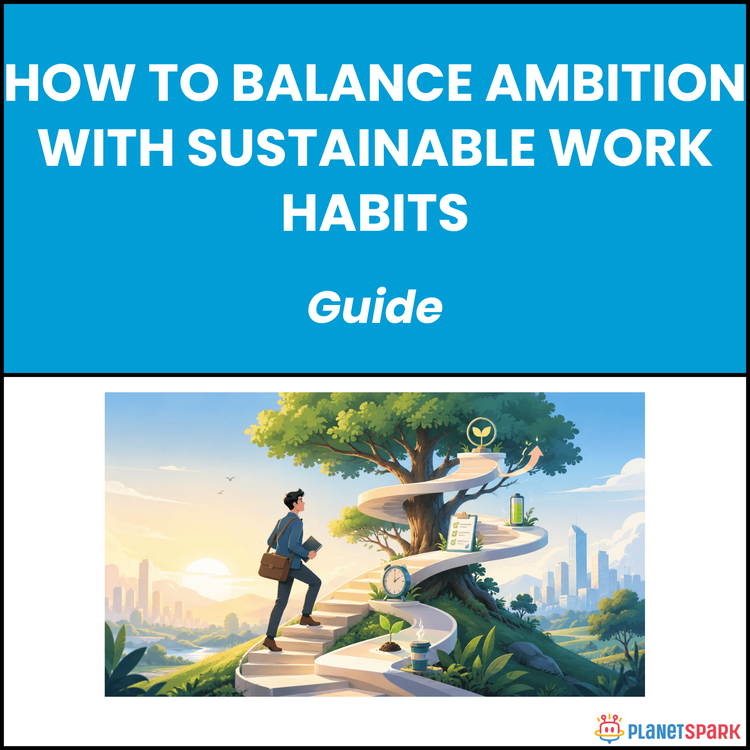
How to Balance Ambition with Sustainable Work Habits
How to Balance Ambition with Sustainable Work Habits: A Practical Guide for Professionals Who Want to Grow Without Burning Out
Ambition can be one of your biggest strengths. It pushes you to learn, take responsibility, chase better opportunities, and raise your standards.
But ambition without sustainable habits can slowly turn into exhaustion.
You may still be working hard, meeting deadlines, and saying yes to new opportunities, but inside, your energy starts dropping. Focus becomes harder. Rest feels guilty. Your calendar looks full, but your motivation feels thin.
How to Balance Ambition with Sustainable Work Habits is a practical playbook for working professionals who want to grow fast without burning out. It helps you understand the difference between healthy ambition and unsustainable overwork, then gives you tools to build better rhythms around energy, focus, recovery, values, and long-term growth.
Who Is This Resource For?
This resource is designed for professionals who want to achieve more without damaging their wellbeing.
It is especially useful for:
- Early-career professionals trying to prove themselves
- Career switchers adjusting to new expectations
- Managers balancing personal goals and team responsibilities
- Consultants handling multiple clients and deadlines
- High performers who feel pressure to always be “on”
- Professionals who work long hours but feel their output quality dropping
- Anyone who wants to build a successful career without running on burnout
If you often feel productive but never finished, anxious when resting, guilty for slowing down, or unsure whether your current pace is sustainable, this guide is for you.
What Does This Resource Contain?
This resource is structured around a five-step system for building sustainable ambition.
1. The Ambition Trap
The guide begins by explaining how high ambition can become unhealthy when effort consistently exceeds recovery.
It highlights common warning signs such as:
- Feeling productive but never truly done
- Feeling anxious during rest
- Being available 24/7
- Cancelling personal plans for work
- Losing creative energy
- Forgetting what you are working toward
This section helps professionals recognise that burnout is not a personal failure. It is often a systems problem.
2. The Five-Layer Model
The resource introduces a helpful model for sustainable ambition.
The five layers are:
- Energy management
- Cognitive clarity
- Emotional resilience
- Strategic direction
- Peak performance
This model shows that strong performance does not come only from pushing harder. It comes from building strong foundations first.
3. Energy Audit Worksheet
The Energy Audit helps you track your energy across three working days.
You rate your energy from 1 to 5 across time blocks such as:
- 7–9 AM
- 9–11 AM
- 11 AM–1 PM
- 1–3 PM
- 3–5 PM
- 5–7 PM
- Evening
You also note whether each activity energised or drained you.
This helps you understand when you do your best work and where your energy is being lost.
4. Redefining Ambition
The guide helps you shift from velocity ambition to directional ambition.
Velocity ambition is about moving faster, achieving more, and comparing yourself to others.
Directional ambition is about knowing what you value, what success means to you, and what kind of professional you want to become.
This section is useful because many professionals are working hard toward goals they have not recently questioned.
5. Values Alignment Worksheet
The Values Alignment Worksheet helps you identify your top five professional values.
You then rate how well your current work and ambitions align with those values.
This exercise helps you see whether your ambition is being powered by real meaning or external pressure.
6. Sustainable Systems
The resource explains that consistent performance depends on systems, not heroic effort.
It focuses on three core systems:
Focus System
This includes deep work blocks, meeting batching, single-tasking, and start-work rituals.
Recovery System
This includes daily recovery, breaks, sleep, movement, and end-work rituals.
Boundary System
This includes end-of-work times, availability windows, device-free spaces, and saying “not now” before saying yes.
7. Systems Design Checklist
The checklist helps you assess which systems are already working and which ones need improvement.
It covers:
- Deep work habits
- Phone and notification control
- Breaks and sleep
- Offline time
- Availability boundaries
- Personal commitments
- Saying no without guilt
This makes it easy to identify your highest-leverage improvement areas.
8. Strategic Recovery
The guide explains that recovery is not the opposite of ambition. It is what makes ambition sustainable.
It breaks recovery into four levels:
- Daily recovery
- Weekly recharge
- Monthly reset
- Annual disconnection
This section helps professionals stop treating rest as something they earn only after finishing everything.
9. Recovery Planning Template
The Recovery Planning Template helps you define what you currently do and what you will commit to at each recovery level.
It encourages realistic recovery, not perfect recovery.
For example, a consistent 15-minute walk may be more useful than an unrealistic two-hour routine that never happens.
10. Managing Comparison Culture
The resource addresses how comparison can make ambition unhealthy.
It suggests three practices:
- Curate your inputs
- Run your own race
- Celebrate long-term progress
This section is useful for professionals who feel behind because of social media, workplace pressure, or constant comparison with peers.
11. Case Study
The guide includes a case study of Priya, a product manager who was working more than 60 hours a week and feeling depleted.
Her rebuild included:
- A 7 PM shutdown ritual
- 9–11 AM deep work blocks
- Monday planning and Friday review
- One offline Sunday per month
- A wins journal
- Gym three times a week
Within six weeks, she reported sharper focus, better decision-making, and more creative ideas.
12. Common Mistakes and Fixes
The guide lists seven common mistakes professionals make, including:
- Treating recovery as a reward
- Confusing busyness with progress
- Setting only output goals
- Running on stress
- Neglecting sleep, movement, and nutrition
- Saying yes by default
- Waiting for burnout before making changes
Each mistake includes a practical fix.
13. Quarterly Self-Evaluation
The Sustainable Ambition Check-In helps you review your energy, values, focus, recovery, direction, comparison pressure, and overall pace every 90 days.
This section helps you make sustainable ambition a long-term practice.
14. Daily Playbook
The resource includes a practical daily structure with:
- Morning activation
- Peak deep work
- Communication windows
- Meeting blocks
- Low-cognitive admin tasks
- End-of-day shutdown ritual
This gives readers a simple daily rhythm they can adapt to their own work.
15. 30-Day Implementation Roadmap
The guide ends with a four-week roadmap:
Week 1: Awareness
Complete the Energy Audit, Values Alignment Worksheet, and identify your top unsustainable patterns.
Week 2: Design
Build your Focus System, create a Recovery Plan, and write your personal definition of success.
Week 3: Implement
Use your new daily structure, start a wins journal, and practise the shutdown ritual.
Week 4: Review
Complete the self-evaluation, note what improved, and share one insight with a colleague or accountability partner.
Summary of the Resource
How to Balance Ambition with Sustainable Work Habits is a practical guide for professionals who want to grow with energy, clarity, and consistency.
It helps readers move away from overwork and comparison-driven achievement. Instead, it shows them how to build ambition around better systems.
The resource focuses on:
- Managing energy, not just time
- Defining ambition clearly
- Building focus, recovery, and boundary systems
- Protecting deep work
- Planning recovery at different levels
- Avoiding comparison culture
- Reviewing progress every quarter
- Implementing changes through a 30-day roadmap
The main message is simple: ambition is not the problem. The problem is ambition without sustainable habits.
How Will This Resource Be Useful?
This resource helps professionals become more effective without depending on constant pressure or exhaustion.
It helps you understand your energy patterns.
The Energy Audit shows when you are sharpest, when you feel drained, and which activities affect your performance most.
It helps you reconnect ambition with meaning.
The Values Alignment Worksheet helps you check whether your goals still match what matters to you.
It helps you protect focus.
The Focus System encourages deep work blocks, meeting boundaries, and single-tasking so that your best energy goes to your most important work.
It helps you recover before burnout.
The recovery framework helps you plan rest daily, weekly, monthly, and annually instead of waiting until you feel completely depleted.
It helps you avoid comparison-driven decisions.
The section on comparison culture helps you stop using other people’s progress as your only measure of success.
It gives you practical systems.
The resource is not only motivational. It includes worksheets, checklists, templates, a daily playbook, and a 30-day roadmap.
It supports long-term career growth.
By building sustainable habits now, professionals can grow consistently instead of burning out after short bursts of overwork.
How Should You Use This Resource?
Use this guide as a working playbook.
Step 1: Read the introduction and ambition trap section
Start by understanding how ambition can become unsustainable. Notice which warning signs feel familiar.
Step 2: Study the Five-Layer Model
Use the model to check whether your foundation is strong.
Ask yourself:
- Am I managing my energy well?
- Do I have enough focus?
- Am I emotionally resilient?
- Is my direction clear?
- Is my performance sustainable?
Step 3: Complete the Energy Audit
Track your energy for three working days.
Look for patterns in your highest and lowest energy blocks.
Step 4: Complete the Values Alignment Worksheet
List your top five professional values and rate how aligned your current work is with each one.
This helps you understand whether your ambition is truly yours.
Step 5: Review your systems
Use the Systems Design Checklist to assess your focus, recovery, and boundary systems.
Choose one system to improve first.
Step 6: Build a realistic recovery plan
Use the Recovery Planning Template to define daily, weekly, monthly, and annual recovery habits.
Keep it realistic. The best recovery plan is the one you will actually follow.
Step 7: Reduce comparison pressure
Curate your inputs, define success in your own words, and start tracking your own progress over time.
Step 8: Use the Daily Playbook
Try the daily structure for one week.
Adjust the timings to fit your role, but keep the principles:
- Protect your morning focus
- Batch communication
- Schedule meetings intentionally
- Save low-focus tasks for low-energy periods
- End work with a shutdown ritual
Step 9: Follow the 30-Day Roadmap
Use the roadmap to move from awareness to design, implementation, and review.
Do not try to change everything at once. Build sustainable change sustainably.
Action Steps
Start with these steps:
1. Read the ambition trap section and highlight the warning signs that apply to you.
2. Complete the Energy Audit for three working days.
3. Identify your top three energy drains.
4. Complete the Values Alignment Worksheet.
5. Choose one focus habit to improve this week.
6. Choose one recovery habit to schedule daily.
7. Set one clear end-of-work boundary.
8. Start a wins journal to track progress over time.
9. Try the Daily Playbook for seven days.
10. Use the 30-Day Implementation Roadmap to keep going.
The goal is not to become less ambitious.
The goal is to become more sustainably excellent.
You do not need to prove your commitment through exhaustion. You can grow, lead, achieve, and still protect the systems that keep you healthy and effective.
Ambition is powerful when it is supported by energy, direction, recovery, and focus.
Start with one habit this week. Protect one block of deep work. Schedule one real recovery practice. End one workday with intention instead of collapse.
Small, consistent changes can reshape the way you work over time.