
How to Balance Data and Intuition in Decision-Making

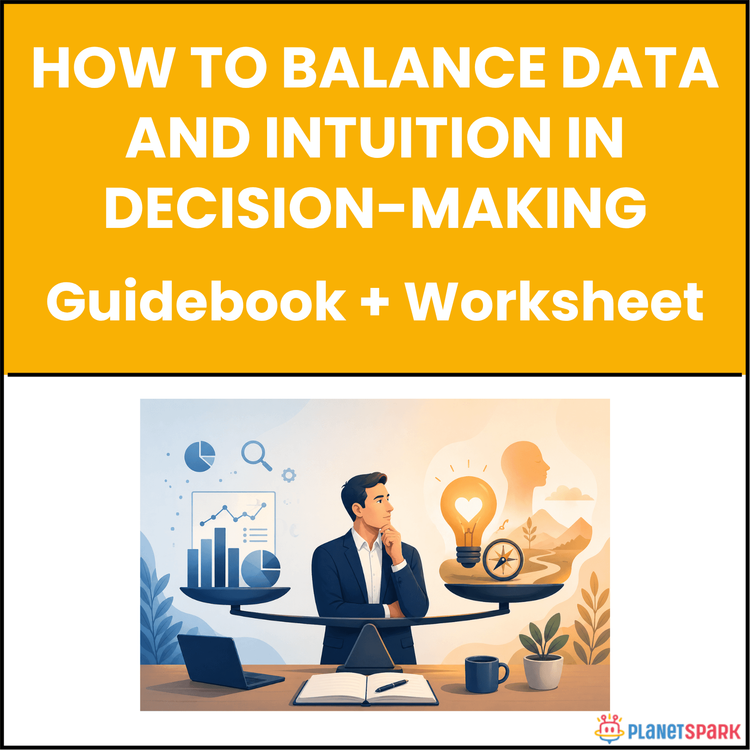
How to Balance Data and Intuition in Decision-Making
Striking the Right Balance Between Data and Intuition: A Guide to Smarter, Faster Decisions
As a professional, you face countless decisions every day—whether it's choosing a career path, making a critical business decision, or selecting the right team member. The challenge is deciding when to rely on data and when to trust your gut. In an era of information overload, professionals often feel trapped between these two extremes—data-driven paralysis or risky, intuition-based decisions. This guide will help you learn how to strike the right balance between the two for faster, more confident decision-making.
Designed for busy professionals like you, this resource will help you harness both data and intuition to make decisions with greater certainty and effectiveness. Whether you're in management, consulting, or navigating a career transition, mastering the balance between data and intuition will elevate your decision-making skills.
Who Is This Resource For?
This guide is ideal for:
- Career Switchers: Professionals looking to make important decisions during a transition and unsure whether to lean on data or intuition.
- Managers and Consultants: Leaders who need to make fast, high-stakes decisions regularly, and want to do so without second-guessing.
- Early and Mid-Career Professionals: Those seeking to build their decision-making competence and make faster, smarter choices without getting bogged down by overthinking.
- Outcome-Oriented Professionals: Anyone seeking a practical, actionable approach to decision-making that gets results.
What Does This Resource Contain?
This resource is packed with frameworks, tools, and actionable strategies to help you improve your decision-making process:
- The Data-Intuition Tension: Learn why professionals often mismanage the balance between data and intuition and how to avoid common traps like analysis paralysis or over-reliance on gut feel.
- Decision Type Classification: Understand the different types of decisions (Routine, Analytical, Judgment Calls, Crisis) and learn which approach—data or intuition—works best for each.
- D.A.T.A. Framework: A step-by-step process for analyzing any decision, ensuring you consider both data and intuition.
- The 70/30 Rule: A mental anchor for knowing when to gather data (70%) and when to trust your instincts (30%).
- Pre-Mortem Technique: A tool for stress-testing decisions before they are made to uncover hidden risks.
- Decision Confidence Matrix: A visual tool to help you know when you have enough data to proceed, based on the reversibility of the decision and data confidence.
Summary of the Resource
This guide offers a structured approach to help you blend data and intuition for confident decision-making:
- Start by understanding your own decision-making style.
- Apply the D.A.T.A. framework to balance intuition and data based on your decision type.
- Use the 70/30 Rule to avoid waiting for 100% certainty.
- Leverage the Pre-Mortem Technique and Decision Confidence Matrix to fine-tune your decisions.
- Document and reflect on your decisions to continuously improve your process.
By the end of this guide, you'll be equipped to make smarter, faster, and more defensible decisions in your professional life.
How Will This Resource Be Useful?
This resource will help you:
- Make faster decisions: By knowing when to rely on data and when to trust your gut, you’ll be able to act swiftly and with confidence.
- Avoid decision fatigue: This structured approach will help you stop over-analyzing and start acting.
- Increase your decision-making confidence: The frameworks and tools in this guide will ensure you’re not second-guessing yourself.
- Refine your decision-making skills: With each decision, you’ll build a stronger, more reliable decision-making system.
How Should You Use This Resource?
- Step 1: Read through the guide in its entirety or jump to the section that addresses your current decision.
- Step 2: Complete the self-audit of your decision-making style (e.g., Are you more data-driven or gut-driven?).
- Step 3: Apply the D.A.T.A. Framework to a real decision you're facing. Document your reasoning in each phase.
- Step 4: Use the 70/30 Rule to determine the balance between data and intuition you need for your decision.
- Step 5: Run a Pre-Mortem on your decision to identify potential failure points before you commit.
- Step 6: Revisit your decision-making process regularly, using the Decision Confidence Matrix to refine when you need more data versus when you can act.
Action Steps
1. Audit your decision style: Take the Decision Style Audit to understand whether you're overly reliant on data or intuition.
2. Apply the D.A.T.A. Framework: Pick a current decision and walk through each phase: Define, Analyse, Trust, Act.
3. Run a Pre-Mortem: Use the pre-mortem technique on an upcoming high-stakes decision to identify hidden risks.
4. Track your decisions: Start a decision log to reflect on each decision and improve your process over time.
5. Share with a colleague: Encourage a peer to go through this guide with you, especially the pre-mortem technique.
Book your free session today!