
How to Balance High Performance With Long-Term Sustainability

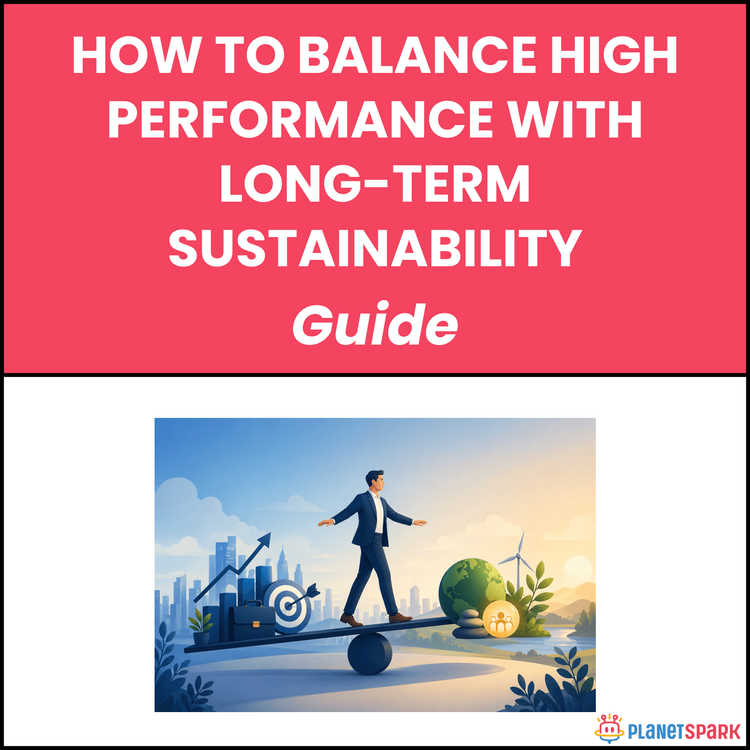
How to Balance High Performance With Long-Term Sustainability
Achieving High Performance with Long-Term Sustainability: A Practical Guide for Working Professionals
If you are someone who consistently delivers, meets deadlines, and takes on more responsibility—but still feels mentally drained, constantly “on,” and unable to switch off—you’re not alone. Many high-performing professionals find themselves stuck in a cycle where output is high, but energy, focus, and long-term motivation are quietly declining.
The reality is simple: performing at a high level without a sustainable system eventually leads to burnout, inconsistent results, and stalled growth. Yet, most professionals are never taught how to balance ambition with longevity.
That’s exactly why the resource “How to Balance High Performance with Long-Term Sustainability” exists. It is designed to help you move away from reactive overwork and toward a structured, repeatable system that allows you to perform at your best—consistently and sustainably.
Who Is This Resource For?
This resource is especially valuable if you are:
- A working professional managing high workloads and tight deadlines
- A consultant or manager balancing performance expectations with limited bandwidth
- A mid-career professional noticing early signs of burnout or fatigue
- A career switcher trying to prove yourself in a demanding environment
- Someone who feels productive but not fulfilled or energised
- A high achiever who wants to sustain success—not just achieve it temporarily
If you are ambitious but want a smarter, more sustainable way to work, this guide is built for you.
What Does This Resource Contain?
This is not a motivational read. It is a structured, practical playbook designed for immediate application.
Inside the resource, you’ll find:
- A clear breakdown of the “performance-sustainability trap” and why overwork backfires
- A redefinition of high performance across four key dimensions: output, capacity, relational, and adaptive performance
- A powerful four-pillar sustainability framework:
- Energy Management (physical, mental, emotional, purpose)
- Strategic Prioritisation
- Boundary Architecture
- Mindset & Meaning
- A detailed energy audit to assess where you are currently depleted
- Practical tools to prioritise high-impact work and reduce reactive overload
- Boundary-setting frameworks with real-world communication examples
- A three-phase sustainability system: Design, Execute, Recover
- A weekly planning protocol (Sunday planning system)
- Deep work strategies to improve focus and output quality
- Recovery frameworks across daily, weekly, and long-term timelines
- A comprehensive sustainability audit checklist
- Worksheets for weekly planning and monthly reflection
- A real-world case study showing how a high performer transitioned to sustainable success
- Common mistakes that undermine long-term performance
Everything is designed to help you take action immediately—not just understand the theory.
Summary of the Resource
“How to Balance High Performance with Long-Term Sustainability” is a practical, system-driven guide that helps professionals maintain high output without sacrificing their energy, focus, or wellbeing.
It replaces the outdated “work harder” mindset with a smarter approach: managing energy, prioritising effectively, setting boundaries, and building recovery into your workflow.
If you want to continue performing at a high level—not just for the next few months, but for years—this resource gives you the structure to do exactly that.
How Will This Resource Be Useful?
This resource helps you shift from short-term performance to long-term excellence.
You’ll gain:
- Greater control over your time, energy, and workload
- Consistent focus instead of reactive, fragmented workdays
- Higher-quality output with less cognitive strain
- Reduced risk of burnout and fatigue
- Stronger decision-making and strategic thinking
- Better work-life boundaries without compromising performance
- A repeatable system you can rely on even during high-pressure periods
Most importantly, it helps you stop relying on willpower—and start working through systems that sustain performance naturally.
How Should You Use This Resource?
To get the best results, follow a structured approach:
Start by reading the guide fully once to understand the complete framework and how each component connects.
Next, assess your current state using the Sustainability Audit Checklist. Identify your weakest pillar—this becomes your starting point.
Then, begin implementing one pillar at a time:
- Improve energy management before optimising productivity
- Align your priorities before increasing your workload
- Set boundaries before trying to “do more”
Use the Three-Phase System in your weekly workflow:
- Design your week intentionally
- Execute with focused deep work blocks
- Recover deliberately to restore capacity
Finally, use the worksheets and reflection questions regularly to review, refine, and improve your system over time.
This is not a one-time read—it is a resource you revisit whenever performance starts to feel unsustainable.
Action Steps
After accessing this resource, take these steps immediately:
1. Set aside 30 minutes to complete the Sustainability Audit Checklist
2. Identify your lowest-scoring pillar (energy, prioritisation, boundaries, or mindset)
3. Implement one small, specific change in that area this week
4. Schedule your first weekly planning session (Sunday or pre-week)
5. Block at least two 90-minute deep work sessions in your calendar
6. Plan one deliberate recovery activity this week
7. Reflect at the end of the week on what improved and what didn’t
Small, consistent adjustments here will create significant long-term results.
Sustainable performance is not about doing less—it’s about doing what matters, in a way that you can sustain. When you manage your energy, protect your focus, and build recovery into your system, you don’t just perform better—you perform longer, with more clarity and control.
Use this resource to redesign how you work, so success doesn’t come at the cost of your wellbeing—but is supported by it.
Book your free session today!