
How to Balance Individual Work With Leadership Responsibilities

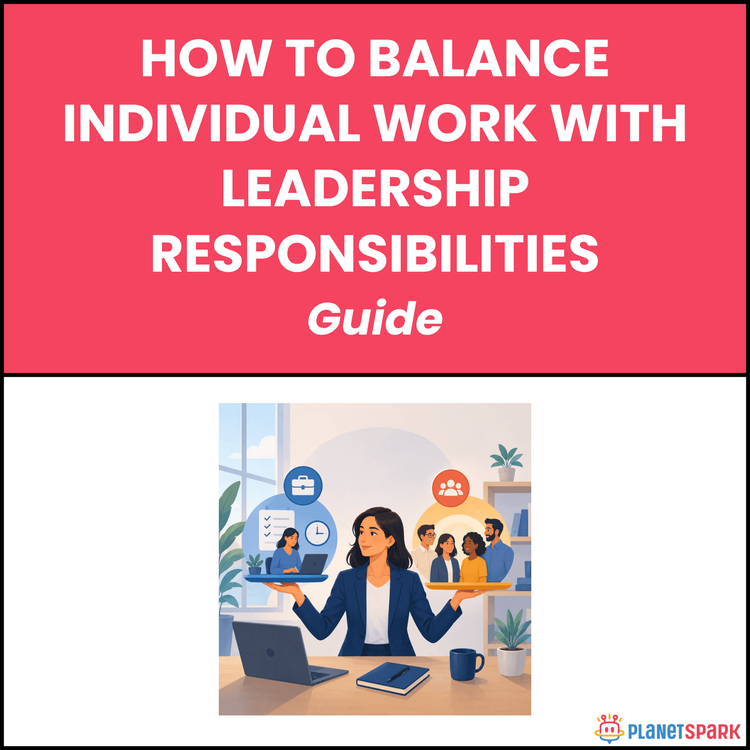
How to Balance Individual Work With Leadership Responsibilities
Balancing Leadership and Individual Work: A Practical Guide for Working Professionals
At some point in almost every professional’s career, the nature of work begins to change. You are no longer responsible only for your own deliverables, deadlines, and performance. Suddenly, you are also expected to mentor teammates, manage stakeholders, guide projects, lead meetings, provide feedback, and support team performance—all while continuing to deliver your own work at a high level.
For many working professionals, this transition feels overwhelming.
You may find yourself constantly switching between execution mode and leadership mode throughout the day. One moment you are deep in analysis, writing, coding, strategy, or client work, and the next moment you are solving team issues, attending meetings, responding to escalations, or coaching colleagues. Over time, this constant context-switching creates mental fatigue, reactive work patterns, and a persistent feeling that you are falling behind in both roles.
The challenge is not simply poor time management. It is the absence of systems designed to help professionals operate effectively across both individual contribution and leadership responsibilities.
That is exactly why the resource “How to Balance Individual Work With Leadership Responsibilities” was created.
This practical guide is designed specifically for working professionals navigating dual-role pressure—people who are expected to perform as both high-quality contributors and dependable leaders at the same time. Instead of offering vague productivity advice, the resource provides practical frameworks, diagnostics, delegation systems, calendar structures, communication norms, and decision-making tools that can be implemented immediately in real work environments.
Whether you are a first-time manager still handling execution tasks, a consultant leading client relationships while managing delivery, or a senior individual contributor overseeing cross-functional workstreams, this guide helps you build a sustainable operating system that reduces overwhelm and improves clarity.
Most importantly, the guide reframes balance as a learnable skill rather than a personality trait. The professionals who successfully balance leadership and execution are not naturally more disciplined or productive—they simply rely on better systems, boundaries, and routines.
Who Is This Resource For?
This guide is especially useful for:
- First-time managers balancing team leadership with execution work
- Senior individual contributors managing cross-functional responsibilities
- Consultants handling both delivery and stakeholder management
- Product managers, project managers, and team leads
- Startup professionals wearing multiple hats
- Mid-career professionals transitioning into leadership roles
- Professionals struggling with burnout caused by constant context-switching
- Anyone who feels pulled between “doing the work” and “leading the work”
If your workload feels fragmented, reactive, or constantly overloaded, this resource is designed to help you regain structure and control.
What Does This Resource Contain?
This is not a generic productivity guide. It is a structured, implementation-focused playbook for dual-role professionals.
Inside the resource, you’ll find:
- A detailed explanation of the “Dual-Role Trap” and why professionals struggle
- A self-assessment diagnostic to identify your current leadership-work balance
- Clear frameworks explaining Contributor Mode vs. Leader Mode
- A practical Time Audit worksheet to identify low-value work
- The Ideal Week calendar architecture for structured scheduling
- A Priority Matrix to identify work that only you should handle
- A 5-step Smart Delegation framework
- A Delegation Decision Checklist for faster decision-making
- A Transition Ritual framework to reduce cognitive switching fatigue
- Communication norms that protect both deep work and leadership quality
- A dual-track performance dashboard to measure execution and leadership together
- A real-world case study showing an 8-week transformation
- The 7 most common mistakes dual-role professionals make
- A Quarterly Role Reset worksheet for sustainable long-term balance
- The LEAD Framework for real-time decision-making under pressure
- A quick-reference summary card for daily application
- A practical 30-day implementation roadmap
Everything inside the guide is designed for immediate workplace application—not passive reading.
Summary of the Resource
“How to Balance Individual Work With Leadership Responsibilities” is a practical framework for professionals who feel stretched between execution and leadership demands. It helps you build systems that improve focus, delegation, communication, strategic thinking, and team management without sacrificing your own productivity.
Instead of relying on motivation or working longer hours, the resource teaches you how to redesign the way you operate.
The guide helps professionals:
- Reduce reactive work patterns
- Protect deep-focus time
- Delegate more effectively
- Improve team clarity and communication
- Create sustainable leadership habits
- Reduce burnout caused by constant context-switching
Most importantly, it helps professionals transition from overwhelmed operators to intentional leaders.
How Will This Resource Be Useful?
One of the biggest challenges professionals face after stepping into leadership responsibilities is that expectations increase faster than systems evolve.
You are expected to:
- Deliver high-quality work individually
- Support team performance consistently
- Respond quickly to issues
- Lead strategically
- Stay available for communication
- Maintain productivity under pressure
Without a clear structure, this creates constant overload.
This resource helps solve that problem by providing practical systems that improve how you work daily.
You’ll gain:
- Better clarity on where your time actually goes
- Improved ability to separate deep work from leadership work
- Stronger delegation habits that reduce overload
- Clear communication systems that reduce interruptions
- Better decision-making under pressure
- More sustainable weekly work rhythms
- Reduced stress caused by reactive task-switching
- Improved leadership presence without sacrificing execution quality
The guide also helps you identify invisible productivity drains that most professionals overlook, such as unnecessary meetings, poor delegation structures, unclear priorities, and unmanaged communication expectations.
By applying these frameworks consistently, professionals can reclaim time, improve performance quality, and reduce burnout significantly.
How Should You Use This Resource?
The guide is designed to be highly actionable and easy to implement alongside a full workload.
To get the best results, use it in phases rather than trying to apply everything at once.
Phase 1: Build Awareness
Start by completing the Dual-Role Diagnostic honestly. This establishes your current baseline and helps you identify where your biggest challenges exist.
Then review the Contributor Mode and Leader Mode framework carefully. Understanding these two operating modes is essential before building systems around them.
Phase 2: Audit Your Current Workflow
Next, complete the Time Audit exercise for one work week.
Track:
- Meetings
- Deep work
- Leadership activities
- Administrative tasks
- Delegation opportunities
- Reactive interruptions
This exercise often reveals major inefficiencies that professionals do not notice day-to-day.
Phase 3: Redesign Your Calendar and Priorities
Use the Ideal Week framework to structure:
- Deep work blocks
- Leadership windows
- Team communication time
- Reflection periods
- Buffer zones
Then apply the Priority Matrix to determine:
- What only you should handle
- What should be delegated
- What can be eliminated entirely
Phase 4: Improve Delegation and Communication
Once your structure improves, begin implementing:
- The 5-step delegation framework
- Delegation checklists
- Communication norms
- Leadership office hours
- Meeting boundaries
This phase helps reduce constant interruptions and improves team autonomy.
Phase 5: Build Long-Term Sustainability
Finally, implement:
- Weekly reviews
- Quarterly role resets
- The dual-track dashboard
- The LEAD decision-making framework
These systems help maintain balance over time rather than temporarily.
Action Steps
After accessing this resource, take these practical steps immediately:
1. Complete the Dual-Role Diagnostic honestly
2. Track your time for one full work week
3. Identify at least 3 tasks that should be delegated
4. Block two protected deep-work sessions on your calendar
5. Define communication norms for your team
6. Schedule recurring 1:1 leadership conversations
7. Use the Priority Matrix to review your workload
8. Create a simple weekly review system every Friday
9. Choose one framework to implement this week instead of trying everything at once
10. Revisit the guide after 30 days to measure improvement
Small structural changes can create major improvements in productivity, leadership quality, and energy management over time.
Balancing leadership responsibilities with individual contribution is one of the defining professional challenges of modern work. But the solution is not working harder, staying online longer, or trying to become endlessly productive.
The real solution is designing systems that help you operate intentionally across both roles.
This resource helps you move away from reactive firefighting and toward sustainable, high-impact leadership. It gives you practical frameworks that improve not only how you work, but how your team experiences your leadership as well.
You do not need perfect balance overnight. You need better systems, clearer priorities, and consistent habits that compound over time.
Book your free session today!