
How to Build a Job Pipeline

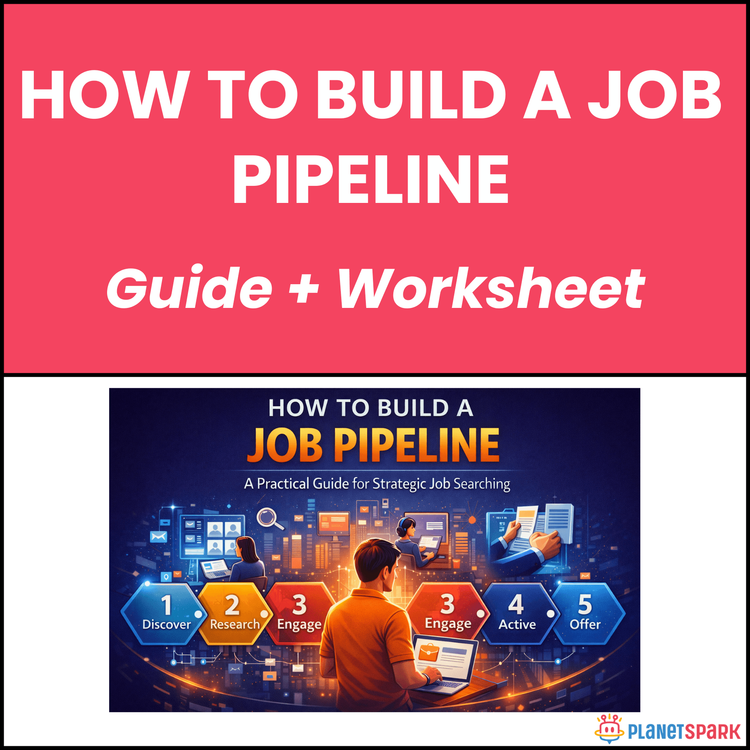
How to Build a Job Pipeline
How to Build a Job Pipeline: A Strategic Job Search System for Working Professionals
Many professionals approach job searching with hope rather than strategy. They apply to a few roles, wait for responses, and repeat the process when nothing happens. Weeks pass, inboxes stay quiet, and the entire process begins to feel frustrating and unpredictable.
The reality is that most job searches fail not because professionals lack skills, but because they lack a system.
A structured job pipeline changes that completely. Instead of relying on chance, it creates a steady flow of opportunities across different stages—from discovering companies to interviews and offers. The resource “How to Build a Job Pipeline” introduces this exact system: a practical framework that helps professionals manage their job search like a pipeline rather than a one-off attempt.
Designed as a guidebook and worksheet, this resource helps professionals move from reactive job hunting to a strategic and repeatable process that produces consistent results.
Who Is This Resource For?
This resource is designed for professionals who want a structured and effective approach to job searching. It is particularly valuable for:
Working professionals with 0–15 years of experience who want a more strategic job search approach.
Career switchers exploring opportunities in a new industry or role.
Managers and consultants aiming to move into higher-impact positions.
Professionals who feel stuck applying online but rarely getting responses.
Individuals who want to use networking, research, and targeted applications more effectively.
Time-poor professionals who want a practical framework instead of scattered advice.
If you are someone who wants more control, clarity, and momentum in your job search, this resource provides the structure needed to achieve it.
What Does This Resource Contain?
The guidebook is structured as a step-by-step system that walks professionals through the entire process of building and managing a job pipeline. It combines frameworks, worksheets, templates, and real-world strategies that can be implemented immediately.
The core components inside the resource include:
The Job Pipeline Framework
The guide introduces the five stages of a professional job pipeline:
Discover – identifying potential companies and opportunities
Research – deeply understanding companies, roles, and teams
Engage – networking and initiating conversations
Active – participating in interviews and ongoing discussions
Offer – negotiating and evaluating opportunities
This framework helps professionals maintain multiple opportunities simultaneously rather than relying on a single application.
Target Definition Framework
The resource begins by helping professionals define their job target clearly using three layers:
Role clarity (function, level, and job titles)
Sector clarity (industries, company types, and cultures)
Constraint clarity (location, compensation expectations, and timelines)
A structured worksheet helps readers create a precise job target statement that guides their entire search.
Target Company List Builder
Professionals learn how to build a focused list of 30–50 companies instead of randomly applying to job postings. The guide explains how to identify high-potential organizations through:
Job boards and hiring trends
Industry lists and awards
LinkedIn connections and referrals
Business news and funding announcements
This section also introduces a simple company tracking system.
Company Research Framework
The guide teaches professionals how to conduct meaningful research before applying or networking.
Readers learn how to evaluate:
Company strategy and growth signals
Industry challenges and opportunities
Team structures and leadership
Role expectations and success metrics
This research process helps create more relevant outreach messages and stronger interview performance.
Networking Activation Strategy
Networking is one of the most powerful parts of the resource.
The guide introduces the “Three Circles of Network Activation”:
Inner Circle – people who know your work well
Middle Circle – professional acquaintances and former colleagues
Outer Circle – new connections in target companies
It also provides ready-to-use outreach templates for reconnection messages, informational interviews, and referral requests.
Application Quality Checklist
Instead of mass-applying to dozens of roles, the guide encourages precision. The application framework focuses on:
Aligning resumes with job descriptions
Highlighting measurable achievements
Writing concise and personalised cover notes
Leveraging insider referrals before applying
This approach significantly improves response rates compared to traditional job board applications.
Weekly Pipeline Review System
One of the most practical tools in the resource is the Weekly Pipeline Review.
Professionals are encouraged to spend 60–90 minutes each week reviewing their pipeline and performing four key actions:
Review current opportunities
Follow up on conversations
Activate new opportunities
Refresh the pipeline with new companies
This habit ensures consistent momentum throughout the job search.
Pipeline Tracking System
The guide also includes a simple pipeline tracker structure that professionals can build in spreadsheets or tools like Notion.
The tracker helps manage:
Company names and roles
Opportunity stages
Internal contacts
Last actions and next steps
This tracking system becomes the central command center for the entire job search.
Real-World Case Study
The resource includes a real example of a professional who implemented the pipeline system and transformed her job search results.
By defining her target role, building a list of companies, activating her network, and consistently managing her pipeline, she generated multiple interviews and offers within weeks.
This case study demonstrates how disciplined execution can dramatically improve job search outcomes.
Summary of the Resource
For professionals who want a quick overview, this resource delivers a structured job search system built around one central idea: opportunities should flow through a pipeline.
Instead of applying randomly, professionals learn to:
Define clear career targets
Build a list of strategic companies
Conduct meaningful research
Leverage professional networks
Submit higher-quality applications
Track and manage opportunities systematically
The result is a predictable, manageable job search process that replaces uncertainty with strategy.
How Will This Resource Be Useful?
This resource provides several practical benefits for working professionals.
It Creates Structure in a Chaotic Process
Many job seekers feel overwhelmed because their search lacks direction. The pipeline framework introduces a clear system that organizes every step.
It Improves Response Rates
By focusing on research, networking, and targeted applications, professionals significantly increase the likelihood of hearing back from employers.
It Builds Professional Confidence
Having multiple opportunities in different stages of the pipeline reduces anxiety and creates leverage during interviews and negotiations.
It Encourages Strategic Networking
Instead of random outreach, professionals learn how to reconnect with existing contacts and build meaningful new relationships.
It Enables Consistent Momentum
The weekly pipeline review ensures that professionals keep moving forward rather than losing motivation during slow periods.
How Should You Use This Resource?
To get the most value from this guidebook, approach it as both a learning tool and a working document.
Step 1: Read the Guide Completely
Start by reading the resource from beginning to end. This helps you understand the full job pipeline methodology and how each step connects.
Step 2: Define Your Job Target
Use the target definition framework to write a clear one-sentence job target that defines your ideal role, industry, and constraints.
Step 3: Build Your Company List
Create a spreadsheet or tracker and list 30–50 companies that align with your target.
Step 4: Conduct Research
For your top companies, spend time understanding their business, leadership, and hiring needs.
Step 5: Start Networking
Reconnect with contacts and initiate informational conversations with professionals working in your target companies.
Step 6: Submit Targeted Applications
Apply selectively to roles that align strongly with your skills and career goals.
Step 7: Run a Weekly Pipeline Review
Dedicate a fixed weekly time to update your tracker, follow up on conversations, and add new opportunities.
Following these steps ensures that your pipeline continues to grow and evolve.
Action Steps
If you want to start implementing the job pipeline strategy immediately, begin with these simple steps:
Write your one-sentence job target statement.
Open a job pipeline tracker in Google Sheets or Notion.
List your first 10 target companies.
Identify three people in your network who could help your search.
Send two personalized outreach messages.
Research one company deeply and create a brief profile.
Submit one tailored job application aligned with your target role.
Even these small actions can shift your job search from passive to proactive.
A successful job search is rarely the result of a single application or a stroke of luck. It is the result of a well-managed system that consistently creates new opportunities.
The job pipeline framework transforms the way professionals approach career transitions. Instead of hoping for the right opportunity to appear, you actively build a structured flow of opportunities and manage them strategically.
When professionals combine clear targets, thoughtful research, meaningful networking, and disciplined execution, the job search stops feeling like a gamble and starts functioning like a process.
If you are ready to take control of your career growth and build a job search system that works, this resource provides the exact roadmap to get started.