
How to Build a Personal Brand That Signals Strategic Value

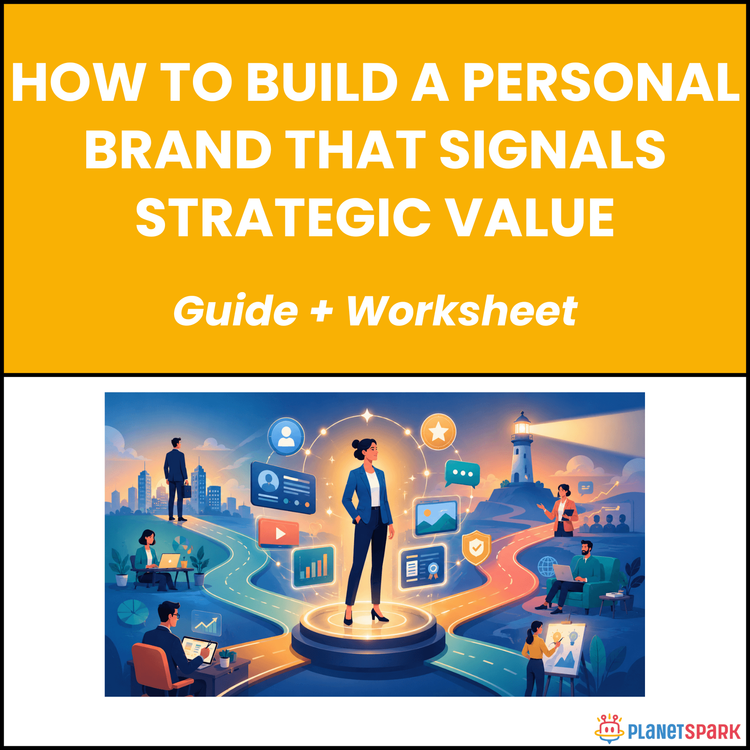
How to Build a Personal Brand That Signals Strategic Value
Build a Personal Brand That Signals Strategic Value: A Practical Template Pack for Professionals
Being good at your job matters. But in today’s professional world, it is not always enough.
Before someone interviews you, hires you, recommends you, invites you to speak, or considers you for a promotion, they often form an impression from the signals already available: your LinkedIn headline, your resume summary, your bio, your outreach message, your portfolio, your content, and the way you explain your work.
That is where many professionals get stuck.
They either sound too generic, using phrases like “results-driven professional” or “experienced manager,” or they say too much without a clear message. In both cases, the result is the same: their real value is not obvious.
The “How to Build a Personal Brand That Signals Strategic Value” template pack is designed to fix that. It helps working professionals turn scattered career experience into a clear, credible, and consistent personal brand that communicates strategic value across LinkedIn, resumes, bios, outreach messages, consulting pitches, promotion conversations, and speaking opportunities.
Who Is This Resource For?
This resource is built for professionals who want their career presence to work harder for them.
It is especially useful for:
- Job seekers who want recruiters and hiring managers to quickly understand their value
- Career switchers who need to explain a pivot with confidence and credibility
- Consultants and freelancers who want to communicate what they solve, for whom, and why they are different
- Managers and early leaders preparing for promotion or internal visibility conversations
- Professionals building a stronger LinkedIn presence or thought leadership platform
- Speakers, panelists, podcast guests, or experts who need a sharper professional bio and pitch
- Anyone whose resume, LinkedIn, portfolio, and outreach messages currently feel disconnected
If you have ever struggled to answer “What do you actually want to be known for?” this resource gives you the structure to find and express that answer.
What Does This Resource Contain?
This is not a generic personal branding guide. It is a scenario-driven template pack with 10 practical templates, plus strategy frameworks, audit tools, a 30-day sprint plan, and a metrics tracker.
Here is what you will find inside.
1. Personal Brand Clarity Worksheet
This is the foundation of the entire pack. It helps you define your professional identity, brand pillars, unique value proposition, target audience, and differentiator statement.
The worksheet pushes you to answer essential questions such as:
- What are you known for?
- Who are you trying to influence?
- What outcomes do you help people or organizations achieve?
- What makes you meaningfully different from others with similar experience?
This template is especially useful before rewriting your LinkedIn profile, resume summary, bio, or website copy.
2. LinkedIn Profile Optimisation Guide
This template helps you rebuild your LinkedIn profile with strategic intent.
It covers your headline, About section, experience bullets, and Featured section. Instead of presenting your LinkedIn profile as a list of past jobs, the guide helps you frame it around outcomes, credibility, and positioning.
It includes formulas for writing a stronger headline, opening your About section with a hook, adding credibility signals, and turning experience bullets into measurable impact statements.
3. Career Pivot Narrative Builder
Career transitions can be difficult to explain, especially when your past experience does not obviously match your next role.
This template helps you create a clear pivot story using a four-part arc:
- The Foundation
- The Catalyst
- The Bridge
- The Vision
It helps you show that your career change is intentional, not random. You will learn how to connect past experience to future direction through transferable skills, preparation, and a realistic 90-day contribution statement.
4. Consulting / Freelance Value Proposition Template
For consultants, freelancers, and independent professionals, vague service descriptions are not enough.
This template helps you define your positioning statement, core problem-solution frame, social proof, engagement models, ideal client profile, and contact approach.
It is useful for client pitches, website bios, proposals, introductory emails, and personal landing pages.
5. Thought Leadership Content Planner
If you want to build authority but struggle with inconsistent posting or random content ideas, this planner gives you a system.
It helps you define:
- Your content audience
- The transformation your content provides
- Your distinctive point of view
- Your tone of voice
- Three content pillars
- A 4-week content calendar
The resource also recommends a content ratio: 50% core expertise, 30% adjacent insight, and 20% behind-the-work content. This keeps your content focused while still allowing personality and range.
6. Professional Bio Template
Most professionals need more than one version of their bio.
This template helps you write three formats:
- A 50-word micro bio
- A 100-word standard bio
- A 200-word full bio
Each version is designed for a different context, such as social profiles, speaker introductions, company pages, media kits, websites, conference programs, and award applications.
The key rule is consistency: each version should share the same core positioning, title descriptor, primary achievement, and forward-looking call to action.
7. Brand Audit & Consistency Checker
Many professionals build their brand over time, but their messaging drifts.
Your LinkedIn may say one thing. Your resume may say another. Your portfolio may introduce you differently. Your email signature may be outdated.
This audit helps you review your active brand touchpoints across LinkedIn, resume, portfolio, website, and email signature. It includes a consistency matrix to check whether your title, value proposition, target audience, achievements, tone, and call to action are aligned.
8. Networking Outreach Message Template
Outreach often fails because it sounds generic, transactional, or copy-pasted.
This template includes message structures for:
- Cold outreach to a hiring manager
- Warm introductions to potential collaborators
- Community or event follow-ups
The resource emphasizes specificity. Instead of opening with generic phrases, it helps you reference the person’s work, connect your value to their context, and suggest a clear next step.
9. Internal Visibility & Promotion Pitch Template
Doing great work is not always enough if leaders do not understand your strategic impact.
This template helps you prepare for performance reviews, promotion conversations, internal transfers, or visibility discussions. It guides you through your strategic positioning statement, impact evidence, case for the next level, and 90-day plan.
The emphasis is on business value, not personal ambition.
10. Speaker / Panel Bio & Pitch Template
If you are applying for a speaking slot, panel, podcast interview, webinar, or expert feature, this template helps you position yourself credibly.
It includes a speaker bio structure, talk or panel pitch framework, audience takeaway, talk description, “why this, why now” section, and technical logistics.
It helps you move beyond a job-title-based bio and present yourself as a relevant, engaging expert.
Summary of the Resource
This resource helps professionals build a personal brand that is clear, credible, consistent, and differentiated.
At a high level, it helps you:
- Define what you want to be known for
- Translate your experience into a clear value proposition
- Improve your LinkedIn, resume, bio, and outreach messaging
- Create a stronger story for career pivots, promotions, consulting, or speaking
- Align your professional presence across platforms
- Build visibility through thought leadership and networking
- Track progress using personal brand metrics
The resource is built around the Strategic Value Signal Framework, which includes four pillars: clarity, credibility, consistency, and contrast. The idea is simple but powerful: your brand should not just be visible; it should communicate the right value to the right people.
How Will This Resource Be Useful?
This template pack is useful because it turns personal branding from a vague idea into a practical process.
Instead of asking you to “build your brand” in abstract terms, it gives you specific templates for real professional situations.
You can use it to gain:
More Clarity
The Personal Brand Clarity Worksheet helps you define your audience, strengths, value proposition, and differentiators. This prevents scattered messaging and helps you speak about your work with more confidence.
Stronger Credibility
The LinkedIn, resume, bio, promotion, and speaker templates encourage you to include evidence, metrics, proof points, and outcomes. This helps you move beyond claims and show why your work matters.
Better Career Positioning
Whether you are job searching, switching careers, freelancing, seeking promotion, or building thought leadership, the resource helps you position yourself intentionally for your next move.
Consistent Messaging Across Platforms
The Brand Audit & Consistency Checker helps ensure your LinkedIn, resume, portfolio, website, and email signature all tell the same professional story.
This matters because inconsistent messaging creates doubt. Consistent messaging builds trust.
More Effective Outreach
The networking templates help you write messages that feel personal, relevant, and purposeful. This can improve the quality of your conversations with hiring managers, collaborators, clients, and industry peers.
Greater Confidence in Professional Conversations
When you have a clear value proposition, pivot story, promotion pitch, or consulting statement, you are less likely to ramble or undersell yourself. You can communicate your value with structure and calm confidence.
A Practical System for Visibility
The Thought Leadership Content Planner and Personal Brand Metrics Tracker help you turn visibility into a repeatable habit. You can plan content, monitor progress, and adjust based on what is actually working.
How Should You Use This Resource?
You do not need to complete every template in one sitting. The best way to use this resource is to start with your current professional goal.
Step 1: Start With Template 01
Begin with the Personal Brand Clarity Worksheet.
Even if you are eager to update your LinkedIn profile or rewrite your bio, start here first. Your brand pillars, target audience, unique value proposition, and differentiator statement will shape everything else.
Block 60–90 minutes for this exercise. Do not rush it.
Step 2: Choose Your Current Career Scenario
Once your foundation is clear, choose the pathway that fits your current situation.
If you are actively job seeking, use:
- Template 01: Personal Brand Clarity Worksheet
- Template 02: LinkedIn Profile Optimisation Guide
- Template 06: Professional Bio Template
- Template 07: Brand Audit & Consistency Checker
- Template 08: Networking Outreach Message Template
If you are switching careers, use:
- Template 01: Personal Brand Clarity Worksheet
- Template 03: Career Pivot Narrative Builder
- Template 06: Professional Bio Template
- Template 08: Networking Outreach Message Template
If you are a consultant or freelancer, use:
- Template 01: Personal Brand Clarity Worksheet
- Template 04: Consulting / Freelance Value Proposition Template
- Template 06: Professional Bio Template
- Template 10: Speaker / Panel Bio & Pitch Template
If you are seeking promotion, use:
- Template 01: Personal Brand Clarity Worksheet
- Template 09: Internal Visibility & Promotion Pitch Template
- Template 07: Brand Audit & Consistency Checker
If you are building thought leadership, use:
- Template 01: Personal Brand Clarity Worksheet
- Template 05: Thought Leadership Content Planner
- Template 06: Professional Bio Template
- Template 10: Speaker / Panel Bio & Pitch Template
Step 3: Fill In the Templates With Evidence
The strongest personal brands are not built on vague claims.
As you complete the templates, add:
- Metrics
- Specific examples
- Project outcomes
- Client or stakeholder results
- Career achievements
- Relevant credentials
- Clear audience language
For example, instead of writing “I help teams improve performance,” write something more specific, such as “I help early-stage SaaS teams reduce onboarding friction and improve trial-to-paid conversion through data-led product strategy.”
Specificity makes your brand more believable.
Step 4: Apply the Outputs Immediately
Do not let the templates sit in a folder.
Use your completed sections to update real-world touchpoints such as:
- LinkedIn headline
- LinkedIn About section
- Resume summary
- Portfolio homepage
- Professional bio
- Email signature
- Outreach messages
- Consulting pitch
- Promotion document
- Speaker submission
The value of the resource comes from application, not completion.
Step 5: Run a Brand Audit
After making updates, use the Brand Audit & Consistency Checker.
Check whether your title, value proposition, target audience, achievements, tone, and call to action match across platforms.
If someone reads your LinkedIn, resume, and website, they should understand the same core message.
Step 6: Follow the 30-Day Sprint Plan
The resource includes a 30-day Personal Brand Sprint Plan. This is helpful if you want structure and momentum.
The sprint is divided into four weeks:
- Week 1: Foundation
- Week 2: Presence
- Week 3: Outreach
- Week 4: Visibility
By the end of 30 days, the goal is not to have a perfect personal brand. The goal is to have a functional, strategic brand that is clear enough to use and improve.
Step 7: Review Your Progress Monthly
Use the Personal Brand Metrics Tracker to monitor signals such as:
- LinkedIn profile views
- Connection requests received
- Inbound job, collaboration, or client opportunities
- Content posts published
- Post impressions
- Meaningful conversations started
- Speaking, podcast, or panel invitations
- Website or portfolio visits
The resource encourages tracking directional growth rather than chasing vanity numbers. This is important because personal brand growth is usually incremental and cumulative.
Action Steps
Here is what to do after downloading the resource:
1. Open Template 01 and complete your Personal Brand Clarity Worksheet.
2. Write one clear unique value proposition in 1–2 sentences.
3. Identify your current goal: job search, career pivot, consulting, promotion, thought leadership, or speaking.
4. Choose the template pathway that matches your goal.
5. Update one public brand touchpoint first, such as your LinkedIn headline or About section.
6. Add at least one measurable achievement to your LinkedIn or resume.
7. Use the Brand Audit & Consistency Checker to find mismatches across platforms.
8. Send 3–5 personalized outreach messages using the networking template.
9. Plan one thought leadership post using the content planner.
10. Set a monthly reminder to review your brand metrics and refine your positioning.
Your personal brand is already being read. Every profile view, resume scan, introduction, and conversation gives people a signal about who you are and what value you bring.
The question is whether that signal is clear, credible, and aligned with where you want to go next.
This resource gives you the structure to stop guessing and start communicating your professional value with intention. Use it when you are preparing for a job search, making a career pivot, launching a consulting practice, asking for a promotion, building visibility, or stepping into a more strategic version of your career.
A strong personal brand is not about sounding impressive for the sake of it. It is about making your expertise, values, and direction easy for the right people to understand.
Start with clarity. Build with evidence. Stay consistent. Revisit your brand every time your career evolves.