
How To Build A Reputation For Sound Judgment And Decision Quality

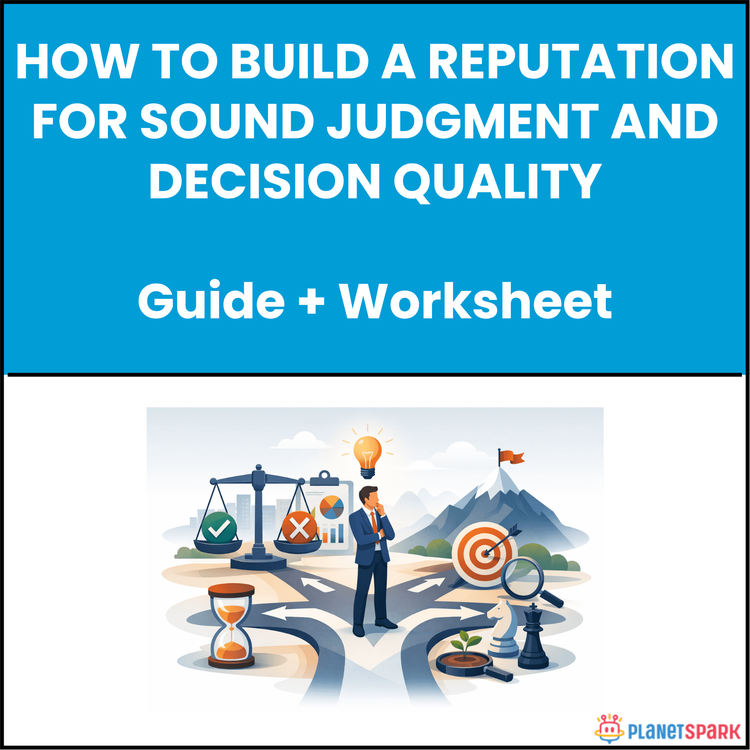
How To Build A Reputation For Sound Judgment And Decision Quality
How to Build a Reputation for Sound Judgment & Decision Quality: A Practical Guide
Judgment is the career skill nobody teaches—but everyone notices. The “Judgment Reputation Guide” helps professionals build credibility as the person trusted to make the right call, consistently and under pressure.
Who Is This Resource For?
This guide is designed for:
- Career changers stepping into new domains
- Early-to-mid career professionals (0–15 years experience)
- Consultants whose credibility depends on recommendations
- Managers whose teams look to them for direction
- Anyone aiming to be trusted with high-stakes decisions
If you want to be known for sound judgment and decision quality, this resource is built for you.
What Does This Resource Contain?
Inside the guide, you’ll find:
- Introduction: Why judgment is the defining leadership skill
- The Foundation: What judgment is—and is not
- The Five Pillars of Judgment Reputation:
1. Problem Framing
2. Evidence Calibration
3. Consequence Mapping
4. Transparent Reasoning
5. Reflective Learning
- Worksheets for problem framing, decision documentation, and post-mortems
- Tools like the Evidence Quality Checklist and Reasoning Transparency Template
- Common traps (speed pressure, sunk cost, recency bias, false consensus, etc.) and counter-moves
- Case study showing reputation reset through visible reasoning
- Self-assessment diagnostic
Summary of the Resource
The “Judgment Reputation Guide” is a structured toolkit that reframes decision-making as a reputation asset. It ensures professionals can frame problems correctly, calibrate evidence, anticipate consequences, communicate reasoning transparently, and learn reflectively.
How Will This Resource Be Useful?
By applying this guide, you’ll gain:
- Clarity on what sound judgment looks like in practice
- Confidence in framing and communicating decisions
- Awareness of evidence quality and confidence calibration
- Tools to anticipate second-order consequences
- Strategies to make your reasoning visible
- Long-term resilience through reflective learning
How Should You Use This Resource?
Follow a phased approach:
1. Use the Problem Framing Worksheet for major challenges.
2. Apply the Evidence Quality Checklist before recommendations.
3. Map consequences with reversibility and tripwires.
4. Document reasoning with the Decision Template.
5. Run post-mortems and update mental models.
6. Revisit the five pillars quarterly.
Action Steps
After accessing this resource, take these immediate steps:
1. Write down one current decision and reframe it using the Reframe Ladder.
2. Run the Evidence Quality Checklist before finalising.
3. Document your reasoning with the Decision Template.
4. Schedule a post-mortem review date.
5. Share your reasoning transparently in your next stakeholder meeting.
6. Start a Decision Journal to track outcomes and learning.
Judgment builds trust faster than technical skill. With this guide, you can move from competent to credible, ensuring your career trajectory reflects both decision quality and leadership readiness.
Book your free session today!