
How to Build Authority Without Overexposing Yourself

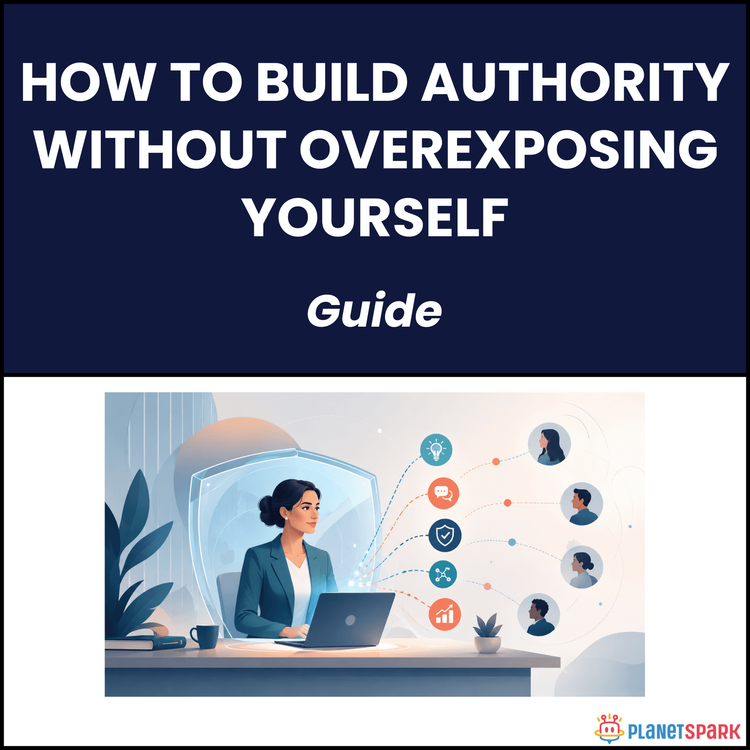
How to Build Authority Without Overexposing Yourself
Build Professional Authority Without Overexposing Yourself
Building authority at work should not require you to post constantly, share every achievement, or turn your professional life into a public performance.
Yet many working professionals feel pressured to do exactly that. If you are job searching, switching careers, growing a consulting practice, building a LinkedIn presence, or trying to be seen as credible in your field, the usual advice is often: “be more visible.”
But visibility alone does not create authority.
In fact, too much visibility without focus can weaken your professional brand. When you talk about too many topics, list too many credentials, or show up everywhere without a clear message, people may know you exist, but they may not know what to trust you for.
That is why the How to Build Authority Without Overexposing Yourself template pack exists. It is designed for professionals who want to establish credibility, signal expertise, and grow their professional presence with intention, without oversharing, burnout, or performative self-promotion. :contentReference[oaicite:0]{index=0}
This resource helps you communicate authority through precision: the right message, in the right format, for the right audience, at the right moment.
Who Is This Resource For?
This template pack is especially useful for working professionals who want to be taken seriously without feeling like they have to constantly promote themselves online.
It is ideal for:
- Job seekers who want to position themselves clearly during a search
- Career switchers who need to explain their expertise in a new direction
- Consultants and freelancers who want to show credibility without sending a full resume
- Managers and senior individual contributors who want to build influence thoughtfully
- Professionals updating their LinkedIn profile or personal website
- Speakers, podcast guests, and panelists who need concise authority-building bios
- People entering a new professional community, network, or industry space
- Anyone who feels uncomfortable with personal branding but still wants to be visible for the right reasons
The resource is particularly valuable if you know you have strong experience, but struggle to explain your value in a clear, focused, and confident way.
What Does This Resource Contain?
The resource is a 10-template authority-building pack. Each template is built around a real professional situation where credibility matters.
Instead of giving generic personal branding advice, the pack gives you practical structures you can fill in, edit, and adapt.
Inside the resource, you will find:
1. Niche Expert Bio
This template helps you introduce yourself on a new platform, in a community, at an industry event, or on a website without sounding like a generalist.
It guides you to define your niche label, professional context, authority signal, proof points, and closing signal. The goal is to help you write a focused bio that communicates what you are known for, not just where you have worked.
2. Thought Leadership Pitch
This template is for pitching an article, podcast topic, conference session, newsletter contribution, or media idea.
It helps you lead with a sharp angle instead of a vague “I would love to contribute” message. You define your pitch title, specific insight, relevant credibility, format, audience fit, and low-pressure close.
3. Selective Credential Sheet
This is a curated one-page alternative to a full resume.
It is useful for consultants, freelancers, advisors, and subject-matter experts who need to share credibility in a proposal or project-based context. The template includes space for your expertise domain, positioning statement, curated experience, areas of authority, external validation, and even work you intentionally do not do.
4. Authority-Positioning LinkedIn Summary
This template helps you rewrite your LinkedIn About section so it attracts the right opportunities instead of sounding like a highlight reel.
It guides you through an opening hook, what you do and for whom, one clear proof point, your current focus, and a soft closing signal.
5. Quiet Influence Email
This email template is designed for warm outreach to a senior professional, mentor, peer collaborator, or influential person in your industry.
The focus is on making a high-signal, low-noise introduction. You learn how to reference someone’s work specifically, explain your relevant context briefly, make a small ask or offer, and close without pressure.
6. Expert Contribution Brief
This template helps you position a guest article, expert quote, research collaboration, column, or opinion piece before you write it.
It includes sections for contribution metadata, core argument, section outline, authority case, and audience value statement. This is especially helpful when you want to contribute expertise without over-pitching yourself.
7. Strategic Speaking Bio
This template helps you create a concise, credibility-forward speaker bio for panels, podcasts, conferences, or keynote introductions.
It includes short and standard bio formats, with clear rules around limiting credentials, avoiding unsupported superlatives, and tailoring the bio to the event audience.
8. Professional Positioning Statement
This is a practical template for answering the question, “So, what do you do?”
It helps you define who you serve, the problem you solve, what you do, and the outcome you create. The final statement is designed to be short, natural, and useful in interviews, networking events, client meetings, team introductions, and LinkedIn headlines.
9. Authority Audit Worksheet
This is the diagnostic foundation of the entire pack.
Before writing any bio, email, pitch, or LinkedIn summary, the worksheet helps you identify your real zones of credibility. It asks you to reflect on your depth of expertise, credibility signals, measurable outcomes, recognition, endorsements, and overexposure risks.
This template helps ensure that what you communicate is defensible, specific, and grounded in real experience.
10. Expertise Showcase Email
This template is for reaching out to a prospective client, hiring manager, or senior collaborator by offering value first.
Instead of asking for a job, contract, or meeting immediately, you demonstrate your expertise through a specific observation and useful insight. The email is designed to feel like a helpful contribution, not a sales pitch.
Summary of the Resource
How to Build Authority Without Overexposing Yourself is a practical template pack for professionals who want to become known for the right things.
The core message is simple: authority is not built by saying more. It is built by saying the right things with clarity, restraint, and evidence.
The resource helps you move away from scattered self-promotion and toward focused professional positioning. It gives you templates for bios, LinkedIn summaries, pitches, outreach emails, speaking introductions, contribution briefs, and private authority reflection.
For someone short on time, the biggest value is this: the pack helps you quickly turn your experience into credible professional communication that can be used across real career situations.
How Will This Resource Be Useful?
This resource is useful because it solves one of the most common professional branding problems: knowing you have value, but not knowing how to communicate it without sounding too loud, too vague, or too self-promotional.
Here is how it can help:
It helps you clarify what you want to be known for
Many professionals try to present everything they have done. This can make their message feel crowded.
The Authority Audit Worksheet helps you identify your strongest credibility zones before you start writing. That means your bio, pitch, email, or LinkedIn summary is based on real authority, not guesswork.
It helps you avoid generic professional language
Phrases like “passionate professional,” “results-driven leader,” or “open to opportunities” rarely communicate clear value.
The templates push you toward specific problems, audiences, outcomes, proof points, and context. This makes your communication sharper and more memorable.
It helps you build credibility without oversharing
Not every achievement needs to be public. Not every credential needs to be listed. Not every thought needs to become a post.
The resource teaches selective visibility. You learn how to decide what to share, what to leave out, and how to make fewer messages carry more weight.
It helps you communicate differently in different situations
A LinkedIn About section, a speaker bio, a consulting credential sheet, and a cold outreach email should not sound the same.
This pack gives you situation-specific templates, so you can adapt your authority signal based on the audience and purpose.
It helps you take action quickly
The resource is not just a guide to read. It is a toolkit to use.
You can fill in the templates, refine them, test them with trusted peers, and apply them to your next professional opportunity.
How Should You Use This Resource?
To get the most value from this template pack, do not start by writing a public bio or LinkedIn summary immediately.
Use the resource in phases.
Step 1: Start with the Authority Audit Worksheet
Begin with Template 09.
This worksheet helps you identify your actual authority before you communicate it. Complete it privately and honestly. Focus on what you can genuinely defend through experience, outcomes, projects, recognition, or repeated professional demand.
Ask yourself:
- What problem can I solve better than most people in my field?
- What do colleagues or clients come to me for specifically?
- What measurable outcomes or proof points do I already have?
- What am I currently sharing that may dilute my authority?
This step gives you the foundation for every other template.
Step 2: Choose your top professional use case
Do not try to complete all 10 templates at once.
Choose the template that matches your current priority.
For example:
- Updating your LinkedIn profile? Use the Authority-Positioning LinkedIn Summary.
- Preparing for networking or interviews? Use the Professional Positioning Statement.
- Pitching a podcast, article, or event? Use the Thought Leadership Pitch.
- Reaching out to a senior professional? Use the Quiet Influence Email.
- Building a consulting profile? Use the Selective Credential Sheet.
Start with the situation where credibility matters most right now.
Step 3: Fill in the template with specific, evidence-based language
Avoid vague adjectives. Replace broad claims with clear proof.
Instead of saying, “I am an experienced strategy professional,” explain the specific type of problem you solve, who you solve it for, and what changes because of your work.
The templates are designed to help you write with precision. Use the prompts as scaffolding, but make the final version sound like you.
Step 4: Cut anything that does not strengthen your authority signal
One of the most important lessons in the resource is restraint.
If a credential, role, project, or sentence does not support your main positioning, remove it. More information is not always more persuasive.
A short, focused bio is often stronger than a long one. A specific email is stronger than a broad one. A single relevant proof point is stronger than five unrelated achievements.
Step 5: Adapt every version to the context
Do not reuse the same language everywhere.
The resource makes it clear that authority is contextual. What matters to a hiring manager may not matter to a podcast host. What works in a client proposal may not work in a new team introduction.
Before using any template, ask:
- Who is reading this?
- What do they need to believe about me?
- What proof would matter most to them?
- What should I leave out?
Step 6: Test your output with a trusted professional peer
Before publishing or sending your final version, share it with one trusted professional peer.
Ask them: “Does this make you confident about my expertise in this specific area?”
Their answer will help you see whether your positioning is clear to someone outside your own head.
Step 7: Review quarterly, not constantly
Your authority positioning should evolve, but it should not change every week.
Review your bios, summaries, statements, and templates every three months. Update them when something meaningful changes, such as a completed project, new measurable result, new niche, or relevant credential.
This keeps your professional presence current without making it reactive.
Action Steps
Use the resource in this order:
1. Complete the Authority Audit Worksheet first.
2. Write one sentence that captures your most defensible authority claim.
3. Choose the top two or three professional situations where you need stronger positioning.
4. Use the relevant templates to draft your bio, LinkedIn summary, pitch, email, or positioning statement.
5. Remove any credential, phrase, or detail that does not support your core authority signal.
6. Adapt the final version to the exact audience or opportunity.
7. Share it with a trusted peer for feedback.
8. Use the revised version in one real professional situation within the next week.
9. Track what gets responses, replies, referrals, or conversations.
10. Revisit and refine your materials every quarter.
Professional authority is not about being everywhere. It is about being clear, credible, and useful in the right moments.
This resource gives you a practical way to build that kind of authority. It helps you stop relying on generic visibility and start communicating with intention. Whether you are preparing for a career move, strengthening your LinkedIn presence, pitching your expertise, or reaching out to someone influential, the templates give you a structured way to show what you know without overexposing yourself.
The professionals who stand out are not always the loudest. They are the ones who communicate with precision, back their claims with evidence, and know when to speak with purpose.
Use this template pack to define your expertise, sharpen your message, and build a professional presence that feels confident, focused, and sustainable.