
How to Build Career Assets That Survive Role Changes

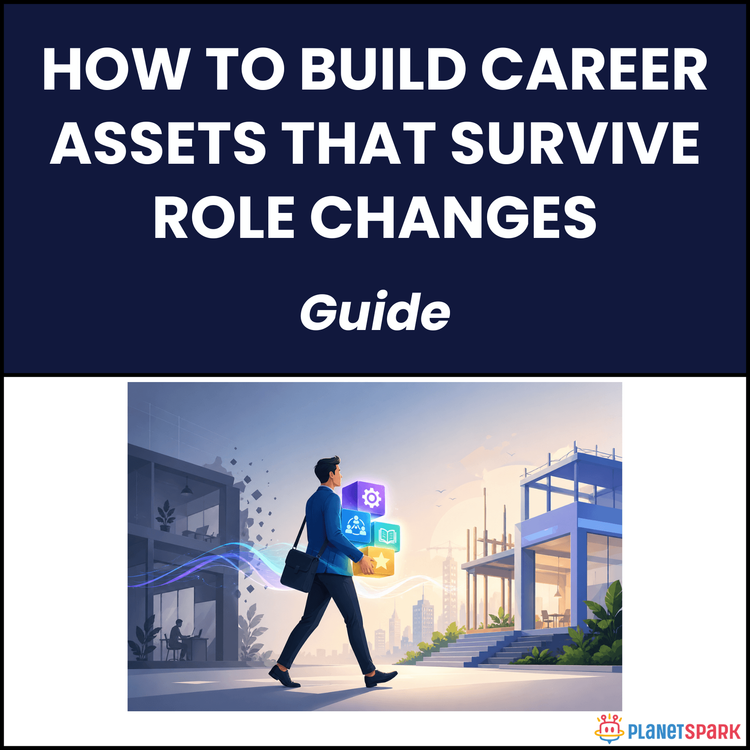
How to Build Career Assets That Survive Role Changes
Creating Career Assets That Endure Through Role Changes: A Practical Guide for Long-Term Career Growth
Most professionals build their careers around their current job.
Your title, your company, your responsibilities — all of it feels like your identity. But the moment that role changes, everything feels uncertain. Whether it’s a job switch, layoff, or career pivot, many professionals suddenly realise they don’t have a clear, portable story of their value.
This is exactly the problem the resource “How to Build Career Assets That Survive Role Changes” is designed to solve.
It shifts your focus from short-term job performance to long-term career strength — helping you build assets that stay with you, no matter where you go next.
Who Is This Resource For?
This guide is especially useful for:
- Early to mid-career professionals (0–15 years experience) who want to future-proof their careers
- Job seekers who want to stand out beyond their resume
- Career switchers trying to reposition their experience for new roles
- Managers and team leads who want to build a portable leadership identity
- Consultants and freelancers who need strong proof, brand, and credibility
- Anyone who feels “stuck” in a role that may not translate well elsewhere
If you’ve ever wondered, “What do I actually have that transfers beyond this job?” — this resource is for you.
What Does This Resource Contain?
This is not a generic career guide. It is a structured, actionable playbook built around practical frameworks and exercises.
Here’s what you’ll find inside:
The 5 Career Asset Classes Framework
- Transferable Skills
- Documented Proof
- Personal Brand
- Curated Network
- Intellectual Capital
A Career Asset Inventory (Self-Audit)
- Identify your real strengths across skills, results, and reputation
- Spot gaps in your current career positioning
Transferable Skills Reframing System
- Learn how to convert job duties into universally valuable capabilities
- Upgrade your resume and professional narrative
Career Evidence Folder System
- A practical method to document your work, results, and impact
- Helps you avoid scrambling during job searches
Personal Brand Building Framework
- LinkedIn optimization guidance
- Content strategy and consistency habits
- How to define and communicate your professional identity
Networking Strategy That Actually Works
- Focus on meaningful relationships, not superficial connections
- Build mentors, sponsors, and peer collaborators
Intellectual Capital Development
- Turn your experience into frameworks, ideas, and insights
- Become known for how you think, not just what you do
Worksheets and Checklists
- Career Asset Builder Checklist
- Role-Change Readiness Worksheet
- Career Asset Strength Assessment
Real-World Case Study
- A practical example of how one professional used these strategies to pivot successfully
Step-by-Step Systems for Role Transitions
- What to do before leaving a role
- How to maximize your first 90 days in a new role
Summary of the Resource
At its core, this guide teaches one powerful idea:
Your job is temporary. Your career assets are permanent.
Instead of relying on your current role, you learn how to build a portfolio of assets — skills, proof, relationships, and visibility — that move with you across opportunities.
It gives you both the strategy and the systems to:
- Understand your current career position
- Strengthen weak areas
- Build long-term credibility
- Stay prepared for any career transition
How Will This Resource Be Useful?
This resource delivers practical, real-world benefits that directly impact your career:
Clarity
You understand what you actually bring to the table — beyond your job title.
Confidence
You can clearly articulate your value in interviews, networking conversations, and career transitions.
Stronger Opportunities
With better proof, brand, and network, opportunities start coming to you — not just the other way around.
Faster Career Transitions
You avoid last-minute scrambling because your assets are already built and documented.
Long-Term Career Security
Instead of depending on one company or role, you build a system that keeps you relevant across industries and changes.
How Should You Use This Resource?
To get the most value, don’t treat this as something to “read later.” It’s designed for active use.
Here’s the best way to approach it:
Step 1: Read for Context
Go through the entire guide once to understand the full framework.
Step 2: Start With the Career Asset Inventory
Complete the self-audit honestly. This sets your baseline.
Step 3: Build One Asset at a Time
Don’t try to fix everything at once. Focus on one or two areas:
- Skills
- Proof
- Brand
- Network
- Intellectual capital
Step 4: Create Your Career Evidence Folder
Start documenting your work immediately — this is one of the highest ROI actions.
Step 5: Apply Weekly Habits
- Add one achievement to your evidence folder
- Reach out to one person in your network
- Capture one learning or insight
Step 6: Revisit Quarterly
Use the checklist and assessment tools to track progress and adjust your focus.
This resource is designed to be reused — not consumed once and forgotten.
Action Steps
If you want to start immediately, follow this simple checklist:
1. Create a Career Evidence Folder today
2. Add at least 3 recent achievements with measurable results
3. Rewrite 2–3 job responsibilities as transferable skills
4. Update your LinkedIn headline using capability-based language
5. Reach out to one person in your network with something valuable
6. Identify one area where your career assets are weakest
7. Commit to improving that area over the next 30 days
Small, consistent actions will compound faster than occasional effort.
Your career will change — that part is inevitable.
What determines your growth is whether you build assets that move with you, or stay dependent on a role that may not last.
This guide helps you shift that mindset. It gives you the tools to build a career that is portable, credible, and resilient — no matter what changes around you.
You don’t need to do everything at once. Start with one habit this week, and build from there.
Over time, those small actions turn into a powerful career advantage that most professionals never intentionally build.