
How to Build Psychological Safety in Your Immediate Work Circle

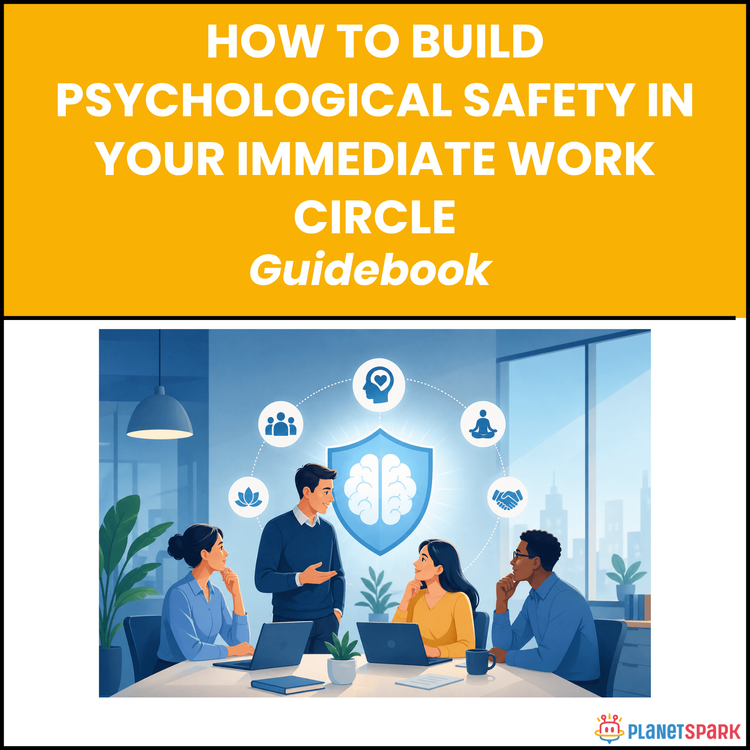
How to Build Psychological Safety in Your Immediate Work Circle
Building Psychological Security at Work: A Practical Guide for Working Professionals to Build Trust, Improve Dialogue, and Strengthen Team Dynamics
Most professionals think team performance problems are caused by weak communication, unclear accountability, or poor leadership. Sometimes that’s true. But often the deeper issue is simpler and more invisible: people do not feel safe enough to speak honestly.
Ideas stay unspoken. Concerns get buried. Feedback gets softened or avoided. Meetings become performance instead of collaboration.
And that’s costly.
When people don’t feel psychologically safe, innovation slows, mistakes get hidden, conflict becomes personal, and teams operate far below their potential.
That’s exactly why “How to Build Psychological Safety in Your Immediate Work Circle” was created.
This practical guidebook helps working professionals move beyond abstract leadership theory and build trust, openness, and stronger team dynamics through small but powerful daily behaviours. Instead of treating psychological safety as a leadership buzzword, this resource turns it into a practical skill you can develop and apply immediately.
Who Is This Resource For?
This resource is especially valuable for:
- Early to mid-career professionals who want to contribute more effectively in teams
- Managers and aspiring leaders building stronger team cultures
- Consultants navigating client dynamics and stakeholder relationships
- Career changers developing collaborative leadership skills
- Professionals managing conflict, silence, or low trust in teams
- Anyone who wants to lead with greater trust, openness, and influence
If you’ve ever wondered how to help people speak up more, handle disagreement better, or create healthier team dynamics without formal authority, this guide is for you.
What Does This Resource Contain?
This is not a motivational piece about “being a better teammate.” It is a practical operating manual for building psychological safety in real-world work settings.
Inside the resource, you’ll find:
- A clear explanation of psychological safety and why it drives performance
- The Four Stages of Psychological Safety framework for diagnosing team maturity
- A practical method to assess your current team safety climate
- Step-by-step strategies for modelling vulnerability and trust-building behaviours
- Frameworks for responding constructively to mistakes and failures
- Meeting structures that make speaking up easier and more natural
- The HEAR conversation framework for psychologically safe dialogue
- Conflict navigation tools that preserve trust while enabling honest disagreement
- Reflection worksheets to strengthen awareness and behaviour change
- Weekly habits checklists for building consistency
- A psychological safety conversation planner for difficult discussions
- A real-world case study showing how these principles work in practice
- Common mistakes that undermine safety and how to avoid them
- A self-assessment to identify your growth areas
- A practical language toolkit for high-stakes moments
- A structured 30-day action sprint to turn learning into action
It is designed not just to be read, but applied.
Summary of the Resource
“How to Build Psychological Safety in Your Immediate Work Circle” is a hands-on guide for helping professionals create environments where people feel safe to contribute, challenge ideas, admit mistakes, and do better work together.
At its core, the resource shows that psychological safety is not built through grand leadership gestures, but through repeatable micro-behaviours, practical structures, and intentional conversations.
If you want a practical roadmap to improve trust and collaboration at work, this resource gives you one.
How Will This Resource Be Useful?
This guide helps you develop a professional skill that quietly influences almost everything else.
You’ll gain:
- Greater confidence in managing team dynamics
- Better tools for building trust and openness
- Practical ways to encourage participation and honest dialogue
- Stronger conflict navigation skills
- Better responses to mistakes, tension, and difficult conversations
- Clear systems for creating healthier meeting and feedback norms
- Greater leadership credibility, even without formal authority
Most importantly, it helps you create conditions where people can do their best thinking and best work.
And that changes teams.
How Should You Use This Resource?
Use this resource in phases rather than trying to absorb everything at once.
Start by reading through the full guide once to understand the overall framework and progression.
Then assess your current team dynamics using the diagnostic tools and self-assessment sections. Clarity comes before change.
Next, choose one or two practices to implement immediately—such as improving how you respond to mistakes, using the HEAR framework, or introducing a safer meeting structure.
Use the worksheets, checklists, and conversation planner as working tools, not one-time exercises.
Then work through the 30-day sprint to build momentum through small, visible behaviour shifts.
Revisit the guide whenever you are:
- Managing team tension or conflict
- Leading meetings or projects
- Preparing for difficult feedback conversations
- Entering a new team environment
- Building leadership capability
The power of this resource comes through repeated use, not one-time reading.
Action Steps
After accessing this resource, take these steps immediately:
1. Complete the psychological safety self-assessment honestly
2. Identify one trust gap in your immediate work circle
3. Apply one new meeting or conversation practice this week
4. Use the reflection journal to track what changes
5. Start the 30-day sprint and focus on one behaviour shift per week
6. Share one insight from the guide with a colleague or team member
Don’t try to transform culture overnight.
Start small. Start visible. Start consistently.
Psychological safety often sounds like a “soft skill,” but in reality, it shapes hard outcomes—performance, innovation, retention, decision quality, and trust.
The professionals who build extraordinary teams are rarely the loudest or most charismatic. They are the ones who create environments where others can think, contribute, challenge, and grow without fear.
That is what this resource helps you build.
Use it not just as a guidebook, but as a practice manual for becoming the kind of professional people trust, speak openly with, and want to work alongside.
Because stronger teams rarely happen by accident.
They are built.