
How to Build Sustainable Productivity Without Overexertion

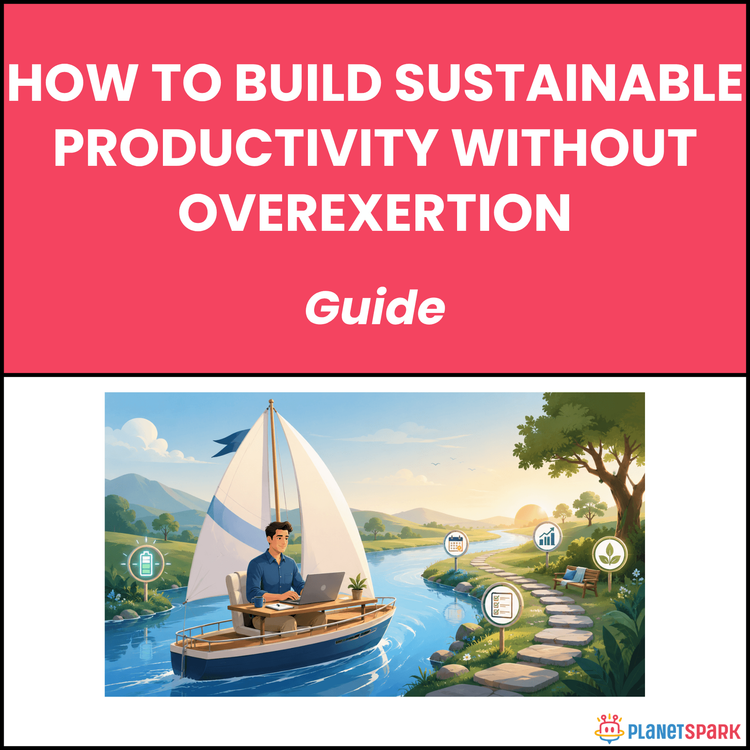
How to Build Sustainable Productivity Without Overexertion
Build Sustainable Productivity Without Overexertion: A Practical Guide for Working Professionals
Many professionals are doing everything they are “supposed” to do.
They answer emails quickly. They attend every meeting. They finish tasks late into the evening. They stay available, responsive, and committed.
But by the end of the week, they still feel behind.
That is the problem this resource is built to solve.
How to Build Sustainable Productivity Without Overexertion is a practical guide for working professionals who want to produce strong results without burning out in the process. It shows that productivity is not about pushing harder every day. It is about building a better operating model around energy, priorities, systems, and recovery.
This guide helps readers move away from overwork and toward a healthier way of working that is focused, structured, and sustainable.
Who Is This Resource For?
This resource is useful for professionals who want to perform well without constantly feeling drained.
It is especially helpful for:
Career changers managing learning, applications, and current work
Early-career professionals trying to build strong work habits
Mid-career professionals handling heavier responsibilities
Managers balancing team needs, meetings, and strategic work
Consultants working across multiple clients or projects
Professionals who feel busy all day but still lack meaningful progress
Anyone who wants to improve productivity without sacrificing health, focus, or personal life
If you often feel productive on paper but exhausted in reality, this guide will feel relevant.
What Does This Resource Contain?
This guide is structured around a clear sustainable productivity framework.
It focuses on four main pillars:
Energy Architecture
This section helps readers understand that time is not the only resource that matters. Energy is the real foundation of sustainable output.
The guide explains four types of energy:
Physical energy: Sleep, movement, nutrition, and rest.
Mental energy: Focus, concentration, and decision-making ability.
Emotional energy: Mood, relationships, motivation, and psychological safety.
Purposive energy: Meaning, alignment, and the feeling that your work matters.
It also includes a 7-day energy audit to help readers track their energy patterns across the week.
Priority Clarity
This section helps readers separate important work from urgent-feeling work.
The guide uses the Eisenhower Matrix to show how tasks can be grouped into:
Urgent and important
Not urgent but important
Urgent but not important
Not urgent and not important
The key message is that sustainable productivity lives in important, non-urgent work. This includes strategic planning, skill development, relationship building, and long-term goals.
Systems and Automation
This section focuses on reducing mental load.
The guide explains that professionals should not rely only on motivation or willpower. Instead, they need repeatable systems for recurring work.
It includes practical systems for:
Email management
Meeting decisions
Task capture
Asynchronous communication
Daily shutdown routines
The idea is simple: good systems reduce repeated decisions and protect mental bandwidth.
Recovery Rituals
This section explains that recovery is not a reward. It is a requirement.
The guide shows how sleep, breaks, holidays, and proper mental detachment support better performance. It also explains the value of micro-recovery during the workday and macro-recovery through real time off.
This section is especially important for professionals who feel guilty about resting.
Worksheets and Tools Inside the Guide
The resource includes several practical tools that readers can use immediately.
These include:
A 7-day energy audit
A sustainable productivity checklist
A weekly design template
A sustainability self-assessment
A quick reference productivity cheat sheet
A 30-day launch plan
These tools make the guide practical, not just motivational.
Summary of the Resource
How to Build Sustainable Productivity Without Overexertion helps professionals stop equating productivity with exhaustion.
It teaches readers how to manage energy, protect priorities, build reliable systems, and recover intentionally.
The guide’s main message is clear:
**Sustainable productivity is not about doing more at any cost. It is about doing the right work in a way that can last.**
Instead of relying on longer hours, the guide helps professionals build better conditions for consistent performance.
How Will This Resource Be Useful?
This guide is useful because it addresses the hidden cost of modern productivity culture.
Many professionals are productive in the short term but depleted in the long term. This resource helps them change that pattern.
It Helps You Understand Your Energy
The 7-day energy audit helps readers see when they feel strongest, when they lose focus, and what drains them most.
This makes it easier to plan difficult work during peak energy periods instead of forcing focus at the wrong time.
It Helps You Focus on What Actually Matters
The priority clarity section helps readers stop treating every task as equally important.
By identifying the “Big 3” outcomes for the week, professionals can focus on work that moves the needle instead of simply clearing busywork.
It Helps Reduce Decision Fatigue
The guide encourages simple systems for email, meetings, tasks, and communication.
This reduces the number of small decisions professionals make every day and creates more mental space for meaningful work.
It Helps Prevent Burnout
One of the strongest parts of the guide is its focus on recovery.
It reminds readers that rest, sleep, breaks, and holidays are not signs of weakness. They are part of long-term performance.
It Helps Build a Sustainable Weekly Rhythm
The weekly design template gives readers a simple structure for planning their week before the week takes over.
This helps reduce reactive work and creates a stronger sense of control.
It Makes Productivity Practical
The resource does not ask readers to completely change their life overnight.
It gives small, realistic steps such as energy tracking, email batching, weekly resets, shutdown rituals, and recovery commitments.
How Should You Use This Resource?
Start by reading the guide once from beginning to end.
This will help you understand the full framework before you begin filling in the worksheets.
Complete the 7-Day Energy Audit
Track your physical, mental, and emotional energy across the week.
Look for patterns such as:
When your energy is highest
When your energy drops
Which tasks drain you
Which activities restore you
This is the foundation for building a better productivity system.
Identify Your Peak Work Hours
Once you know your strongest energy windows, protect them.
Use those hours for deep work, strategic thinking, writing, planning, problem-solving, or skill development.
Avoid spending your best hours on low-value admin or unnecessary meetings.
Do a Weekly Priority Reset
Set aside 20 minutes at the start or end of each week.
Use that time to:
Brain dump all open tasks
Sort priorities
Choose your Big 3 outcomes
Block important work on your calendar
Delete or delegate low-value work
This one habit can make the entire week feel more intentional.
Build One System at a Time
Do not try to systemise everything at once.
Start with one area, such as email or task capture.
For example, you can begin by checking email only twice a day or using one trusted place to capture all tasks.
Small systems create big relief over time.
Create a Shutdown Ritual
The guide recommends a simple 10-minute shutdown ritual.
At the end of the workday:
Review what you completed
Capture open tasks
Check tomorrow’s calendar
Write your Big 3 for the next day
Say, “Shutdown complete”
This helps your mind stop carrying work into the evening.
Use the Monthly Checklist
At the end of each month, use the sustainable productivity checklist to review your progress.
Look at your energy, priorities, systems, and recovery.
Do not aim for perfection. Use the checklist to identify one area to improve next.
Follow the 30-Day Launch Plan
The guide ends with a practical 30-day plan.
Week 1 is for diagnosis.
Week 2 is for designing your energy zones and weekly reset.
Week 3 is for building systems.
Week 4 is for sustaining progress and improving recovery.
This makes implementation easier because the process is broken into manageable stages.
Action Steps
Here are simple next steps to take after reading the guide:
Complete the 7-day energy audit.
Identify your lowest-scoring productivity pillar.
Block your peak energy hours for important work.
Choose your Big 3 outcomes for the week.
Batch email instead of checking it constantly.
Decline or question meetings where your presence is not essential.
Pick one trusted task capture system.
Create a 10-minute shutdown ritual.
Schedule one full no-work day each week.
Choose one recovery upgrade for this month.
If the full guide feels like a lot, start with just one action: complete the energy audit.
That one exercise will give you the clarity needed to make better productivity decisions.
Sustainable productivity is not about becoming a different person. It is about building better conditions for the professional you already are.
When your energy is protected, your priorities are clear, your systems are reliable, and your recovery is planned, work becomes less reactive and more intentional.
You do not need to prove your value through exhaustion.
You need a way of working that helps you perform well, grow consistently, and still have energy for the rest of your life.
This guide gives you that starting point.