
How to Communicate Effectively Across Cultures and Time Zones

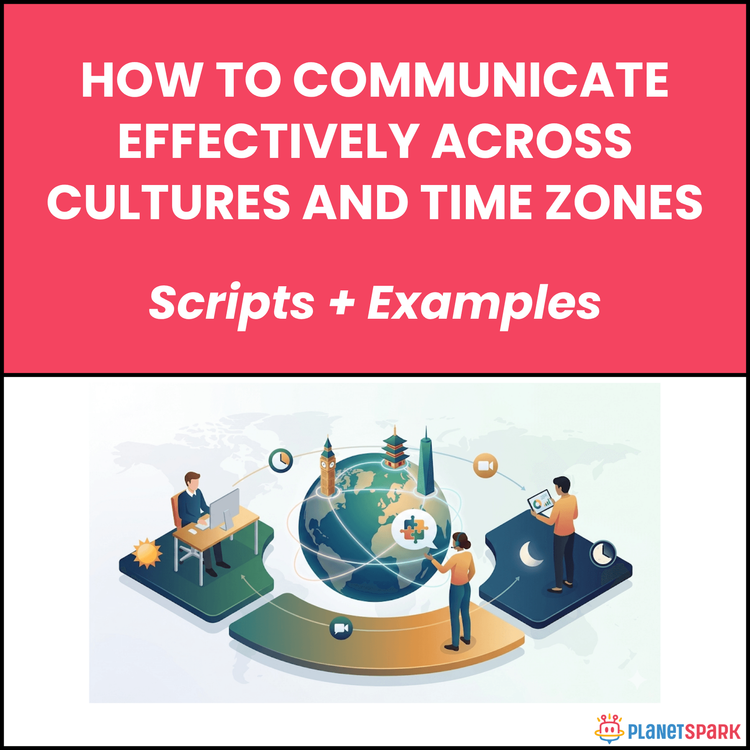
How to Communicate Effectively Across Cultures and Time Zones
Mastering Global Conversations in a Distributed Workplace
In today’s workplace, being technically strong is no longer enough. You can lead projects, manage stakeholders, and deliver exceptional work—but if your communication breaks down across cultures, countries, or time zones, your impact often gets lost in translation.
A message that feels clear to you may feel abrupt to someone else. A meeting that seems efficient to one team may feel rushed or exclusionary to another. And when global collaboration becomes your everyday reality, these communication gaps stop being minor inconveniences—they start affecting trust, execution, and career growth.
That is exactly why PlanetSpark created this practical resource: “How to Communicate Effectively Across Cultures and Time Zones.” This toolkit is designed to help professionals communicate with clarity, confidence, and cultural intelligence in real-world global work environments.
Who Is This Resource For?
This resource is especially valuable for:
- Early-career professionals working with global clients or distributed teams
- Mid-career managers leading remote or multicultural teams
- Consultants presenting ideas to international stakeholders
- Career switchers entering global-first organizations
- Team leads responsible for cross-border collaboration
- Professionals navigating virtual meetings, written communication, and stakeholder alignment across geographies
If your work involves people from different cultures, communication styles, or time zones, this resource was built with your reality in mind.
What Does This Resource Contain?
This guide is not generic advice about “being culturally sensitive.” It is a practical operating system for real workplace communication.
Inside the resource, you will find:
- A foundational framework for understanding cultural communication differences
- Practical models such as high-context vs low-context communication, power distance, and collectivist vs individualist cultures
- Ready-to-use email and written communication scripts for different cultural contexts
- A four-step framework for running effective cross-cultural meetings
- Time-zone communication strategies that prevent burnout and improve fairness
- The STAR async communication format for remote collaboration
- Feedback frameworks including SBI (Situation–Behavior–Impact) adapted for cultural sensitivity
- Communication checklists and worksheets for real-time application
- A real-world case study showing how a product manager navigates a three-time-zone launch
- Action tools, templates, reflection exercises, and implementation checklists
The guide is built to be used repeatedly—not just read once. The worksheets and frameworks are designed as live working tools.
Summary of the Resource
“How to Communicate Effectively Across Cultures and Time Zones” is a practical communication toolkit for modern professionals working across borders.
Instead of offering abstract theory, it provides scripts, frameworks, meeting templates, feedback models, and communication systems you can apply immediately in emails, meetings, async updates, and stakeholder conversations.
Its core goal is simple: help you reduce miscommunication, build trust faster, and become a more effective professional in global environments.
How Will This Resource Be Useful?
This resource helps you solve some of the most common—and costly—professional communication challenges.
By applying this guide, you will be able to:
- Write emails that land well across different cultures
- Lead meetings where every voice feels included
- Handle feedback conversations with cultural intelligence
- Avoid misunderstandings caused by tone, context, or language differences
- Build stronger professional relationships across borders
- Manage time-zone communication without creating always-on team cultures
- Increase credibility with international stakeholders
Most importantly, it helps you replace guesswork with repeatable communication systems.
How Should You Use This Resource?
To get maximum value from this guide, follow this practical approach:
Step 1: Start with the foundations
Begin by reading the cultural awareness section carefully. Understand how different cultures interpret hierarchy, directness, silence, and decision-making.
Step 2: Audit your current communication style
Use the reflection exercises and self-assessment tools to identify your default communication patterns.
Step 3: Apply the scripts immediately
Use the email templates, meeting frameworks, and async communication models in your next real workplace interaction.
Step 4: Practice cultural calibration
Before important communication, use the checklists provided to adjust tone, structure, formality, and timing.
Step 5: Review and improve
After meetings or stakeholder conversations, revisit the worksheets and identify what worked, what created friction, and what you can improve.
This guide becomes more powerful with repeated application.
Action Steps
After accessing this resource, do these five things immediately:
1. Identify one global stakeholder or team you communicate with regularly
2. Review your last email or Slack message through the cultural checklist
3. Use the STAR async communication format in your next written update
4. Send a structured pre-meeting brief before your next international meeting
5. Practice one culturally calibrated feedback conversation using the SBI model
Small changes in communication style often create outsized professional results.
The professionals who thrive in global workplaces are not necessarily the loudest, fastest, or most technically skilled. They are the ones who can build trust, reduce friction, and create clarity across differences.
Cross-cultural communication is not a soft skill. It is a career accelerator.
This resource gives you practical systems, scripts, and frameworks to build that skill with intention. Use it consistently, stay curious, and keep refining your approach. Over time, these communication habits can become one of the most valuable assets in your professional toolkit.