
How to Communicate Like a Leader Without a Title

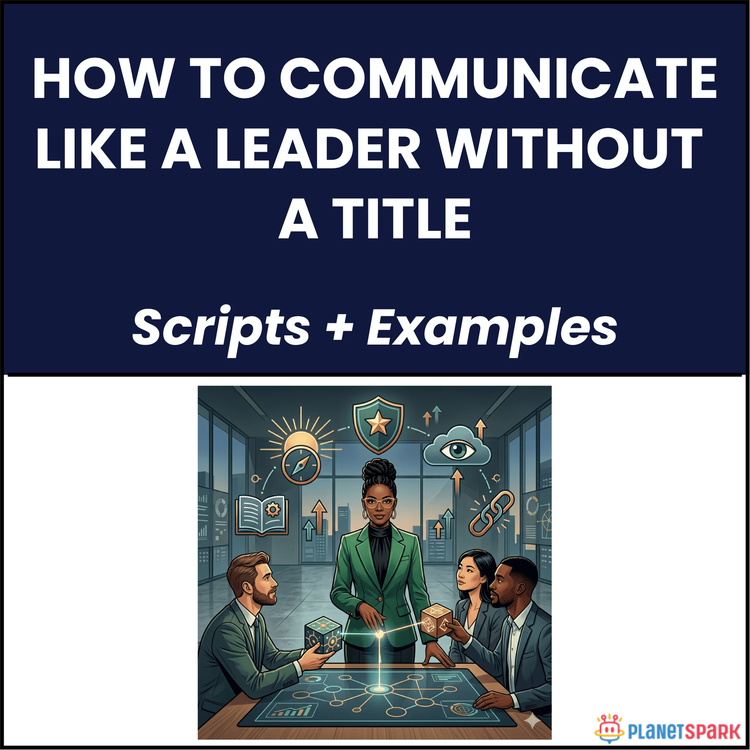
How to Communicate Like a Leader Without a Title
A Practical Guide to Influence Without Authority at Work
If you’ve ever had a strong idea—but struggled to get people to take it seriously—you’ve experienced one of the most common career bottlenecks: communication.
You might be doing great work. You might be thinking strategically. But if your ideas come across as hesitant, unclear, or unstructured, they often get ignored, misunderstood, or credited to someone else.
In today’s workplace, leadership is not defined by your title—it’s defined by how you communicate. That’s exactly why the resource “How to Communicate Like a Leader Without a Title” exists. It’s a practical playbook designed to help working professionals communicate with clarity, confidence, and influence—so they can lead conversations, shape decisions, and earn respect, regardless of their role.
Who Is This Resource For?
This resource is especially valuable if you are:
- A working professional (0–15 years of experience) looking to build leadership presence
- Someone whose ideas are often overlooked in meetings or discussions
- A professional who struggles with confidence in high-stakes conversations
- A manager, consultant, or individual contributor working across stakeholders
- Someone preparing for promotions or leadership roles
- Anyone who wants to communicate more clearly, assertively, and effectively at work
If you’ve ever been told to “be more visible” or “communicate better” without clear guidance—this playbook is built for you.
What Does This Resource Contain?
This is not generic advice about “speaking confidently.” It’s a structured, skill-based system built around real workplace scenarios.
Inside the resource, you’ll find:
- A clear explanation of why communication is the foundation of leadership
- A 5-skill framework to develop leader-level communication progressively
- Skill 1: Precision language—how to replace hesitant communication with confident, clear statements
- Skill 2: The PCS method (Problem → Consequence → Solution) to structure ideas persuasively
- Skill 3: The EAR framework (Establish → Acknowledge → Redirect) for handling difficult conversations
- Skill 4: Stakeholder-centred communication to influence without authority
- Skill 5: Practical techniques to contribute effectively in meetings and group settings
- Ready-to-use scripts for meetings, feedback, disagreements, and stakeholder conversations
- Real-world examples showing how communication changes outcomes
- A case study demonstrating how consistent application builds visibility and influence
- A self-assessment tool to identify communication gaps
- A 7-day action plan to start applying these skills immediately
Everything is designed for real-world application—not theory.
Summary of the Resource
“How to Communicate Like a Leader Without a Title” is a practical communication playbook that helps professionals move from passive participation to active influence. It provides clear frameworks, scripts, and habits that enable you to express ideas effectively, handle difficult conversations confidently, and contribute strategically in any professional setting.
If you want to be taken seriously, trusted, and seen as a leader—this resource gives you the tools to make that shift.
How Will This Resource Be Useful?
This resource helps you transform how you show up in conversations.
You’ll gain:
- The ability to communicate ideas with clarity and confidence
- Stronger influence in meetings and decision-making discussions
- Practical tools to handle difficult conversations without hesitation
- Improved stakeholder communication across different personalities and priorities
- Increased visibility and recognition for your contributions
- Better control over how your ideas are received and acted upon
- A clear path to building leadership presence—without waiting for a title
Most importantly, it helps you stop underselling your thinking—and start communicating it in a way that drives action.
How Should You Use This Resource?
To get the best results, treat this playbook as a practice tool—not just a read.
Start by reading the full guide once to understand the five communication skills and how they build on each other.
Next, pick one skill to focus on rather than trying to apply everything at once. For example, start with precision language or the PCS framework.
Use the scripts actively in your daily work—meetings, emails, Slack messages, and one-on-one conversations.
After important interactions, use the reflection prompts to evaluate what worked and what could improve.
Apply the frameworks in real situations:
- Use PCS before pitching ideas
- Use EAR during difficult conversations
- Use stakeholder-centred framing in cross-team discussions
Follow the 7-day action plan to build momentum and consistency. Revisit the resource regularly as your responsibilities grow—it becomes more valuable at higher levels of responsibility.
Action Steps
After accessing this resource, take these steps immediately:
1. Review your last 3–5 emails or messages and remove hedging language (e.g., “just,” “maybe,” “I think”)
2. Use the PCS framework to structure your next idea or proposal
3. Speak within the first five minutes of your next meeting
4. Identify one difficult conversation you’ve been avoiding—and plan it using the EAR framework
5. Map one key stakeholder and tailor your next communication to their priorities
6. Volunteer to summarise decisions in your next group discussion
Small changes in how you communicate can create outsized shifts in how you’re perceived.
Leadership communication is not about being loud, aggressive, or overly polished. It’s about being clear, intentional, and effective. When you communicate with precision, structure your ideas thoughtfully, and engage stakeholders with awareness, you naturally position yourself as someone worth listening to—and following.
Use this resource to build that capability deliberately. Because the fastest way to grow your career is not just to do better work—but to communicate your thinking in a way that moves people.