
How To Decide Under Pressure Without Compromising Quality

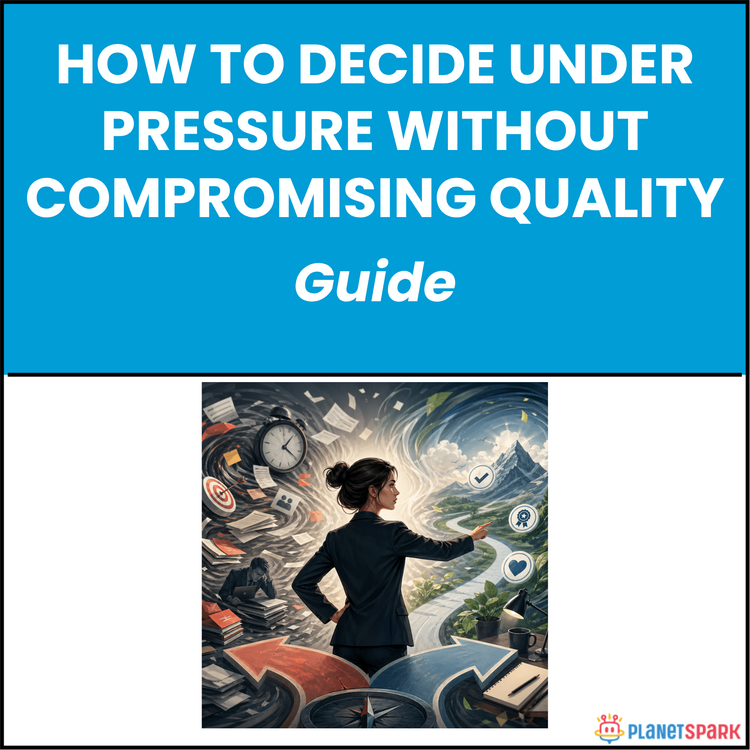
How To Decide Under Pressure Without Compromising Quality
How to Decide Under Pressure Without Compromising Quality: A Practical Guide for Fast, Confident, and High-Impact Decisions
If you’ve ever made a decision quickly—only to regret it later—you’re not alone.
Pressure changes how you think.
Deadlines shrink. Stakes rise. Emotions intensify. And in that moment, your brain shifts from deliberate reasoning to reactive decision-making.
The result?
Decisions that feel right in the moment—but don’t hold up later.
That’s exactly why the resource “How to Decide Under Pressure Without Compromising Quality” exists. It gives you a structured system to protect decision quality—even when time is limited and pressure is high.
Instead of reacting, you learn how to decide with control.
Who Is This Resource For?
This resource is especially valuable if you are:
- A working professional with 0–15 years of experience
- A manager or team lead handling urgent decisions
- A consultant or client-facing professional under pressure
- A career switcher navigating high-stakes choices
- A professional prone to overthinking or rushing decisions
- Someone who wants to improve speed without sacrificing quality
If you’ve ever thought, “I need to decide quickly—but I don’t want to get it wrong,” this guide is built for you.
What Does This Resource Contain?
This is not a theoretical guide—it is a real-time decision-making system.
Inside the resource, you’ll find:
- A clear explanation of why pressure breaks decision quality (page 2), including how stress shifts your brain from analytical thinking to reactive mode
- The PACE Decision Protocol (page 3), a 4-step framework:
- Pause (create a gap before reacting)
- Assess (clarify facts, assumptions, and stakes)
- Choose (select using structured lenses)
- Evaluate (review before execution)
- Practical tools for each phase:
Pause (page 4):
- Micro-pause techniques (2–5 seconds)
- Physical and cognitive reset methods
- Triggers to recognise when you’re under pressure
Assess (page 5–6):
- The 90-Second Situation Map
- Fact vs assumption separation
- Stake calibration (reversible vs irreversible decisions)
- Rapid consultation strategy
Choose (page 7–8):
- The 3-Lens decision filter:
- Reversibility
- Alignment
- Defensibility
- The Three-Option Rule to avoid binary thinking
Evaluate (page 9):
- The 60-second pre-mortem technique
- Decision documentation system
- Review checkpoints for learning
- A real-time Pressure Decision Checklist (page 10)
- The 5 common decision traps (page 11), including:
- Urgency theatre
- Binary thinking
- Seniority pressure
- Sunk cost fallacy
- Perfectionism paralysis
- A decision-type matrix (page 12) to match speed vs rigour based on stakes and reversibility
- A 30-day practice plan (page 13) to build decision-making habits
- A weekly reflection worksheet (page 14)
- A real-world case study showing how structured thinking prevented a costly mistake (page 15)
- A communication framework to present decisions confidently (page 16)
- A team-based adaptation of the PACE framework (page 17)
Everything is designed to be used in real time—not after the decision is already made.
Summary of the Resource
“How to Decide Under Pressure Without Compromising Quality” is a practical decision-making playbook that helps professionals make fast, structured, and defensible decisions—even in high-pressure situations.
It replaces reactive thinking with a simple, repeatable system that balances speed and quality.
If you want to make decisions you can stand by—even under pressure—this resource gives you the system.
How Will This Resource Be Useful?
This resource helps you move from reactive decisions to controlled execution.
You’ll gain:
- A clear system to make decisions under time pressure
- Reduced impulsive or regret-driven decisions
- Better clarity in high-stakes situations
- Increased confidence in your judgment
- Faster decision-making without sacrificing quality
- Stronger professional credibility and trust
- A repeatable process you can apply across roles and situations
As explained in the introduction (page 2), the goal is not to eliminate pressure—but to build a system that works effectively within it.
Most importantly, it helps you stop letting pressure dictate your decisions.
How Should You Use This Resource?
To get the best results, use this as a real-time decision tool.
Start with awareness:
- Recognise when you are under pressure
- Identify triggers (urgency, emotional intensity, deadlines)
Apply the PACE framework:
Pause:
- Take 2–5 seconds
- Create a mental gap before reacting
Assess:
- Separate facts from assumptions
- Define the real decision
- Evaluate stakes and reversibility
Choose:
- Generate at least 3 options
- Apply reversibility, alignment, and defensibility lenses
Evaluate:
- Run a quick pre-mortem
- Identify failure risks
- Set a review checkpoint
Communicate clearly:
- State your decision first
- Give one clear reason
- Acknowledge uncertainty
- Commit to follow-up
Review and improve:
- Use weekly reflection
- Identify patterns in your decisions
- Improve consistency over time
As shown in the framework diagram (page 3), the power of PACE lies in its simplicity—it adds just enough structure to improve decisions without slowing you down.
Action Steps
After accessing this resource, take these steps immediately:
1. Identify one recent decision you made under pressure
2. Reflect: did you pause, assess, choose, and evaluate?
3. Save the PACE checklist on your phone
4. Practise inserting a 2-second pause in your next decision
5. Use the Three-Option Rule for your next choice
6. Apply a 60-second pre-mortem before executing
7. Write down one decision and your reasoning today
8. Schedule a weekly 10-minute decision review
Small changes in how you decide create large changes in outcomes.
Pressure will never go away.
But your ability to handle it can improve dramatically.
The most effective professionals are not the ones who avoid pressure.
They are the ones who can think clearly inside it.
When you build that skill, your decisions improve, your confidence increases, and your professional reputation strengthens.
And that’s what separates reactive professionals from trusted decision-makers.
Book your free session today!