
How to Design Energy Recovery Windows into Your Workday

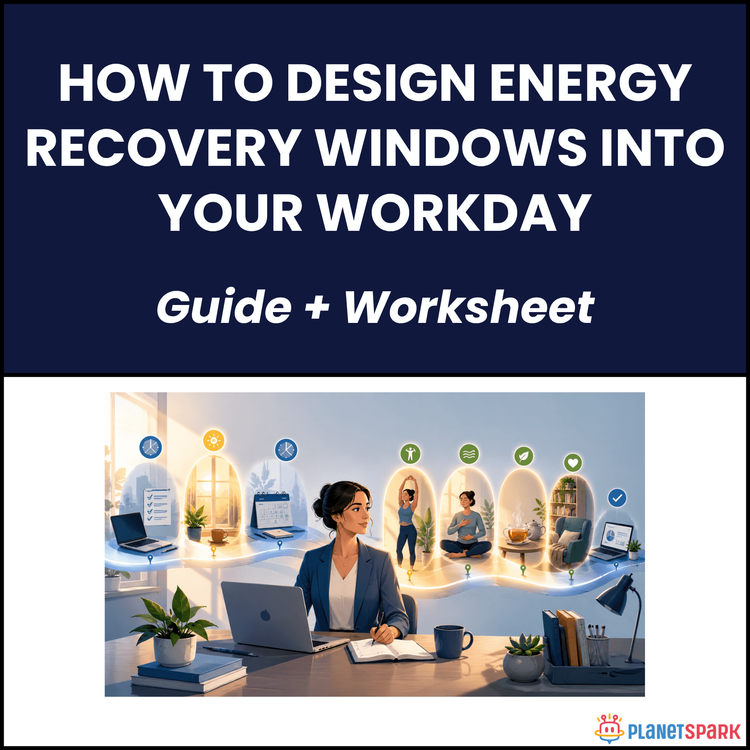
How to Design Energy Recovery Windows into Your Workday
How to Design Energy Recovery Windows into Your Workday
Most professionals are taught how to manage time, but very few are taught how to manage energy.
You may have enough hours in the day, but still feel mentally drained by afternoon. You may sit at your desk for long stretches, move from one meeting to another, and keep pushing through tiredness with coffee, willpower, or pressure.
The result is not better performance. It is lower focus, more mistakes, emotional reactivity, and long-term exhaustion.
The guide How to Design Energy Recovery Windows into Your Workday helps working professionals build short, intentional recovery breaks into their daily schedule. These breaks are called Energy Recovery Windows, or ERWs.
This resource is practical, structured, and easy to apply. It helps you understand your energy patterns, identify what blocks your recovery, and design small recovery moments that fit into a real workday.
Who Is This Resource For?
This resource is useful for professionals who want to perform well without constantly running on empty.
It is especially helpful for:
Working professionals with long or demanding workdays
Managers handling meetings, decisions, and team pressure
Consultants managing client work and frequent context switching
Career switchers trying to maintain performance while adapting to new roles
Early-to-mid career professionals building sustainable work habits
Professionals who experience afternoon brain fog or low focus
People who feel tired even when their calendar looks manageable
Anyone who wants to protect energy, not just manage time
If you often feel mentally sharp in the morning but drained by mid-afternoon, this guide can help you redesign your workday more intentionally.
What Does This Resource Contain?
This guide contains a complete system for building recovery into your workday.
It includes practical explanations, worksheets, reflection prompts, a recovery activity menu, a readiness assessment, and a weekly implementation planner.
1. Why Energy Recovery Matters
The guide begins by explaining why energy recovery is a skill most professionals were never taught.
It highlights an important point: the brain is not designed for nonstop focus. Most people work in cycles of high attention followed by natural dips in energy.
When professionals ignore those dips, they often experience lower decision quality, reduced communication effectiveness, and higher risk of burnout.
2. What an Energy Recovery Window Means
The guide defines an Energy Recovery Window as a short, intentional pause built into the workday.
These pauses usually last between 3 and 15 minutes.
The goal is to help your nervous system, focus, and emotional reserves partially recover before the next work block.
The guide also makes a clear distinction between true recovery and passive distraction. Scrolling social media or mentally preparing for the next meeting is not real recovery.
A true ERW requires deliberate disengagement from work-related stimulation.
3. The Three Main Areas of Recovery
The guide explains that recovery can happen in three important areas.
Cognitive recovery helps your decision-making, planning, and focus restore.
Emotional recovery helps reduce reactivity and improves patience, clarity, and communication.
Physical recovery helps reduce tension, improve circulation, and restore alertness.
This helps readers understand that recovery is not laziness. It is a performance support system.
4. Step 1: Map Your Personal Energy Curve
The first step helps you understand when your energy rises, holds, and drops during the day.
The guide explains that different professionals may have different energy patterns.
Some people have high morning energy and an afternoon dip.
Some people build energy slowly and peak later.
Some people have two strong energy peaks with a dip in between.
The worksheet includes a 3-day energy tracking log where you rate your energy and focus every 90 minutes.
This helps you identify the best places to insert recovery windows.
5. Step 2: Understand the Four Types of Energy Recovery
The guide explains four types of micro-recovery.
Cognitive Disengagement
This means stepping away from thinking, problem-solving, or decision-making.
Examples include sitting quietly, staring out a window, doodling, or doing a simple task with no pressure.
Movement Recovery
This involves light physical activity that releases tension and improves alertness.
Examples include stretching, walking, climbing stairs, or doing gentle movement.
Sensory Downshift
This means reducing visual and sound stimulation so your nervous system can settle.
Examples include breathing exercises, sitting in silence, stepping outside, or closing your eyes for a few minutes.
Social Micro-Recovery
This involves light, positive interaction that is not work-related.
Examples include a short friendly conversation, texting a friend, or sharing a kind comment with someone.
6. Step 3: Identify Your Recovery Blockers
The guide helps you identify what stops you from taking recovery breaks.
It separates blockers into two categories.
Internal blockers include guilt, perfectionism, fear of missing messages, and the belief that busyness equals productivity.
External blockers include back-to-back meetings, constant notifications, lack of quiet space, and workplace cultures that reward constant availability.
The worksheet includes a Recovery Blocker Audit where you write down your blockers and one small shift you can make.
7. Step 4: Design Your Energy Recovery Windows
This section helps you create a personal ERW blueprint.
The guide encourages readers to think of the workday in three zones:
Morning: best for deep work and high-focus tasks
Midday: best for lighter cognitive tasks and connection
Afternoon: best for execution tasks and structured recovery
The main principle is simple: do not let more than 90 minutes pass without a deliberate recovery pause.
The worksheet helps you plan your work blocks, ERW triggers, recovery type, and duration.
8. Step 5: Anchor Recovery with Triggers
The guide explains that recovery habits are easier to maintain when they are connected to clear triggers.
It introduces three types of triggers.
Time-based triggers use alarms or calendar reminders every 90 minutes.
Transition triggers use natural moments like the end of a meeting, finishing a task, or before starting a new work block.
Depletion signal triggers use personal warning signs like rereading the same text, irritability, or decision avoidance.
This section helps readers build recovery into their routine instead of relying on motivation.
9. ERW Menu: 20 Recovery Activities Under 10 Minutes
The guide includes a quick-reference menu of recovery activities.
These include:
Looking out a window
Making tea slowly
Sitting quietly
Doing breathing exercises
Stepping outside
Stretching the neck and shoulders
Taking a short walk
Having a short non-work conversation
Sending a kind message to a friend
This makes it easier to choose a recovery activity quickly during the workday.
10. Real-World Case Study
The guide includes the case of Priya, a senior manager at a consulting firm.
Before using ERWs, Priya had back-to-back calls, ate lunch at her desk, and felt drained by afternoon.
After implementing recovery windows, she added short decompression breaks, took lunch away from her screen, and built in an afternoon walk.
Her energy improved, and her evening work became shorter but more effective.
This example shows that recovery does not require adding more time to the day. It often means using existing gaps more intentionally.
11. Common Recovery Mistakes
The guide explains common mistakes professionals make when trying to recover.
These include:
Using screens as recovery
Planning the next task during a break
Skipping recovery when busy
Expecting instant results
Each mistake is paired with a practical fix.
12. ERW Readiness Assessment
The guide includes a short self-evaluation to help readers assess their current recovery habits.
It asks about energy awareness, screen-free breaks, meeting buffers, lunch habits, movement breaks, and end-of-day energy.
This helps readers understand where they are starting from.
13. The RECHARGE Framework
The guide introduces the RECHARGE Framework as a quick-reference model.
It stands for:
Rhythm
Environment
Choice
Habit Stack
Accountability
Review
Guard
Experiment
This framework helps readers design recovery windows that are realistic and sustainable.
14. 7-Day ERW Implementation Planner
The guide ends with a 7-day planner that helps readers move from learning to action.
Each day has a simple focus:
Day 1: Observe your energy
Day 2: Identify your lowest-energy slots
Day 3: Take your first recovery window
Day 4: Add a trigger
Day 5: Stack the habit
Day 6: Experiment with recovery type
Day 7: Review and design your next week
This makes the guide easy to apply step by step.
Summary of the Resource
How to Design Energy Recovery Windows into Your Workday is a practical guide for professionals who want to protect their energy and improve performance.
The resource teaches that recovery is not a reward for finishing work. It is part of how good work becomes sustainable.
It helps readers understand their energy patterns, choose the right type of recovery, design small recovery breaks, and build habits that fit into a busy workday.
The main message is clear: you do not need a perfect schedule to recover better. You need small, intentional recovery windows placed at the right moments.
How Will This Resource Be Useful?
This guide is useful because it turns recovery into a practical workday system.
It helps you understand your energy patterns.
Instead of guessing why you feel tired, you can track your energy and focus across the day.
It improves focus and decision-making.
Short recovery windows help reduce mental fatigue and support clearer thinking.
It helps reduce emotional reactivity.
When you build in pauses, you are less likely to react sharply during stressful conversations or meetings.
It supports better work quality.
Recovery helps you return to tasks with more attention, patience, and clarity.
It helps prevent burnout.
By recovering throughout the day, you reduce the buildup of exhaustion that can lead to long-term burnout.
It makes recovery realistic.
The guide focuses on 3 to 15-minute windows, not unrealistic lifestyle changes.
It helps teams work better.
Managers can use the ideas to create healthier meeting norms, calendar buffers, and recovery-friendly team culture.
How Should You Use This Resource?
Use this guide as both a learning resource and a workday design tool.
Step 1: Read the guide once fully.
Start by understanding the concept of Energy Recovery Windows and why they matter.
Step 2: Track your energy for three days.
Use the 3-day energy tracking log to rate your energy and focus every 90 minutes.
Step 3: Identify your low-energy slots.
Look for the times when your energy and focus are consistently low. These are your best ERW placement zones.
Step 4: Choose recovery types that fit your needs.
Use cognitive disengagement, movement, sensory downshift, or social micro-recovery based on what kind of depletion you are experiencing.
Step 5: Complete the recovery blocker audit.
Write down the internal and external blockers that stop you from recovering during the day.
Step 6: Design your ERW blueprint.
Plan your recovery windows into your schedule. Add the time, trigger, recovery type, and duration.
Step 7: Use triggers to make the habit easier.
Connect your recovery window to a calendar reminder, the end of a meeting, or a personal depletion signal.
Step 8: Start with one recovery window per day.
Do not try to redesign your entire schedule immediately. Begin with one 5-minute recovery window and build from there.
Step 9: Review weekly.
At the end of each week, review what worked, what did not, and what needs to change.
Action Steps
After using this resource, take these steps:
Track your energy and focus for three working days.
Circle your two lowest-energy time slots.
Choose one recovery type that feels realistic.
Block one 5-minute ERW into your calendar for tomorrow.
Keep your phone away during that recovery window.
Use a clear trigger, such as the end of a meeting or a 90-minute alarm.
Try one screen-free recovery activity from the ERW menu.
Review how you feel at the end of the day.
Repeat the practice for seven days before judging the results.
Energy is one of your most important professional resources.
You can manage your calendar perfectly and still feel depleted if you never allow your mind and body to recover.
This guide helps you build recovery into the structure of your workday, not as an afterthought, but as part of sustainable performance.
Start small. Choose one 5-minute window. Protect it. Repeat it.
Better energy does not come from pushing harder all day. It comes from knowing when to pause, recover, and return with focus.