
How to Develop Faster AI Feedback Loops for Better Outputs

How to Develop Faster AI Feedback Loops for Better Outputs
How to Develop Faster AI Feedback Loops for Better Outputs: A Practical Guide
AI tools promise quicker and smarter work, but without the right feedback loop, they often deliver lackluster results. Many professionals struggle with poor outputs simply because they lack a system to refine and iterate effectively. How to Develop Faster AI Feedback Loops for Better Outputs provides a practical, structured approach to developing AI feedback loops that accelerate your results. Whether you're a career switcher, consultant under a tight deadline, or a manager seeking better team output, this guide will help you get better results from AI tools faster.
Who Is This Resource For?
This guide is for professionals eager to get better outputs from their AI tools. It’s perfect for:
- Career switchers who want to rapidly learn how to work efficiently with AI
- Consultants who need to generate quality results under pressure
- Managers looking to scale their teams’ productivity using AI tools
- Anyone who’s already using AI but wants to improve their results quickly and with precision
If you want to turn AI interactions from vague guesses into focused, high-quality outputs, this guide is for you.
What Does This Resource Contain?
This guide is filled with frameworks, checklists, and worksheets to help you create faster, more effective AI feedback loops. Here’s what you’ll find inside:
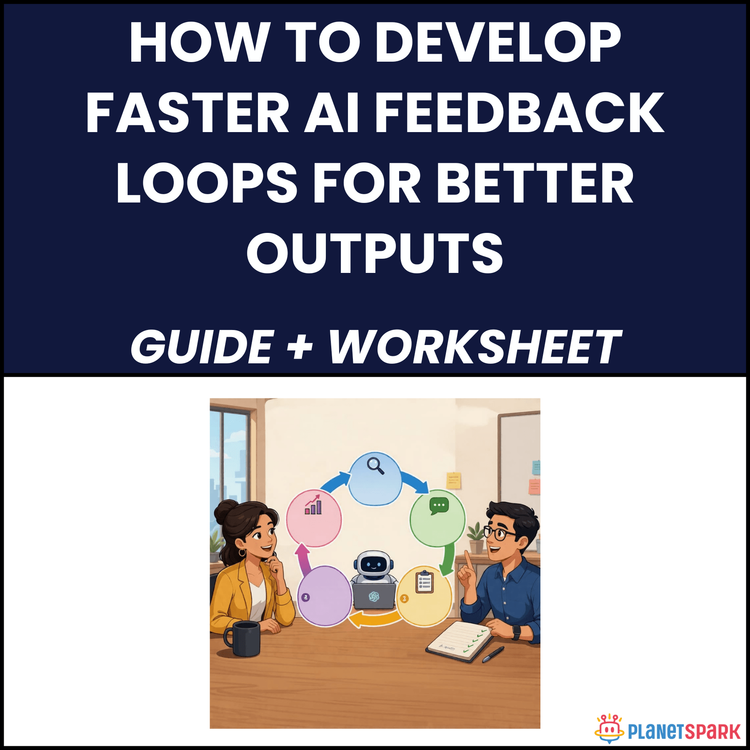
- The AI Feedback Loop framework: a cycle of input, output, evaluation, and refinement for every AI interaction
- A step-by-step process to define output standards before you prompt
- The CRAFT Framework: a structured approach to building effective prompts that get high-quality results quickly
- The 3-Lens Evaluation Method: a rapid evaluation technique to assess accuracy, alignment, and usability
- Targeted Refinement Prompts: how to make fast adjustments without starting from scratch
- Reflection and logging techniques to improve and track your AI learning process
Summary of the Resource
How to Develop Faster AI Feedback Loops for Better Outputs is a structured guide to mastering AI interactions. It walks you through how to evaluate and refine AI outputs systematically, saving time while increasing output quality. By adopting these frameworks, you can speed up your AI feedback loop, improving your results with every iteration.
How Will This Resource Be Useful?
This resource helps you:
- Speed up your AI feedback loop by establishing a clear structure for refining outputs
- Use the CRAFT framework to write more effective, precise prompts from the start
- Quickly identify where outputs need improvement with the 3-Lens Evaluation Method
- Write targeted refinement prompts to make fast adjustments and avoid redoing entire tasks
- Build your AI knowledge over time with reflection and logging techniques, creating a feedback loop for your learning
By applying this guide, you'll be able to work smarter and faster with AI, creating consistently high-quality outputs that meet your professional goals.
How Should You Use This Resource?
To maximize your results with this guide, follow these steps:
1. Define Output Standards: Before prompting, clarify your output’s format, tone, length, and success criteria. This will give you a clear target for your AI interactions (Page 4).
2. Build Prompts with CRAFT: Use the CRAFT Framework (Page 5) to create structured, specific prompts that will lead to more focused AI outputs.
3. Evaluate Outputs Using 3 Lenses: Quickly assess your AI output by checking for accuracy, alignment with your needs, and usability. Apply the 3-Lens Method (Page 7) after every output.
4. Refine with Precision: Write targeted follow-up prompts to adjust for specific issues, rather than rewriting from scratch. Use the refinement methods on Page 8.
5. Log and Learn: Keep track of what works in your AI Feedback Log (Page 9) and review your progress regularly to refine your prompting skills.
Action Steps:
To start developing faster AI feedback loops, take these immediate actions:
1. Define your output standard before prompting, using the checklist provided on Page 4.
2. Use the CRAFT framework to build a structured prompt for your next AI task (Page 5).
3. Evaluate your output using the 3-Lens Method (Page 7) and apply the necessary refinements.
4. Log your feedback and learnings from each session to track progress over time (Page 9).
5. Share your best-performing prompts with colleagues to create a shared library of successful AI interactions.
By following these steps, you’ll build an efficient AI feedback loop that saves time and improves output quality.