
How to Develop Faster Financial Learning Loops Through Reflection

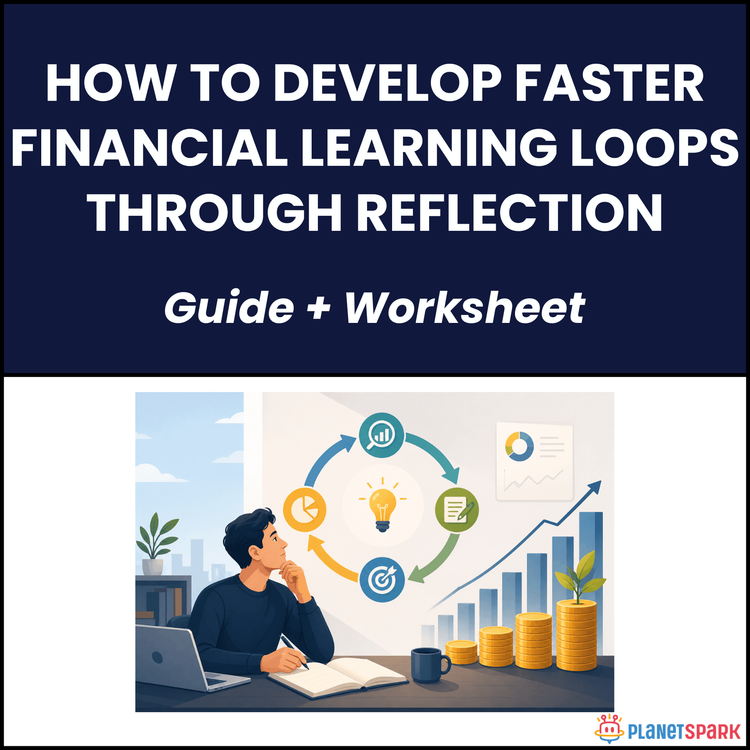
How to Develop Faster Financial Learning Loops Through Reflection
Build Financial Intelligence Faster: A Practical Guide to Financial Learning Loops (With Templates)
Most professionals don’t struggle because they lack financial knowledge.
They struggle because their learning doesn’t stick.
You read an article, attend a meeting, make a decision, maybe even learn from a mistake—but a few weeks later, nothing has fundamentally changed in how you think or decide financially.
This is where most careers plateau.
The real gap isn’t access to information. It’s the absence of a system to learn from experience consistently.
That’s exactly what this resource is designed to solve.
It introduces a structured way to build financial intelligence faster using reflection loops—so every decision, mistake, or insight compounds instead of fading away.
Who Is This Resource For?
This guide and template pack is especially useful for:
- Working professionals (0–15 years of experience) who want to improve financial decision-making
- Managers, consultants, and team leads handling budgets, pricing, or project costs
- Career switchers moving into roles with financial responsibility
- Professionals who feel they “understand finance” but struggle to apply it confidently
- Anyone who wants to move from reactive decision-making to structured financial thinking
You don’t need a finance background to use this. In fact, it’s most powerful for those building financial fluency from the ground up.
What Does This Resource Contain?
This is not just a guide—it’s a complete system built around 10 practical templates, each designed for a real-world financial scenario.
Here’s what you’ll find inside:
1. Post-Decision Financial Debrief
Reflect on major financial decisions and compare expectations vs outcomes
2. Monthly Financial Knowledge Audit
Track what you learned, what you didn’t understand, and what to focus on next
3. Budget Variance Reflection Log
Analyze why actual results differ from planned numbers
4. Financial Concept Stress-Test Worksheet
Apply new financial concepts in simulated real-world scenarios
5. Peer Financial Conversation Debrief
Capture insights from mentors, colleagues, or financial discussions
6. Project P&L Reflection Guide
Review project profitability and improve future assumptions
7. Financial Mistake Pattern Tracker
Identify recurring errors and systemic blind spots
8. Quarterly Financial Growth Review
Measure how your financial thinking has evolved over time
9. New Role Financial Onboarding Reflection
Build a structured financial learning plan in your first 90 days
10. Financial Reading Integration Worksheet
Turn passive reading into actionable financial insights
Each template is tied to a specific use case, making it immediately applicable—not theoretical.
Summary of the Resource
At its core, this resource helps you build a simple but powerful loop:
Experience → Reflect → Apply → Update
Instead of learning randomly, you:
- Capture what happened
- Analyze why it happened
- Update your thinking
- Apply it in the next decision
Over time, this creates compounding financial intelligence—not just more knowledge.
As highlighted in the resource, professionals who consistently run these loops can dramatically accelerate their financial skill development compared to relying on experience alone.
How Will This Resource Be Useful?
This resource directly improves how you think, decide, and act financially.
Here’s what you can expect:
- Better decision-making
You stop guessing and start making informed, structured choices
- Faster learning
Every mistake or success becomes a data point, not a one-off event
- Clear thinking under pressure
You develop mental models you can rely on in real scenarios
- Improved financial confidence
You understand not just “what happened” but “why it happened”
- Stronger professional growth
Financial intelligence becomes a competitive advantage across roles
Instead of repeating mistakes or relying on intuition, you build a repeatable system for improvement.
How Should You Use This Resource?
The power of this resource comes from consistent use—not one-time reading.
Here’s how to approach it:
Step 1: Start With Your Current Context
Pick a template that matches your most recent financial experience
(e.g., a decision, a budget issue, or a conversation)
Step 2: Fill It Completely
Don’t skip sections—especially:
- Assumptions
- Gaps
- Mental model updates
These are where real learning happens.
Step 3: Be Honest, Not Polished
This is a reflection tool, not a report. Write what’s true, not what sounds good.
Step 4: Build a Routine
Use templates at the right moments:
- After decisions
- At month-end
- After projects
- After learning something new
Step 5: Revisit Regularly
Go back to past reflections every quarter to identify patterns and growth
Consistency is what turns this from a worksheet into a system.
Action Steps
If you want to start immediately, follow this:
1. Identify one recent financial decision or mistake
2. Use the Post-Decision Debrief template to analyze it
3. Write down your original assumption vs actual outcome
4. Extract one clear learning in a single sentence
5. Define one action to apply this learning in your next decision
6. Schedule a monthly “Financial Reflection” block in your calendar
7. Commit to completing at least 3–5 reflection loops per month
This is enough to start seeing real improvement within 30–90 days.
Financial intelligence is not built by consuming more content.
It’s built by thinking better about your own experiences.
The professionals who grow fastest are not the ones who know the most—but the ones who learn deliberately from what they do.
This resource gives you that system.
Use it consistently, and over time, you’ll notice a shift—not just in your knowledge, but in how you approach every financial decision with clarity, structure, and confidence.