
How to Diagnose What Your Team Actually Needs From You

How to Diagnose What Your Team Actually Needs From You
Diagnose What Your Team Actually Needs From You: A Practical Guide for Managers and Team Leads
Most managers want to support their teams well. The challenge is that team needs are not always obvious.
A team member may say they need “more clarity,” when the real issue is lack of ownership. A high performer may seem unmotivated, when they are actually burned out or under-challenged. A new hire may appear slow, when they simply do not understand how decisions are made. A remote employee may seem disengaged, when they are isolated from informal communication.
This is why good management cannot rely on guesswork.
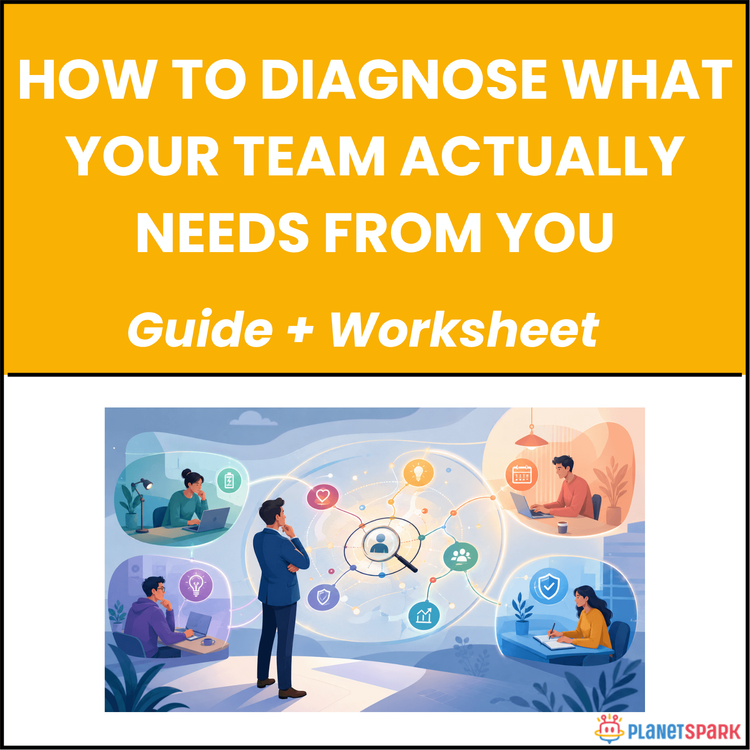
The “How to Diagnose What Your Team Actually Needs From You” guide and worksheet template pack is designed to help managers, team leads, consultants, and people-first professionals understand what is really happening inside their teams before taking action. Instead of reacting to symptoms, this resource gives you a structured way to observe, document, ask better questions, identify patterns, and respond with the right level of support.
It is especially useful for managers who want to lead with clarity, fairness, and evidence rather than assumptions.
Who Is This Resource For?
This resource is ideal for working professionals who manage, support, or influence teams and want to become more intentional in how they lead.
It is especially useful for:
- New managers stepping into a leadership role and trying to understand their team quickly
- Team leads managing direct reports, project teams, or cross-functional groups
- Managers with 0–15 years of professional experience who want practical leadership tools
- Consultants or people managers supporting teams through change, conflict, or uncertainty
- Professionals leading remote, hybrid, or distributed teams
- Managers dealing with disengagement, burnout, unclear ownership, or team friction
- Leaders preparing for 1:1s, quarterly reviews, performance conversations, or development discussions
This is not a theory-heavy management guide. It is a practical toolkit for real workplace situations where you need to understand what your team needs and decide what to do next.
What Does This Resource Contain?
The resource includes a premium guide and worksheet template pack built around ten real-world management scenarios. Each template is designed for a specific situation, so you can choose the tool that matches the challenge you are facing instead of using a generic form.
The pack includes:
1. New Leader Team Needs Audit
This template helps you build an evidence-based picture of your team within your first 30 days as a leader. It guides you to capture each team member’s role, energy level, stated support needs, observed support needs, likely blockers, and your first planned action.
This is useful when you are joining a new team and want to avoid making quick decisions based on incomplete information.
2. Disengaged High-Performer Diagnostic
This template is designed for situations where a previously strong contributor begins to withdraw, produce less, communicate less, or show reduced initiative.
It helps you identify possible root causes such as unmet growth needs, manager relationship friction, burnout, workload imbalance, or external personal factors. It also helps you prepare a thoughtful re-engagement conversation instead of jumping straight into performance management.
3. Quarterly Team Health Check
This template gives you a structured way to assess team health across four important dimensions: clarity, capacity, connection, and confidence.
It helps you review whether the team understands goals, has enough resources, feels psychologically safe, and has the skills and context needed to perform well. It also includes space to define the top three priority actions for the quarter.
4. Struggling New Hire Support Planner
This worksheet helps managers support a new hire who is not meeting expectations or appears overwhelmed.
It separates possible causes into skill gaps, context gaps, expectations gaps, and culture or fit gaps. It also includes a 30-day recovery plan with weekly focus areas, success markers, and check-in dates.
5. Cross-Functional Friction Mapper
This template helps you understand friction between your team and another team before escalating or intervening.
It maps delivery impact, morale impact, relationship impact, and unresolved risks. It also helps you compare what your team says, what the other team may be experiencing, and what the likely root cause might be.
6. Burnout Risk Identification Sheet
This worksheet helps managers identify signs of burnout before they become a crisis.
It includes risk signals such as consistently working beyond contracted hours, declining output quality, increased absenteeism, withdrawal from team interactions, emotional reactivity, and reduced communication. It also helps you analyze workload, unclear priorities, lack of recovery, recognition gaps, and autonomy issues.
7. Role Clarity Gap Assessment
This template is designed for situations where team members are confused about ownership, decision-making authority, responsibilities, or scope.
It includes a role clarity audit table where you can document unclear tasks, who thinks they own them, who should actually own them, what support is needed from others, and what resolution action will be taken.
8. Career Growth Needs Conversation Guide
This guide supports annual reviews, mid-year development conversations, and career-focused 1:1s.
It includes prompts to explore ambition, strengths, energy, skill gaps, exposure gaps, and the support a team member needs from their manager. It also includes a development agreement section so the conversation ends with clear actions and timelines.
9. Remote / Hybrid Team Isolation Checker
This template helps managers identify connection gaps, isolation risks, and communication friction in remote or hybrid teams.
It reviews team rituals, async communication norms, response expectations, camera norms, informal touchpoints, and whether team members feel out of the loop. It also includes reconnection actions such as structured check-ins, peer connection bridges, and infrastructure fixes.
10. Post-Conflict Team Reset Worksheet
This worksheet is designed for use after visible conflict, a breakdown in trust, or a significant interpersonal incident.
It guides managers through incident summary, team impact assessment, and a four-stage reset framework: acknowledge, rebuild safety, restate norms, and reinstate trust. It also includes a 30-day reset tracker to help the team move from disruption to recovery.
Summary of the Resource
At its core, this resource helps managers diagnose before they act.
Instead of assuming what a team member needs, you learn how to gather observations, identify the right scenario, run better conversations, document what you find, and turn insights into practical actions.
The resource is built around a clear leadership philosophy: observe before you act, understand before you decide, and ask before you tell.
It also includes a diagnostic mindset framework that helps managers evaluate team issues through four important lenses:
- Individual vs. systemic: Is this one person’s challenge or a wider team pattern?
- Stated vs. actual needs: What is the person asking for, and what does the evidence suggest they truly need?
- Urgent vs. important: Does this require immediate action or a more thoughtful intervention?
- Your role vs. organisational role: What can you change directly, and what requires escalation or structural support?
The result is a practical management toolkit that helps you move from vague concern to clear diagnosis and from reactive support to intentional leadership.
How Will This Resource Be Useful?
This guide is useful because it helps managers make better decisions with better information.
Many workplace problems are misdiagnosed. A missed deadline may be treated as a time management issue when the real problem is unclear priorities. A disengaged employee may be treated as unmotivated when the real issue is lack of growth. A team conflict may be treated as a personality clash when the root cause is unclear ownership or competing goals.
This resource helps prevent those mistakes.
It helps you understand your team more accurately
The templates encourage you to observe patterns, capture evidence, and compare stated needs with actual signals. This helps you avoid reacting only to the loudest voices or most visible problems.
It improves your 1:1 conversations
Instead of entering conversations with vague questions, you can use the templates to structure what you want to understand. This makes your conversations more focused, respectful, and useful.
It helps you identify root causes
The resource pushes you to look beyond surface-level symptoms. You can separate motivation issues from workload problems, individual gaps from systemic gaps, and short-term stress from deeper burnout risks.
It creates clearer action plans
Each template is designed to move from diagnosis to action. You are not just documenting problems; you are deciding what to do, who owns the next step, and when follow-up should happen.
It supports fairer management
When you use the same structured approach across team members, you reduce the risk of giving attention only to the most vocal people or making decisions based on personal bias.
It strengthens team trust
Teams notice when managers listen carefully, document consistently, and follow through. Using this resource can help you become more reliable, transparent, and thoughtful in how you support people.
It helps you build a long-term leadership practice
The resource includes a diagnostic log and quarterly reflection prompts, so you can track which templates you used, what you discovered, what actions you took, and what patterns emerged over time.
That makes this more than a one-time worksheet pack. It becomes a system for improving how you lead quarter after quarter.
How Should You Use This Resource?
The best way to use this resource is to match the template to the situation you are facing.
Do not treat the templates as general-purpose forms. Each one is designed for a specific management challenge, and the value comes from using the right tool at the right time.
Step 1: Identify the situation
Start by asking: What am I trying to understand?
Are you new to the team? Use the New Leader Team Needs Audit.
Is someone disengaged? Use the Disengaged High-Performer Diagnostic.
Is the whole team showing signs of stress or confusion? Use the Quarterly Team Health Check or Burnout Risk Identification Sheet.
Is there confusion around ownership? Use the Role Clarity Gap Assessment.
If you are unsure where to begin, start with the Quarterly Team Health Check because it gives you the broadest view of team health.
Step 2: Gather observations before speaking
Before you run a conversation or make a decision, write down what you have actually observed.
Look at patterns across meetings, deliverables, communication, energy levels, workload, missed handoffs, and team feedback. Try to separate facts from interpretations.
For example, “They have missed two deadlines in four weeks” is an observation. “They are not committed anymore” is an assumption.
Step 3: Use the template to structure the conversation
Some templates are designed for private manager reflection. Others are designed to support 1:1s, team discussions, or reset conversations.
Use the prompts to ask better questions. Listen carefully. Avoid rushing into advice or solutions too quickly.
The goal is not to prove your initial view correct. The goal is to understand what is really happening.
Step 4: Document what you find
Write down the key signals, root cause hypothesis, agreed actions, owners, and follow-up dates.
Documentation matters because team needs change over time. It also helps you stay accountable and prevents important details from being forgotten after the conversation ends.
Step 5: Act quickly but thoughtfully
Once you have diagnosed the need, choose one or two practical actions.
This might mean clarifying priorities, adjusting workload, creating a development plan, reconnecting an isolated team member, updating ownership agreements, or escalating a systemic issue.
The key is to act on what you learn, not just collect information.
Step 6: Revisit the template later
Team needs are not static. A team that feels clear this quarter may feel overloaded next quarter. A team member who needed skill support during onboarding may need growth opportunities six months later.
Revisit the relevant templates regularly, especially before 1:1s, quarterly reviews, team retrospectives, and major project transitions.
Action Steps
Use this resource as a practical leadership tool, not just a document to read once.
Here is what to do next:
1. Choose one current team situation that needs better diagnosis.
2. Match that situation to the most relevant template.
3. Complete the observation fields before taking action.
4. Run the conversation using the prompts provided.
5. Document the key finding and agreed next step.
6. Take one concrete action within the next 72 hours.
7. Add the situation to the diagnostic log.
8. Review your log monthly to identify patterns across your team.
9. Use the Quarterly Team Health Check at the start of each quarter.
10. Build the habit of opening one relevant template before important 1:1s.
The biggest benefit comes from consistency. One completed template can help you solve one problem. Regular use can help you become a more thoughtful, trusted, and effective manager.
Strong leadership is not about always having the answer immediately. It is about knowing how to ask the right questions, notice the right signals, and respond in a way that actually helps.
This guide gives you a practical structure for doing exactly that. It helps you slow down before reacting, understand before deciding, and support your team with greater clarity and confidence.
Start with one template. Use it in a real conversation. Review what you learn. Then keep going. Over time, this kind of diagnostic practice can change not only how you manage problems, but how your team experiences your leadership.