
How to Disagree with Powerful Stakeholders

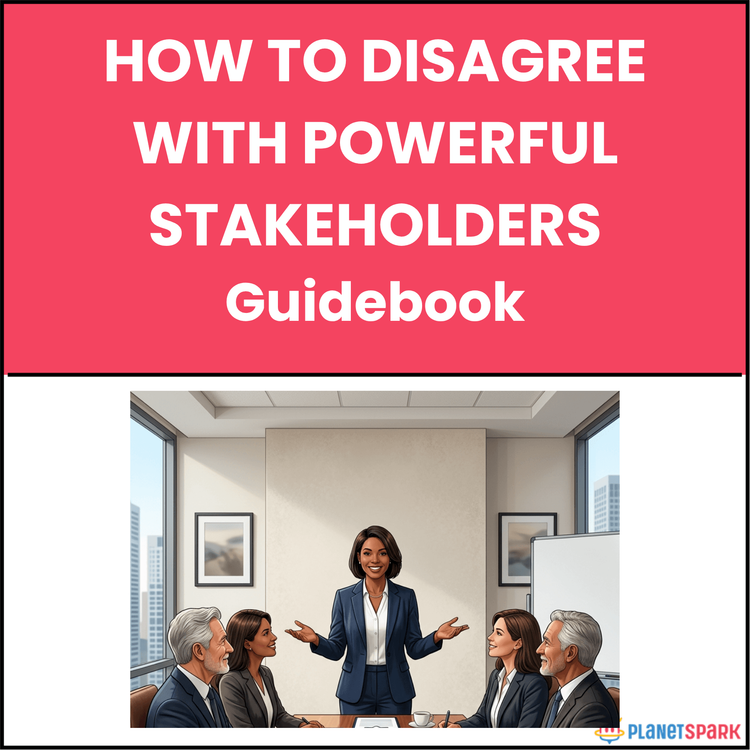
How to Disagree with Powerful Stakeholders
A Practical Guide to Constructively Disagreeing with Senior Stakeholders While Maintaining Strong Professional Relationships
You’ve been in that room before.
A decision is being made. You can clearly see the risks. The data doesn’t add up. Something feels off. But the person driving the decision is more senior, more influential, and more experienced.
So you stay quiet.
This is one of the most common—and costly—mistakes working professionals make. Not because they lack insight, but because they lack a structured way to speak up without damaging relationships or credibility.
That’s exactly why the resource “How to Disagree with Powerful Stakeholders” exists.
This guidebook is designed to help professionals challenge ideas, push back on decisions, and influence outcomes—without being seen as difficult, emotional, or confrontational. It gives you a practical, repeatable system to turn disagreement into a career-strengthening skill instead of a career risk.
Who Is This Resource For?
This resource is especially valuable if you are:
- A working professional with 0–15 years of experience navigating workplace dynamics
- A manager or individual contributor expected to influence decisions without authority
- A consultant or client-facing professional who needs to push back diplomatically
- A mid-career professional aiming to build credibility and strategic voice
- Someone who often spots problems early—but struggles to speak up effectively
- A professional who wants to avoid being seen as a “yes person” while still maintaining strong relationships
If you want to be heard, respected, and trusted in high-stakes conversations, this guide is built for you.
What Does This Resource Contain?
This is not a generic communication guide. It is a structured, real-world system designed for immediate application in professional environments.
Inside the resource, you’ll find:
- The 3-phase disagreement framework: Before, During, and After the conversation
- A pre-conversation preparation worksheet to clarify your thinking and strategy
- A structured communication model to express disagreement without triggering defensiveness
- Proven phrases that open dialogue—and phrases that damage credibility
- Practical techniques to handle pushback, dismissal, or resistance in real time
- An in-room checklist to assess how effectively you handled the conversation
- The DARE framework (Define, Acknowledge, Reframe, Explore) for structured disagreement
- A stakeholder power map to adapt your approach based on influence and openness
- Real-world case studies showing how professionals successfully challenged senior decisions
- Common mistakes that weaken your credibility when disagreeing
- A self-assessment tool to evaluate your current approach
- A quick-reference “pocket guide” for last-minute preparation
- A 30-day practice plan to build this skill through real situations
Everything is designed to help you move from hesitation to confident, structured communication.
Summary of the Resource
“How to Disagree with Powerful Stakeholders” is a practical guide that teaches you how to express disagreement in a way that strengthens your credibility rather than risks it.
It helps you prepare your thoughts, communicate with clarity, handle resistance professionally, and maintain strong relationships—while still standing your ground.
If you’ve ever felt stuck between staying silent and speaking up the wrong way, this resource gives you a clear, actionable path forward.
How Will This Resource Be Useful?
This resource helps you transform how you show up in critical professional moments.
You’ll gain:
- The confidence to speak up in high-stakes discussions
- A structured approach to expressing disagreement without conflict
- Stronger credibility with senior stakeholders and decision-makers
- The ability to influence outcomes, not just execute them
- Better control over difficult conversations and pushback
- A reputation as a thoughtful, strategic contributor—not just a doer
Most importantly, it helps you avoid the long-term “silence tax”—where staying quiet reduces your visibility, influence, and career growth. As highlighted in the guide, professionals who challenge ideas respectfully are often seen as more credible and impactful.
How Should You Use This Resource?
To get the best results, follow a structured approach:
First, read the entire guide once to understand the full framework and flow. This builds context and helps you see how all the pieces connect.
Next, apply the “Before” phase immediately. Use the worksheet to prepare for a real upcoming conversation. Clarify your position, understand the other perspective, and gather your evidence.
Then, focus on the “During” phase. Practice using the recommended language and structure—acknowledging first, introducing your perspective, supporting it with evidence, and proposing alternatives.
After the conversation, apply the “After” phase. Follow up, reinforce the relationship, and build long-term credibility through consistency.
Finally, use the 30-day practice plan to build this skill deliberately. Identify real situations, practice with peers, execute conversations, and reflect on your performance.
This is not a one-time read—it’s a repeatable system you can use throughout your career.
Action Steps
After accessing this resource, take these steps immediately:
1. Identify one real conversation you’ve been avoiding
2. Use the pre-conversation worksheet to clarify your position
3. Write your disagreement in one clear, evidence-backed sentence
4. Prepare at least one alternative solution—not just the problem
5. Practice your phrasing using the recommended language patterns
6. Schedule or initiate the conversation with the right timing
7. Follow up within 24 hours to reinforce credibility and alignment
Small, intentional actions here can significantly improve how you are perceived in your workplace.
Your ability to disagree thoughtfully is one of the most underrated career skills. It’s not about being right—it’s about contributing to better decisions while building trust.
When you learn to challenge ideas without challenging people, you position yourself as someone leaders want in the room—especially when the stakes are high.
Use this resource not just to handle one conversation, but to build a long-term reputation as a professional who speaks with clarity, courage, and credibility.
Book your free session today!