
How to Evaluate Long-Term vs Short-Term Decision Impacts

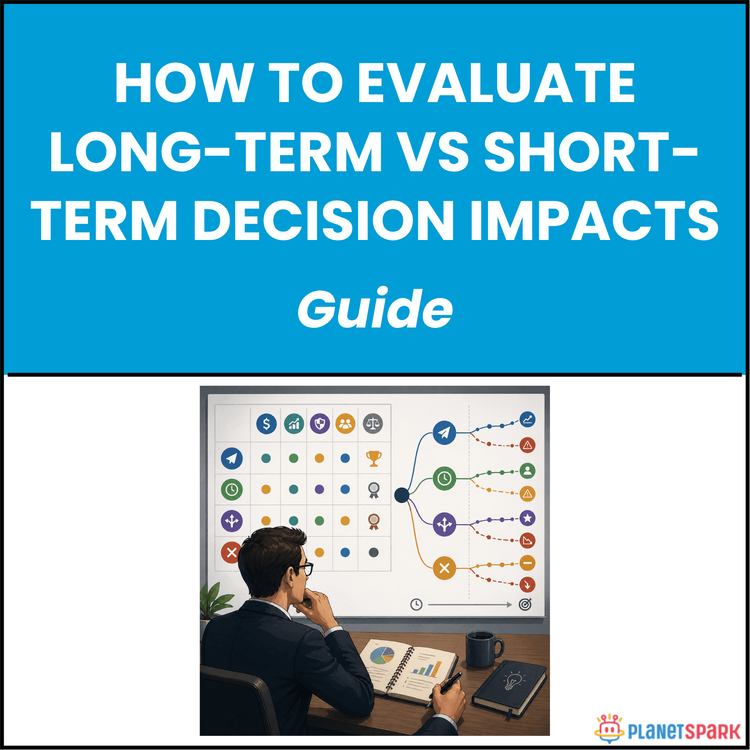
How to Evaluate Long-Term vs Short-Term Decision Impacts
How to Evaluate Long-Term vs Short-Term Decision Impacts: A Practical Guide for Smarter Career and Business Decisions
If you’ve ever felt stuck between choosing what’s immediately rewarding and what’s strategically better—you’re not alone.
Every working professional constantly faces decisions like:
Should I take the higher salary now or invest in long-term growth?
Should I prioritise quick wins or build something sustainable?
Should I act fast—or think deeper?
The challenge is not a lack of intelligence or experience. It’s the absence of a structured way to evaluate decisions across time.
That’s exactly why the resource “How to Evaluate Long-Term vs Short-Term Decision Impacts” exists. It gives you a clear, practical framework to make decisions that balance immediate outcomes with long-term success—without overthinking or second-guessing.
Instead of relying on instinct, you start using a system.
Who Is This Resource For?
This resource is especially valuable if you are:- A working professional with 0–15 years of experience
- A manager or consultant making high-stakes decisions regularly
- A job seeker or career switcher evaluating multiple opportunities
- A founder or business professional balancing short-term results with long-term strategy
- Someone who often feels uncertain, rushed, or conflicted while making decisions
- A professional who wants to think more clearly under pressure
If you want to stop second-guessing your choices and start making confident decisions, this guide is built for you.
What Does This Resource Contain?
This is not a theoretical guide—it is a complete decision-making system.
Inside the resource, you’ll find:
- A clear explanation of why most professionals struggle with short-term vs long-term thinking (page 2)
- The concept of “present bias” and how it affects decision quality (page 3)
- The Dual-Horizon Decision Framework—a 2×2 model to evaluate decisions across time (page 4)
As shown in the framework diagram on page 4, decisions are categorised into four types:
- Quick Wins (high short-term, low long-term)
- Strategic Investments (high on both)
- Long-Term Plays (low short-term, high long-term)
- Low-Value Decisions (low on both)
- A structured 6-step decision-making process (pages 5–10), including:
1. Clarifying the decision
2. Mapping consequences (short-term and long-term)
3. Assigning weights based on priorities
4. Applying the SCOPE Test
5. Stress-testing assumptions
6. Making the decision confidently
- The SCOPE Test (page 8), covering:
- Sustainability
- Compounding
- Opportunity Cost
- Path Dependency
- Externalities
- Practical tools and worksheets (pages 11–14), including:
- Decision Evaluation Worksheet
- Dual-Horizon Checklist
- Priority Weighting Template
- Reflection Questions
- A real-world case study (page 15) demonstrating how structured thinking leads to better outcomes
- Common decision-making mistakes and how to fix them (page 16)
- The Time-Horizon Matrix for quick decision categorisation (page 17)
- Cognitive biases like present bias, sunk cost fallacy, and confirmation bias (page 20)
Everything is designed for real-world application—not passive reading.
Summary of the Resource
“How to Evaluate Long-Term vs Short-Term Decision Impacts” is a practical decision-making playbook for professionals.
It helps you:
- Evaluate decisions using both immediate and future lenses
- Avoid common thinking traps and biases
- Structure complex choices into clear frameworks
- Make faster, more confident decisions
- Balance action with strategic thinking
If you want to improve the quality of your decisions—not just the speed—this resource gives you the system.
How Will This Resource Be Useful?
This resource helps you move from reactive thinking to structured decision-making.
You’ll gain:
- Clarity on what truly matters in each decision
- Confidence in balancing short-term gains and long-term impact
- A repeatable framework you can use across career and business decisions
- Better judgment under pressure
- Reduced overthinking and decision fatigue
- Stronger long-term career and strategic outcomes
As explained in the introduction (page 2), poor decision-making often comes from relying on instinct instead of structured evaluation—this guide replaces that with a clear system.
Most importantly, it helps you make decisions you won’t regret later.
How Should You Use This Resource?
To get the best results, follow a structured approach:
Start with understanding:
- Read the introduction and framework sections (pages 2–4)
- Understand the concept of dual-horizon thinking
Then apply the framework:
- Use the 6-step process for a real decision you’re facing
- Write down your decision statement clearly
Map consequences:
- Identify short-term and long-term outcomes
- Use second- and third-order thinking (“And then what?”)
Apply tools:
- Use the SCOPE Test to evaluate trade-offs
- Complete the Decision Evaluation Worksheet (page 11)
Stress-test your thinking:
- Run a Pre-Mortem analysis
- Challenge your assumptions
Finally:
- Make the decision using the 70% rule
- Set review checkpoints
As highlighted on page 19, clarity and action matter more than waiting for perfect certainty.
Action Steps
After accessing this resource, take these steps immediately:
1. Identify one important decision you are currently facing
2. Write a clear decision statement
3. Define your short-term and long-term horizons
4. List first, second, and third-order consequences
5. Apply the SCOPE Test to evaluate trade-offs
6. Make a decision and set a review checkpoint
Even one structured decision can significantly improve your thinking.
The difference between average and exceptional professionals is not just intelligence—it’s decision quality.
When you learn to evaluate both short-term outcomes and long-term consequences together, your choices become sharper, more aligned, and more effective.
This is not just a framework—it’s a skill that compounds over time.
Book your free session today!