
How to Guide Team Decisions Without Controlling Outcomes

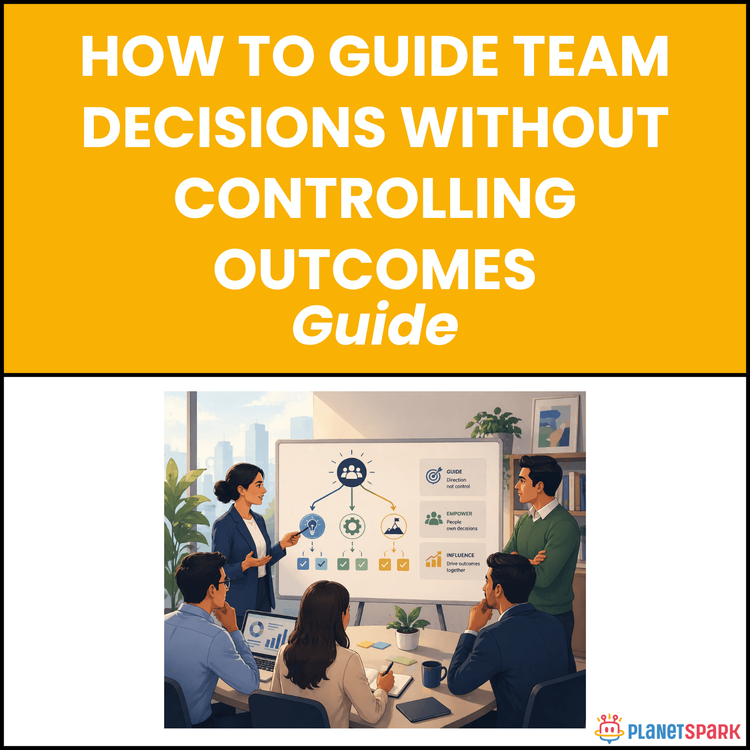
How to Guide Team Decisions Without Controlling Outcomes
Guiding Team Decisions Without Controlling Them: A Practical Playbook
If you’ve ever walked out of a meeting thinking, “We made a decision—but it doesn’t feel right,” you’re not alone.
Maybe the discussion dragged on without clarity. Maybe you stepped in and made the call just to move things forward. Or worse, the team agreed in the room—but didn’t follow through after.
This is one of the most common leadership challenges professionals face: how to guide decisions without taking over.
Because while stepping in may create speed, it often comes at a hidden cost—reduced ownership, weaker thinking, and teams that slowly become dependent on you.
That’s exactly why the resource “How to Guide Team Decisions Without Controlling Outcomes” exists. It’s a practical, real-world playbook that helps you shift from being the person who makes decisions—to the person who builds teams that make better decisions themselves.
Who Is This Resource For?
This resource is especially valuable if you are:
- A working professional with 0–15 years of experience stepping into leadership moments
- A manager or team lead struggling with team dependency or low ownership
- A consultant facilitating discussions, workshops, or client decisions
- A mid-career professional transitioning from “doer” to “multiplier”
- A professional who often feels the urge to step in and “fix” decisions
- Someone who wants to build stronger, more independent teams
If you want to lead through influence—not authority—this guide is built for you.
What Does This Resource Contain?
This is not a traditional leadership theory guide. It’s a structured, actionable system you can apply immediately in meetings and decision-making situations.
Inside the resource, you’ll find:
- A deep breakdown of the “Control Trap” and why even capable leaders overstep
- The GUIDE Framework (Ground, Unlock, Illuminate, Drive, Embed) for facilitative leadership
- Step-by-step techniques for each stage of team decision-making
- Problem framing tools to ensure teams solve the right problem—not just the obvious one
- Practical methods to unlock quieter voices and improve participation
- Trade-off mapping templates to clarify decision criteria
- Decision-making methods (consensus, consent, leader decides) with clear use cases
- The “One-Sentence Decision” rule to ensure clarity and alignment
- A 10-minute decision debrief protocol to build team capability over time
- A powerful question bank with 30 ready-to-use facilitative questions
- Pre-meeting, during-meeting, and post-meeting checklists
- The Influence Spectrum to calibrate when to step in vs step back
- A real-world case study showing transformation in team decision-making
- Common facilitation mistakes—and how to fix them
- A self-evaluation tool to track leadership growth
- A 30-day facilitative leadership sprint for habit-building
Everything is designed for immediate application—not passive reading.
Summary of the Resource
“How to Guide Team Decisions Without Controlling Outcomes” is a practical leadership playbook that helps you move from directive decision-making to facilitative leadership.
It teaches you how to shape thinking without imposing answers, create space for better discussions, and ensure decisions are owned—not just agreed upon.
If you invest a few focused hours in this resource, you’ll gain tools that immediately improve how your team thinks, decides, and executes.
How Will This Resource Be Useful?
This resource helps you move from control to influence.
You’ll gain:
- The ability to guide decisions without taking over
- Strong facilitation skills that improve team thinking quality
- Higher team ownership and accountability
- Better decision outcomes through diverse input
- Reduced dependency on you as the decision-maker
- Stronger leadership presence and long-term credibility
Most importantly, it helps you build a team that doesn’t just follow decisions—but believes in them and executes them effectively.
How Should You Use This Resource?
To get the best results, follow a structured approach:
Start by reading the guide fully to understand the GUIDE framework and the philosophy behind facilitative leadership.
Next, apply one principle at a time. For example, begin with problem grounding in your next meeting before trying to implement everything at once.
Use the question bank actively. Replace your instinct to give answers with structured questions that guide thinking.
Apply the checklists before, during, and after meetings. These are your execution tools—not optional extras.
Experiment with different decision methods depending on the situation. Not every decision needs the same approach.
Use the self-evaluation tool weekly to track progress and identify improvement areas.
Finally, follow the 30-day sprint to turn these behaviours into consistent habits.
You can revisit this resource whenever you:
- Lead team discussions or decision-making meetings
- Notice low engagement or ownership in your team
- Feel the urge to step in and “control” outcomes
- Want to build stronger leadership capability over time
Action Steps
After accessing this resource, take these steps immediately:
1. Identify one upcoming team decision where you usually take control
2. Start the meeting by grounding the problem using 2–3 key questions
3. Use silent writing or round-robin to gather input from everyone
4. Map at least two options with clear trade-offs
5. Close with a one-sentence decision and assign a clear owner
6. Run a short debrief to reflect on the decision process
Small changes in how you run one meeting can transform how your team operates.
Great leadership is not about always having the right answer. It’s about creating the conditions where better answers emerge from the team.
When you guide instead of control, you don’t just improve decisions—you build confidence, ownership, and long-term capability in the people around you.
Use this resource not just to run better meetings, but to become the kind of leader who multiplies thinking, not just directs it.
Book your free session today!