
How to Handle Difficult Conversations Professionally

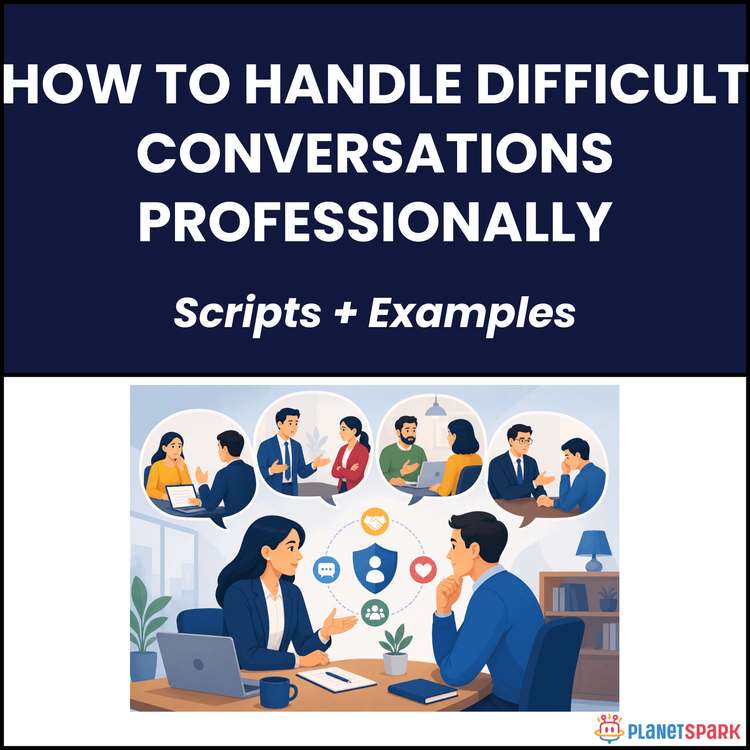
How to Handle Difficult Conversations Professionally
Handle Difficult Conversations at Work: 10 Proven Scripts for High-Stakes Professional Situations
Difficult conversations are part of every professional’s career—but very few people are ever taught how to handle them.
Whether it’s pushing back on a low salary offer, addressing an underperforming team member, or confronting a colleague who’s taken credit for your work, these moments are high-stakes. Handle them poorly, and you risk damaging relationships, credibility, and future opportunities.
So what do most professionals do? They avoid the conversation, delay it, or go in unprepared.
That’s exactly where this resource comes in.
The “How to Handle Difficult Conversations Professionally” toolkit gives you structured, ready-to-use scripts for real workplace scenarios—so you don’t have to guess what to say when it matters most.
Who Is This Resource For?
This resource is designed for professionals across roles and career stages who regularly navigate complex interpersonal situations:
- Job seekers negotiating offers or navigating hiring conversations
- Managers handling performance issues or delivering difficult decisions
- Freelancers and consultants dealing with clients, payments, or scope boundaries
- Mid-level professionals managing peer conflicts and workplace dynamics
- Anyone who wants to communicate assertively without sounding aggressive
If you’ve ever thought, “I know what I want to say, but I don’t know how to say it”—this resource is built for you.
What Does This Resource Contain?
This toolkit includes 10 scenario-specific conversation scripts, each designed for a high-stakes workplace situation.
Here’s a breakdown of what you’ll get:
1. Salary Negotiation Push-Back Script
Helps you counter low offers confidently without risking the opportunity.
2. Underperforming Team Member Script
Guides managers through structured performance conversations.
3. Overdue Invoice Client Script
Helps freelancers escalate payment issues professionally.
4. Scope Creep Boundary Script
Set clear boundaries when work expands beyond agreed terms.
5. Toxic Colleague Confrontation Script
Address difficult peer behavior before escalating.
6. Resignation Conversation Script
Exit professionally while managing emotional reactions.
7. Performance Review Disagreement Script
Challenge unfair evaluations with evidence and clarity.
8. Unreasonable Deadline Pushback Script
Push back constructively while offering solutions.
9. Credit-Stealing Colleague Script
Reclaim recognition without escalating conflict unnecessarily.
10. Layoff Notification Script
Help managers deliver difficult news with clarity and empathy.
Each script includes:
- Exact phrasing you can use in real conversations
- Structured flow (opening, context, response, close)
- Fill-in placeholders for personalization
- Practical tips to handle pushback
Summary of the Resource
This isn’t a theory-heavy communication guide—it’s a practical script library.
Instead of wondering how to phrase difficult conversations, you get:
- Ready-made language for real scenarios
- Clear structure to keep conversations focused
- A repeatable approach that works across situations
At its core, the resource follows a simple but powerful communication structure:
Acknowledge → Describe → Impact → Request → Commit
(as outlined in the summary on page 14)
This ensures every conversation stays professional, clear, and outcome-driven.
How Will This Resource Be Useful?
This toolkit directly improves your ability to handle high-pressure conversations with confidence.
Here’s what changes when you start using it:
You stop avoiding difficult conversations
Clear scripts reduce anxiety and help you take action sooner.
You communicate with confidence
Instead of overthinking, you rely on proven language that works.
You protect relationships while being assertive
The scripts are designed to be direct without being aggressive.
You reduce emotional reactions
Having a structure keeps conversations grounded in facts and outcomes.
You improve professional credibility
Clear, composed communication signals leadership—regardless of your role.
As highlighted in the resource introduction, poor handling of difficult conversations can lead to damaged relationships, missed opportunities, and even reputational risk.
This toolkit helps you avoid exactly that.
How Should You Use This Resource?
To get the most value, treat this toolkit as a preparation and execution guide—not just something to read once.
Here’s how to use it effectively:
Step 1: Identify Your Scenario
Before any conversation, clearly define what situation you’re dealing with.
Step 2: Select the Relevant Script
Choose the template that matches your exact use case.
Step 3: Customize the Script
Fill in placeholders with your context—names, dates, examples, outcomes.
Step 4: Rehearse Once
Read the script aloud or mentally practice it to build confidence.
Step 5: Use It During the Conversation
You can refer to the structure in real-time if needed.
Step 6: Follow Up in Writing
After the conversation, document key points to ensure clarity and accountability.
The resource also emphasizes preparation: clarify your outcome, gather facts, choose the right setting, and plan for pushback before initiating the conversation.
Action Steps
If you want to start handling difficult conversations more effectively, here’s what to do today:
1. Open the toolkit and scan all 10 scenarios
2. Identify 1–2 situations you’re currently facing
3. Pick the relevant script and customize it
4. Schedule or initiate the conversation
5. Use the script to guide your structure and tone
6. Send a follow-up summary after the discussion
Even using one script can significantly improve how your message is received.
Difficult conversations don’t get easier with experience alone—they get easier with preparation and structure.
The professionals who handle these situations well are not more confident by default—they are better prepared.
This resource gives you that preparation.
Instead of avoiding uncomfortable conversations or handling them reactively, you now have a clear, repeatable way to approach them with professionalism, clarity, and control.
Because in your career, what you say—and how you say it—often matters more than what you know.