
How to Identify Emotional Manipulation in Professional Settings

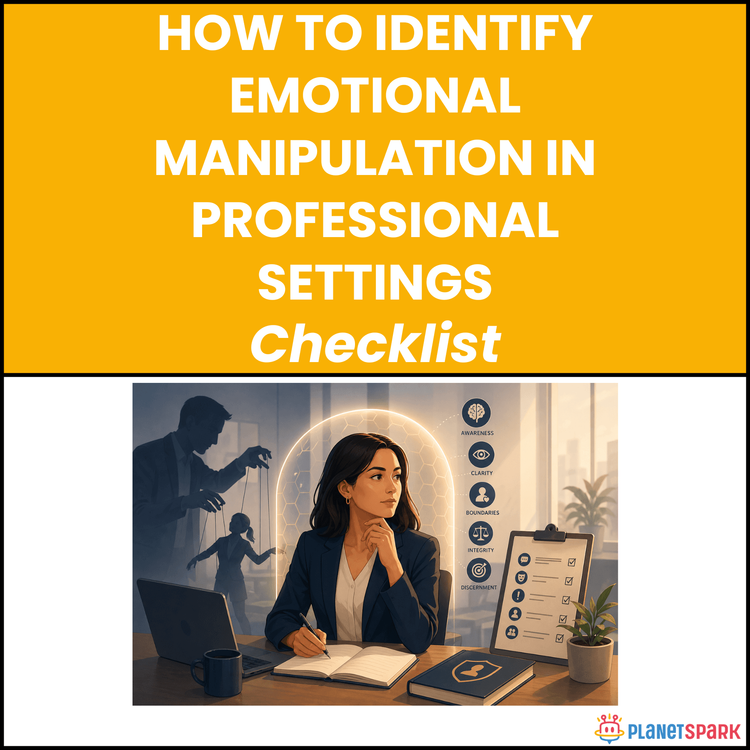
How to Identify Emotional Manipulation in Professional Settings
How to Identify Emotional Manipulation at Work: A Practical Guide to Protect Your Boundaries and Confidence
If you’ve ever walked out of a professional interaction feeling confused, second-guessing yourself, or wondering “Was that my fault?”—you’re not imagining things. Many working professionals experience moments where something feels off, but they can’t clearly explain why.
That’s the challenge with emotional manipulation in the workplace—it’s subtle, often disguised as feedback or high standards, and difficult to name when you’re in the middle of it.
That’s exactly why the resource “How to Identify Emotional Manipulation in Professional Settings” exists. It gives you a clear, structured way to recognise manipulation patterns, separate them from normal workplace challenges, and respond with clarity instead of self-doubt.
Who Is This Resource For?
This resource is especially valuable if you are:
- A working professional with 0–15 years of experience
- A job seeker or early-career professional navigating complex workplace dynamics
- A consultant or client-facing professional dealing with high-pressure relationships
- A manager trying to distinguish between performance issues and unhealthy dynamics
- Someone who often feels confused, drained, or self-critical after certain interactions
- A professional who wants to build stronger boundaries without damaging relationships
If you’ve ever struggled to tell the difference between tough feedback and something more problematic, this guide is built for you.
What Does This Resource Contain?
This is not a theoretical psychology guide—it’s a practical checklist and decision-making tool designed for real workplace situations.
Inside the resource, you’ll find:
- A clear explanation of why emotional manipulation is difficult to recognise in professional settings
- A breakdown of the hidden costs of manipulation, including self-doubt and reduced confidence
- The RADAR framework to identify manipulation across five key dimensions
- Detailed indicators of reality distortion, where your perception is repeatedly questioned
- A framework to identify asymmetric accountability and double standards
- Insights into dependency engineering, where your autonomy is subtly reduced
- Affective cycling patterns that create emotional instability in professional relationships
- Signs of reputation targeting that can impact your credibility with others
- A scoring system to assess the likelihood of a manipulative dynamic
- A structured reflection worksheet to analyse difficult interactions objectively
- A comparison guide to distinguish high standards from manipulation
- A real-world case example showing how professionals can respond strategically
- Common mistakes professionals make—and how to avoid them
- Clear, actionable takeaways to protect yourself without unnecessary confrontation
Everything is designed to help you move from confusion to clarity in real time.
Summary of the Resource
“How to Identify Emotional Manipulation in Professional Settings” is a practical, checklist-driven guide that helps professionals recognise subtle manipulation patterns and respond strategically.
It gives you the language, frameworks, and tools to evaluate workplace interactions objectively—so you can protect your confidence, make better decisions, and navigate complex dynamics with control.
If you’ve ever felt unsure about whether something is “just feedback” or something more concerning, this resource provides the clarity you need.
How Will This Resource Be Useful?
This resource helps you move from self-doubt to self-awareness.
You’ll gain:
- The ability to identify manipulation patterns early—before they escalate
- Clear language to describe and understand difficult workplace dynamics
- Reduced tendency to blame yourself for confusing interactions
- Stronger professional boundaries without unnecessary conflict
- Better decision-making in high-pressure or ambiguous situations
- Increased confidence in your instincts and judgments
- A structured way to analyse interactions instead of reacting emotionally
Most importantly, it helps you stop internalising every difficult experience—and start evaluating situations objectively.
How Should You Use This Resource?
To get the best results, use this resource as both a real-time and reflective tool:
Start by reading the entire guide once to understand the key concepts—especially the RADAR framework.
Next, apply the checklist to one current or recent professional relationship. Don’t overthink—just observe patterns honestly.
Use the reflection worksheet immediately after any interaction that leaves you feeling confused or unsettled. This helps you move from emotion to analysis.
Compare your experience against the “high standards vs manipulation” table to avoid misinterpretation.
If you notice repeated patterns, begin documenting interactions privately. This builds clarity over time and reduces reliance on memory.
Finally, focus on strategic response—not immediate confrontation. Build your awareness, strengthen your network, and act thoughtfully.
This resource is most powerful when used consistently, not just once.
Action Steps
After accessing this resource, take these steps immediately:
1. Identify one recent interaction that left you feeling confused or uncomfortable
2. Apply the RADAR framework to assess that situation
3. Complete Part A of the reflection worksheet within 24 hours
4. Note any recurring patterns across past interactions
5. Start a private log to document future interactions objectively
6. Identify one trusted colleague or mentor you can discuss patterns with
Small steps here can significantly improve your clarity and confidence.
Emotional manipulation thrives in ambiguity. The moment you can name what’s happening, you begin to regain control.
This isn’t about becoming suspicious of everyone—it’s about becoming more aware, more grounded, and more intentional in how you navigate professional relationships.
Use this resource to sharpen your instincts, protect your boundaries, and strengthen your confidence. Because the most effective professionals are not just skilled at their work—they are also clear about the environments they operate in and how they choose to respond.