
How To Identify Social Exclusion Dynamics At Work

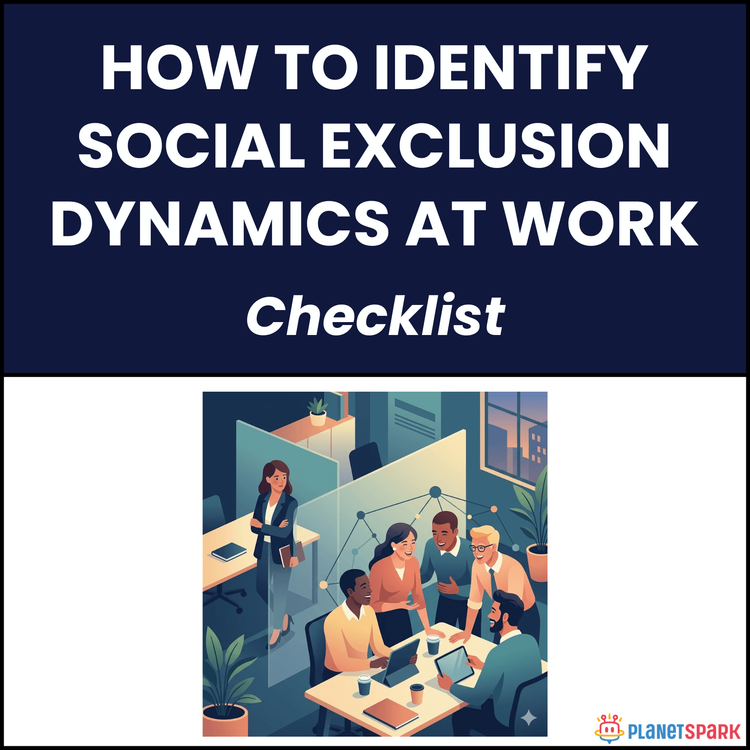
How To Identify Social Exclusion Dynamics At Work
Identifying Social Exclusion at Work: A Practical Guide to Recognising Hidden Patterns and Building Inclusive Teams
Not all workplace problems are visible.
Sometimes, it’s not what is said — it’s what is missing.
The meeting invite you didn’t receive. The idea you shared that was later credited to someone else. The informal conversations you’re never part of. Nothing is openly wrong, but something feels off.
This is how social exclusion operates at work — quietly, subtly, and consistently.
The resource “How to Identify Social Exclusion Dynamics at Work” helps you recognise these patterns with clarity. As explained in the introduction (page 2), exclusion often exists in small, repeated behaviours that are easy to overlook but significant over time.
Who Is This Resource For?
This resource is designed for:
- Working professionals who feel overlooked or disconnected
- Individuals new to teams or transitioning roles
- Managers who want to build inclusive team environments
- Consultants analysing team culture and dynamics
- Professionals who sense something is wrong but cannot clearly define it
If you’ve ever questioned whether you’re being excluded or just overthinking, this guide provides clarity.
What Does This Resource Contain?
This is a practical checklist-based guide focused on awareness and identification. It includes:
- A clear explanation of how social exclusion works in professional environments
- Real examples of subtle exclusion behaviours (page 2):
- Missing meeting invites
- Unequal feedback
- Credit misattribution
- Informal group dynamics
- A structured framework divided into three levels:
- Awareness (recognising patterns)
- Application (evaluating situations)
- Mastery (addressing and improving dynamics)
- A checklist to assess whether exclusion is occurring
- Tools to differentiate between perception and pattern
- Guidance for both individuals and managers
- Practical language to describe and raise concerns constructively
Summary of the Resource
This guide helps you move from confusion to clarity.
Instead of wondering “Is this just me?”, you learn how to:
- Identify patterns objectively
- Understand what is actually happening
- Name the issue with confidence
The result is better awareness, clearer communication, and stronger workplace dynamics.
How Will This Resource Be Useful?
This resource gives you a practical way to understand and navigate workplace dynamics.
You will be able to:
- Recognise exclusion patterns early
- Avoid second-guessing your own experience
- Understand team dynamics more clearly
- Address issues with confidence and clarity
- Support more inclusive and fair environments
- Improve your own awareness as a manager or team member
As highlighted on page 2, exclusion is rarely obvious — but it follows patterns. This guide helps you see those patterns.
How Should You Use This Resource?
To get maximum value, use it as a diagnostic tool.
Step 1: Build Awareness
Read through common exclusion patterns and reflect on your own experience.
Step 2: Observe Consistently
Look for repeated behaviours — not isolated incidents.
Step 3: Use the Checklist
Evaluate whether multiple indicators are present.
Step 4: Validate Your Observations
Check patterns over time rather than reacting immediately.
Step 5: Prepare to Address
Use clear, neutral language when raising concerns.
Step 6: Apply as a Manager
Audit your team’s behaviour and interactions regularly.
Action Steps
Start immediately:
- Think of one situation that felt exclusionary
- Write down what exactly happened
- Identify if it is part of a repeated pattern
- Compare it with examples from the guide
- Note how it impacted your work or confidence
- Decide one step — observe, address, or seek clarity
- Track similar situations over the next week
Social exclusion is powerful because it is subtle.
But once you learn to recognise it, you gain clarity — and clarity gives you control.
You stop questioning yourself and start understanding the system you are operating in.
That shift changes how you navigate your workplace.