
How to Increase Decision Clarity in Ambiguous Situations

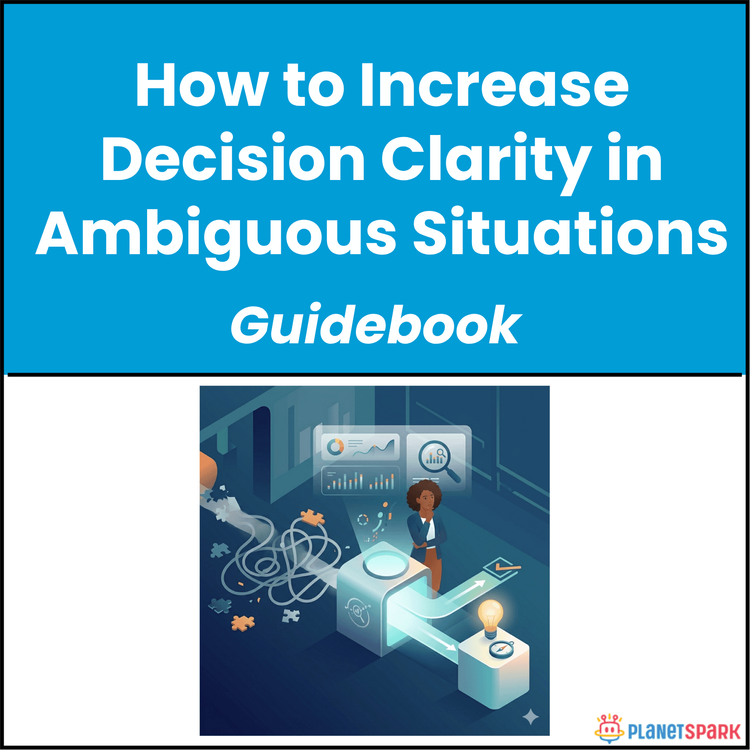
How to Increase Decision Clarity in Ambiguous Situations
How to Increase Decision Clarity in Ambiguous Situations: A Practical Framework to Make Confident Decisions Without Complete Information
Every professional reaches a point where the path isn’t clear. You don’t have complete data. Stakeholders have conflicting opinions. The stakes are high—and waiting for clarity only delays progress. So you hesitate, overthink, or keep gathering information that never feels “enough.”
This is the reality of modern work: ambiguity is not the exception—it’s the norm.
And yet, most professionals were never taught how to make decisions in these conditions.
That’s exactly why the resource “How to Increase Decision Clarity in Ambiguous Situations” exists. It’s a structured, practical guide that helps you cut through uncertainty, think clearly, and act decisively—even when you don’t have all the answers.
Instead of relying on instinct or endless analysis, this guide gives you a repeatable system you can apply immediately.
Who Is This Resource For?
This resource is especially valuable if you are:
- A working professional with 0–15 years of experience
- Someone who struggles with indecision or second-guessing
- A manager or consultant handling complex, uncertain situations
- A professional dealing with multiple stakeholders and unclear ownership
- A career switcher navigating imperfect or high-risk choices
- Anyone who wants to make faster, clearer, and more confident decisions
If you often feel stuck between options or overwhelmed by uncertainty, this guide is built for you.
What Does This Resource Contain?
This is not a generic decision-making guide. It’s a complete, step-by-step system designed specifically for ambiguous situations.
Inside the resource, you’ll find:
- A clear breakdown of why ambiguity causes decision paralysis—and how to overcome it
- The 4 Types of Ambiguity:
- Information ambiguity (missing data)
- Option ambiguity (too many choices)
- Stakeholder ambiguity (misalignment or unclear ownership)
- Outcome ambiguity (unclear success criteria)
- A structured 5-step Decision Clarity Framework:
- Diagnose the situation using a Clarity Audit
- Reduce noise by identifying Minimum Viable Information (MVI)
- Generate structured options using the Rule of Three
- Align stakeholders using RACI and alignment briefs
- Commit and communicate decisions with clarity
- The Clarity Audit tool (know, assume, need, decide) to separate facts from assumptions
- An Assumption Mapping Worksheet to identify hidden decision drivers
- The MVI concept to avoid over-research and analysis paralysis
- A Decision Matrix to evaluate options objectively
- The Rule of Three to avoid false binary thinking
- A stakeholder alignment system using RACI (Responsible, Accountable, Consulted, Informed)
- A 1-page Alignment Brief template to simplify decision communication
- A Decision Clarity Checklist to validate decisions before acting
- A Decision Debrief Worksheet to learn from outcomes
- A real-world case study demonstrating the framework in action
- A 7-day action plan to build decision clarity as a habit
Everything is designed for real-world application—not theoretical understanding.
Summary of the Resource
“How to Increase Decision Clarity in Ambiguous Situations” is a practical system that helps you move from confusion to confident action.
It teaches you how to diagnose the type of ambiguity you’re facing, apply the right tools, evaluate options systematically, and commit to a decision—even when certainty isn’t possible.
Instead of waiting for perfect information, you learn how to act with clarity based on what you know—and what matters most.
If you want to become someone who makes strong decisions under pressure, this resource gives you a clear, repeatable path.
How Will This Resource Be Useful?
This guide helps you shift from hesitation to decisive action.
You’ll gain:
- A clear mental model for handling ambiguity in any situation
- The ability to separate facts, assumptions, and unknowns
- Faster decision-making without over-researching
- Structured thinking when options feel overwhelming
- Confidence in communicating decisions clearly
- Improved stakeholder alignment and reduced confusion
- A repeatable system you can apply across roles and industries
Most importantly, it helps you stop waiting for clarity—and start creating it.
How Should You Use This Resource?
To get the best results, use this guide as an active decision-making tool.
Start by reading the full guide once to understand the framework and how each step connects.
Next, pick one real ambiguous decision you’re currently facing. Avoid hypothetical scenarios—use something that matters.
Begin with the Clarity Audit. Write down what you know, what you’re assuming, what you need, and what you can decide immediately.
Then identify your type of ambiguity. This determines which tools to use next.
Define your Minimum Viable Information and set a decision deadline. This prevents endless analysis.
Generate at least three distinct options before evaluating them. Then use the Decision Matrix to compare them objectively.
Clarify stakeholder roles using RACI and prepare a short alignment brief if needed.
Finally, commit to your decision and communicate it clearly—leading with the recommendation, not the explanation.
After the decision, use the Decision Debrief Worksheet to reflect and improve.
Repeat this process consistently. That’s how clarity becomes a skill.
Action Steps
After accessing this resource, take these steps immediately:
1. Identify one ambiguous decision you’re currently facing
2. Run a 10-minute Clarity Audit (write it down)
3. Identify your type of ambiguity (information, option, stakeholder, or outcome)
4. Define your Minimum Viable Information (one key input)
5. Set a decision deadline within the next 3–5 days
6. Generate 3 distinct options before evaluating
7. Use a simple decision matrix to compare options
8. Make and communicate your decision clearly
Even one structured decision can significantly improve your confidence and effectiveness.
Ambiguity doesn’t go away as your career grows—it increases.
The professionals who stand out are not the ones who avoid uncertainty. They are the ones who can think clearly and act decisively within it. They don’t wait for perfect answers. They use better systems.
This guide gives you that system.
Use it consistently, and over time, you’ll build not just better decisions—but a reputation for clarity, confidence, and leadership in situations where others hesitate.
Book your free session today!