
How to Influence Without Burning Social Capital

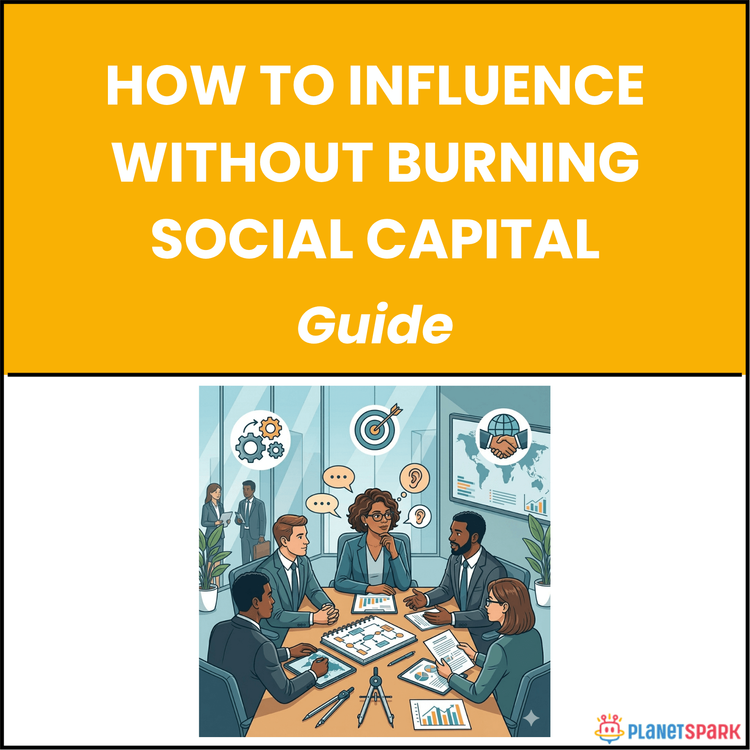
How to Influence Without Burning Social Capital
Influence Stakeholders Without Burning Social Capital
If you’ve ever pushed hard to get something done at work—and later felt like relationships became strained, conversations got colder, or people became less responsive—you’ve already experienced the hidden cost of influence done wrong.
Most professionals don’t struggle with ideas. They struggle with getting those ideas accepted, supported, and executed—without damaging the very relationships they depend on.
You might find yourself:
- Being right in meetings, but ignored
- Pushing harder, only to face more resistance
- Losing allies after high-stakes projects
- Feeling like influence requires trade-offs you don’t want to make
This is exactly why the resource “How to Influence Without Burning Social Capital” exists. It gives you a structured, practical system to move people, decisions, and projects forward—without draining trust, goodwill, or credibility. Instead of relying on force, persistence, or authority, this playbook teaches you how to influence through preparation, empathy, and strategy.
Who Is This Resource For?
This resource is especially valuable if you are:
- A working professional (0–15 years of experience) working across teams or stakeholders
- A consultant, product manager, or individual contributor influencing without authority
- A manager navigating cross-functional alignment
- A professional who feels their ideas don’t gain traction despite being valid
- Someone who wants to build long-term credibility—not just win short-term arguments
- A high performer who may unintentionally come across as “too pushy” or “hard to work with”
If your success depends on people saying “yes” to your ideas, this playbook is directly relevant to your work.
What Does This Resource Contain?
This is not a generic communication guide. It is a structured influence playbook built around real workplace dynamics.
Inside the resource, you’ll find:
- A clear explanation of social capital as a professional “trust ledger” (deposits vs. withdrawals)
- A practical framework to recognise when your influence is strengthening vs. damaging relationships
- The Influence Audit system to assess relationship health before making any ask
- A structured relationship mapping exercise to identify key stakeholders and priorities
- A timing diagnostic to evaluate when influence attempts are likely to succeed
- A step-by-step influence framework:
- Listen first (diagnostic listening)
- Frame your idea based on the other person’s priorities
- Build alignment before making formal asks
- The 3-Part Framing Template to position your ideas as solutions to others’ goals
- A principled ask framework (specific, bounded, reversible) to improve response rates
- Practical strategies to handle resistance without escalating conflict
- A decision model for when to push, pause, or walk away
- Stakeholder-type frameworks (analytical, visionary, relationship, results-driven)
- Guidance for influencing up, across, and down effectively
- A complete Influence Planning Worksheet for real-world application
- A 30-day Influence Reset challenge to build habits systematically
- A self-evaluation tool to measure your influence effectiveness
- Real-world case study showing how influence improves with the right approach
- Common mistakes that silently drain social capital
Everything is designed to be used in real conversations—not just understood conceptually.
Summary of the Resource
“How to Influence Without Burning Social Capital” is a practical playbook that helps professionals influence decisions and people while protecting—and even strengthening—their relationships.
It shifts your approach from reactive persuasion to intentional influence, where every interaction builds long-term credibility instead of depleting it.
If you’ve ever felt like influence requires trade-offs between results and relationships, this resource shows you how to achieve both.
How Will This Resource Be Useful?
This resource helps you move from forceful or inconsistent influence to deliberate, sustainable impact.
You’ll gain:
- A clear understanding of how trust and credibility actually work in professional environments
- A structured way to prepare for high-stakes conversations
- Confidence in influencing without overstepping or damaging relationships
- Stronger stakeholder alignment before decisions are made
- The ability to handle resistance without escalating conflict
- Better judgement on when to push, pause, or step back strategically
- A repeatable system that improves your influence over time
Most importantly, it helps you stop “spending” relationships to get results—and start growing them while achieving outcomes.
How Should You Use This Resource?
To get the best results, approach this playbook as a working system, not just a read-through.
Start by reading the full guide once to understand the concept of social capital and the overall influence framework.
Next, apply the Influence Audit to a real situation:
- Identify key stakeholders
- Assess relationship health
- Understand what each person actually cares about
Then, begin using the core influence sequence:
- Lead with listening in conversations
- Frame your ideas based on stakeholder priorities
- Build alignment before formal discussions
As you gain confidence, start applying advanced elements:
- Use the principled ask framework for important requests
- Diagnose resistance instead of reacting to it
- Adapt your communication based on stakeholder type
In parallel, commit to the 30-day Influence Reset:
- Week 1: Audit relationships
- Week 2: Practise listening-first conversations
- Week 3: Improve framing of ideas
- Week 4: Build consistent relationship deposits
Finally, use the self-evaluation tool to track your progress and refine your approach over time.
This is a resource you will return to before important conversations—not just once.
Action Steps
After accessing this resource, take these steps immediately:
1. Identify one current goal that requires stakeholder support
2. List 3–5 key people who influence that outcome
3. Complete a quick Influence Audit for each person
4. Make one genuine “deposit” (no ask attached) this week
5. Prepare your next conversation using the 3-part framing structure
6. Practise opening your next discussion with a question, not a position
These small, intentional shifts can significantly change how others respond to you. Influence is not about pushing harder or speaking louder. It is about being understood, trusted, and aligned.
When you listen before you speak, frame ideas around others’ priorities, and invest in relationships consistently, your influence becomes stronger—and more sustainable. You don’t just get better outcomes. You build the kind of professional reputation that makes future outcomes easier.