
How to Influence Without Creating Psychological Resistance

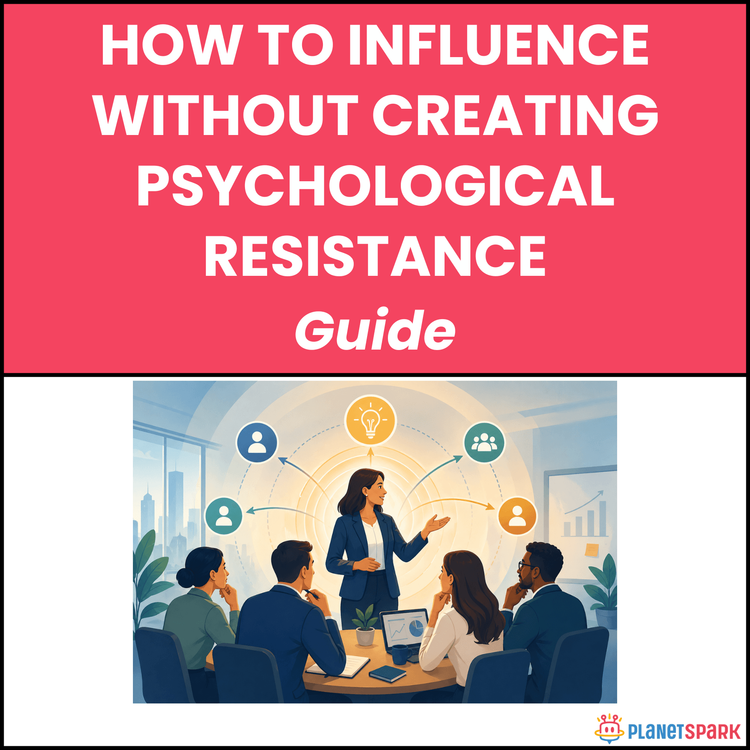
How to Influence Without Creating Psychological Resistance
Master the Art of Influence Without Triggering Resistance: A Practical Guide for Working Professionals
If you’ve ever tried to convince a colleague, align a team, or drive a decision—only to face subtle pushback, silence, or resistance—you’ve experienced one of the most common challenges in the workplace: influence that doesn’t land.
The problem isn’t always your idea. Often, it’s how the idea is perceived.
Many professionals unknowingly trigger psychological resistance when they push too hard, present too directly, or overlook how people process change and control. The result? Good ideas get ignored, conversations stall, and alignment becomes harder than it should be.
That’s exactly why the resource “How to Influence Without Creating Psychological Resistance” exists. It’s designed to help working professionals communicate ideas in a way that reduces defensiveness, builds buy-in, and increases the likelihood of real action.
This guide helps you move from forceful persuasion to strategic influence—using structured frameworks, practical techniques, and real-world applications.
Who Is This Resource For?
This resource is especially valuable if you are:
- A working professional with 0–15 years of experience
- A manager or team leader responsible for alignment and decision-making
- A consultant or client-facing professional influencing stakeholders
- A cross-functional team member working without direct authority
- A mid-career professional stepping into more strategic roles
- Someone who feels their ideas are often resisted, ignored, or misunderstood
If you want your ideas to be heard, accepted, and acted upon—without creating friction—this guide is built for you.
What Does This Resource Contain?
This is not a generic communication guide. It’s a structured system that helps you understand and apply influence in a psychologically effective way.
Inside the resource, you’ll find:
- A clear explanation of psychological resistance and why it occurs in professional settings
- The concept of autonomy and control as core drivers of resistance
- A breakdown of common triggers that cause people to push back on ideas
- A practical influence framework that prioritises alignment over authority
- Techniques to present ideas without threatening the listener’s sense of control
- Language patterns that reduce defensiveness and invite collaboration
- Methods to frame suggestions as shared problem-solving rather than directives
- Strategies to build buy-in before presenting solutions
- Real-world examples of influence done right—and wrong
- A step-by-step approach to structuring high-stakes conversations
- Reflection prompts to evaluate your current influence style
- A checklist to review your communication before important discussions
- Practical scripts and phrasing you can use immediately
- Common influence mistakes professionals make—and how to avoid them
Everything is designed to be applied in real conversations, not just understood conceptually.
Summary of the Resource
“How to Influence Without Creating Psychological Resistance” is a practical, behaviour-focused guide that helps professionals communicate ideas in a way that encourages openness rather than defensiveness.
It shows you how to align with others’ perspectives, reduce friction, and guide conversations toward agreement—without forcing outcomes.
If you want to improve how you influence decisions, drive alignment, and navigate complex conversations, this resource gives you a clear, repeatable system.
How Will This Resource Be Useful?
This resource helps you move from frustration to effectiveness.
You’ll gain:
- A clear understanding of why people resist ideas—even when they’re logical
- Practical tools to reduce defensiveness in conversations
- Stronger ability to influence without formal authority
- Improved communication in meetings, discussions, and negotiations
- Greater success in gaining buy-in for your ideas
- Better collaboration across teams and stakeholders
- Increased confidence in handling high-stakes conversations
Most importantly, it helps you stop pushing harder—and start influencing smarter.
How Should You Use This Resource?
To get the best results, follow a structured approach:
Start by reading the guide fully to understand the psychology behind resistance and influence. This builds foundational clarity.
Next, reflect on your recent conversations. Identify moments where resistance showed up and what may have triggered it.
Then, apply the influence framework to an upcoming real conversation. Focus on how you frame the idea—not just the idea itself.
Use the suggested language patterns and scripts to make your communication more collaborative and less directive.
Before important discussions, run through the checklist to ensure your approach reduces resistance rather than creates it.
After conversations, reflect on what worked and what didn’t—this builds long-term skill.
You can revisit this resource whenever you:
- Need to influence a decision or stakeholder
- Prepare for a high-stakes conversation
- Experience resistance or pushback
- Work in cross-functional or matrix environments
- Want to improve your communication effectiveness
Action Steps
After accessing this resource, take these steps immediately:
1. Block 60 minutes to review the full guide
2. Identify one recent situation where your idea faced resistance
3. Analyse what may have triggered that resistance
4. Choose one upcoming conversation to apply the framework
5. Rewrite how you will present your idea using the suggested techniques
6. Practise one new language pattern before the conversation
7. Reflect on the outcome and refine your approach
Small changes in how you communicate can lead to significantly better outcomes.
Influence is not about control—it’s about alignment. The most effective professionals are not those who push the hardest, but those who understand how people think, feel, and respond.
When you reduce psychological resistance, you don’t just get agreement—you build trust, credibility, and long-term impact.
Use this resource not just to improve your communication, but to transform how you influence, collaborate, and lead in your professional environment.