
How to Make Decisions With Incomplete Information

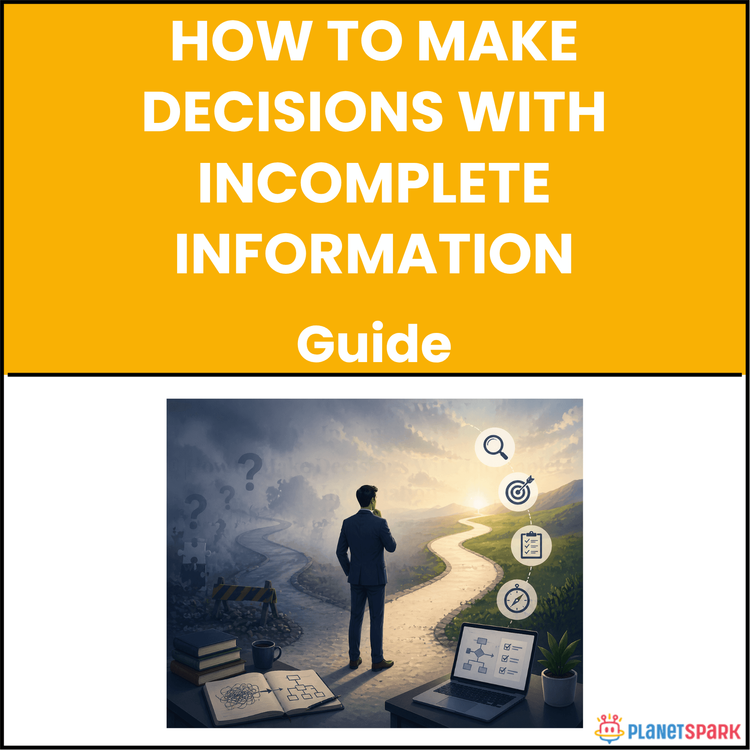
How to Make Decisions With Incomplete Information
Navigating Decisions with Incomplete Data: A Playbook for Making Confident Choices
Every working professional has faced a moment when a decision needs to be made, but the full picture isn’t available. Whether it’s evaluating a job offer, selecting a vendor, or deciding on a project direction, uncertainty is a constant companion in decision-making. But waiting for all the information or trying to predict every outcome is often not an option. This playbook is designed to help you act confidently even when the information is incomplete, using a structured decision-making framework that will help you make better decisions faster.
Whether you're a consultant, manager, or early-career professional, the ability to decide with incomplete information is a skill that can set you apart. This guide provides a clear process to navigate uncertainty, make smarter choices, and take action with confidence.
Who Is This Resource For?
This resource is designed for:
- Career Changers: Professionals who need to make quick decisions about opportunities with incomplete information, such as evaluating new roles or skill-building opportunities.
- Consultants: Those making strategic recommendations without full data, helping clients pivot or adjust plans.
- Managers: Leaders needing to decide under ambiguity, such as prioritizing projects, hiring, or allocating resources.
- Early-Career Professionals: Professionals who need to navigate complex decisions in fast-moving environments, like project selection or dealing with high-stakes deadlines.
- Outcome-Oriented Professionals: Anyone who wants to reduce the mental load of uncertainty and make faster, more confident decisions.
What Does This Resource Contain?
This guide provides a five-phase framework for making decisions under uncertainty:
- Assess: Know what you know and what you don’t.
- Structure: Frame the decision clearly to avoid ambiguity.
- Scout: Gather just the information that will impact your decision.
- Decide: Commit to a decision and take action quickly.
- Review: Reflect on the decision to learn and adapt for future choices.
Along with the framework, this resource includes:
- Practical tools like the Decision Clarity Worksheet and the Pre-Decision Checklist to help you apply the phases.
- Real-World Case Study: A worked example showing how a professional navigated a high-stakes decision.
- Cognitive Bias Insights: Learn about the biases that could distort your decision-making process and how to avoid them.
- Actionable Prompts: Reflection questions and tools to improve your decision-making over time.
Summary of the Resource
This resource provides a structured process for making decisions when you don’t have the full picture:
1. Assess: Identify what you know and what you can find out, and clarify your unknowns.
2. Structure: Frame your decision to focus on key outcomes, and define your must-have criteria.
3. Scout: Gather only the critical information that will directly influence your decision.
4. Decide: Commit to a decision with 70% of the information and take the first action immediately.
5. Review: Reflect on your decision-making process to improve for next time.
By following this framework, you will be able to make confident decisions faster, even in uncertain situations.
How Will This Resource Be Useful?
Using this guide will help you:
- Make faster decisions: By following a structured process, you can make decisions with the information available, without waiting for perfect certainty.
- Improve decision quality: The framework ensures you make more informed decisions by focusing on what truly matters, reducing bias and overthinking.
- Increase confidence: Knowing you have a repeatable system for decision-making helps you trust your judgment, even when the data is incomplete.
- Ensure action: The framework emphasizes taking immediate action, which reduces the chances of analysis paralysis.
How Should You Use This Resource?
- Step 1: Assess the situation. List what you know, what you can find out quickly, and what you cannot know.
- Step 2: Structure your decision by clearly defining the options and criteria. Write a precise decision statement.
- Step 3: Scout for information. Limit yourself to three high-quality, decision-critical sources.
- Step 4: Decide. Use the 70% Rule—if you have 70% of the information you need, commit and act. Then take the first action immediately.
- Step 5: Review your decision. Reflect on how well your decision turned out and capture insights for the next time.
Action Steps
1. Complete the Decision Clarity Worksheet: Write down your decision statement, define your options, and list your must-have criteria.
2. Run the Pre-Decision Checklist: Assess if you’ve considered all the right factors, and check for biases.
3. Use the 70% Rule: Once you have most of the information, commit and act without waiting for the remaining data.
4. Take the First Action: As soon as you decide, complete a concrete action that moves the decision forward.
5. Schedule a Review: Set a date to review the decision in 30 days, and assess how you would approach it differently in hindsight.
Book your free session today!