
How to Navigate Conflicts When You’re Not the Manager

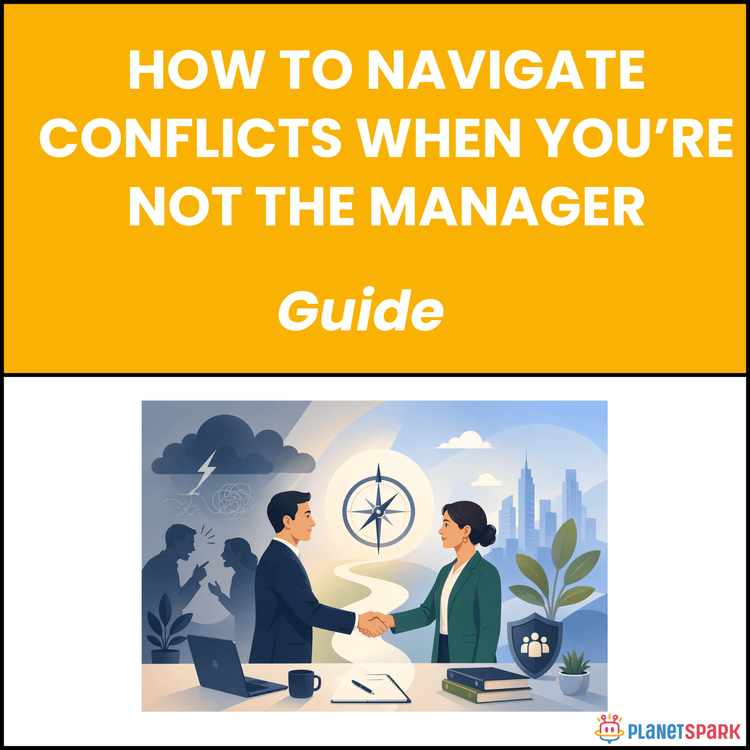
How to Navigate Conflicts When You’re Not the Manager
Resolving Workplace Conflicts Without Authority: Strategies for Professionals
Conflict at work is inevitable—but for most professionals, the real challenge isn’t conflict itself. It’s handling it when you don’t have authority.
You’re not the manager. You don’t control decisions. You can’t enforce outcomes. Yet you’re still expected to collaborate, deliver results, and maintain strong working relationships.
So what do you do when tensions rise, communication breaks down, or someone’s behavior starts affecting your work?
This is exactly where the “How to Navigate Conflicts When You’re Not the Manager” resource becomes essential. It’s a practical, step-by-step playbook designed to help you handle workplace conflict professionally—without relying on hierarchy.
Who Is This Resource For?
This guide is built for professionals who regularly work across teams and need to influence outcomes without formal authority. It is especially useful for:
- Individual contributors working in cross-functional teams
- Consultants managing client or stakeholder friction
- Early-career professionals learning to “manage up”
- New managers who haven’t yet built positional authority
- Career switchers adjusting to new workplace dynamics
If you’ve ever hesitated to address a conflict because “it’s not my place,” this resource directly addresses that gap.
What Does This Resource Contain?
This is not a theoretical guide. It is a structured, highly practical toolkit that you can apply immediately. Inside, you’ll find:
- A proven 5-step CLEAR framework for handling peer conflict
- Scripts and conversation starters you can use in real situations
- A pre-conversation checklist to prepare effectively
- A conflict mapping worksheet to clarify issues before acting
- Real-world case studies showing how conflict plays out in practice
- Guidance for handling sensitive scenarios, including senior stakeholders and team-level conflicts
- A self-assessment tool to understand and improve your conflict style
- Common mistakes and how to avoid them
Each section is modular, so you can either read it end-to-end or jump directly to the part you need in the moment.
Summary of the Resource
At its core, this guide helps you do one thing exceptionally well: handle workplace conflict early, professionally, and effectively—without needing authority.
It introduces the CLEAR framework:
- Clarify the real issue
- Lower the emotional temperature
- Engage with intent
- Align on next steps
- Revisit and reinforce
Instead of avoiding tension or escalating prematurely, you learn how to navigate conflict with structure, confidence, and clarity.
How Will This Resource Be Useful?
This guide goes beyond awareness—it builds a practical skill set that directly impacts your career.
By applying it, you will:
- Address conflicts early before they escalate
- Communicate more clearly and confidently in difficult situations
- Build a reputation as someone who is mature under pressure
- Strengthen professional relationships instead of damaging them
- Increase your influence—even without formal authority
- Improve collaboration and team performance
Most importantly, you stop seeing conflict as something to avoid—and start treating it as a skill you can master.
How Should You Use This Resource?
To get the most value from this guide, use it as both a learning tool and a working reference.
Start with a full read-through
Understand the overall framework and mindset behind conflict navigation.
Use the worksheets before real conversations
Apply the conflict mapping worksheet to clarify your thoughts before engaging.
Prepare using the checklist
Before any difficult conversation, run through the pre-conversation checklist to ensure you’re ready.
Apply the CLEAR framework step by step
Use each stage—Clarify, Lower, Engage, Align, Revisit—as a structured approach.
Revisit after conversations
Use the follow-up guidance to reinforce outcomes and strengthen relationships.
Return to specific sections when needed
Treat this as a playbook you can come back to before any challenging interaction.
Action Steps
If you want to start applying this immediately, here’s a simple plan:
1. Identify one active or recent conflict you’ve been avoiding
2. Use the conflict mapping worksheet to clarify the real issue
3. Prepare your opening using the observation–impact–invitation structure
4. Schedule a conversation at the right time and setting
5. Focus on listening and aligning—not winning
6. Agree on one clear next step
7. Follow up within 24 hours to reinforce the outcome
Even applying this process once can significantly improve your confidence and effectiveness.
Workplace conflict doesn’t disappear as your career grows. If anything, it becomes more complex.
What changes is your ability to handle it.
This resource gives you a repeatable system to approach difficult conversations with clarity, composure, and professionalism—regardless of your title.
If you’re serious about building influence, credibility, and strong working relationships, this is not just a useful guide—it’s a career skill you’ll use repeatedly.
Start with one conversation. Apply the framework. And build from there.
Book your free session today!