
How to Navigate Psychological Power Plays in Meetings

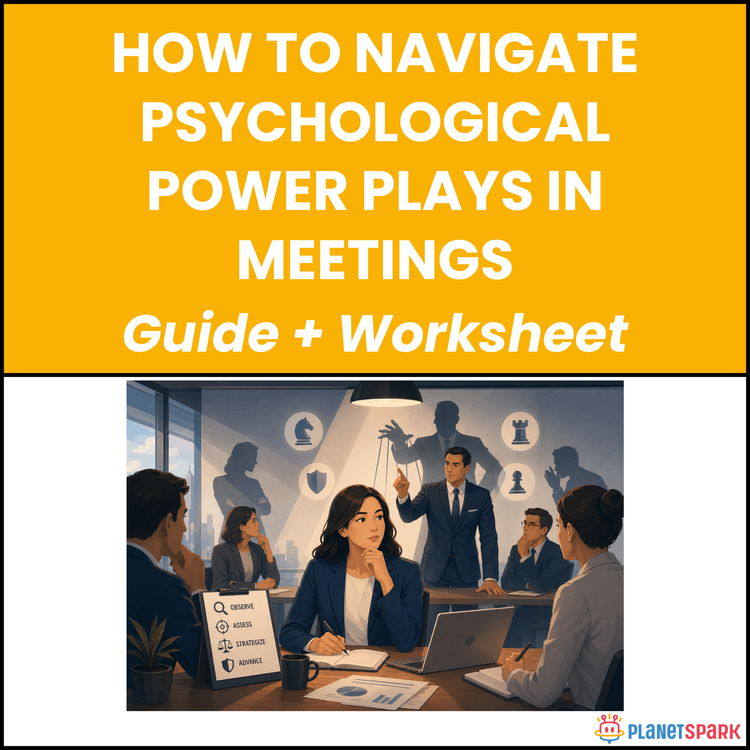
How to Navigate Psychological Power Plays in Meetings
Handling Psychological Power Plays in Meetings with Confidence: A Practical Guide to Influence and Control at Work
If you’ve ever left a meeting feeling unheard, interrupted, or overlooked—despite having strong ideas—you’re not alone. Many professionals walk into meetings prepared on content, but unprepared for the invisible dynamics that actually shape outcomes.
Ideas get dismissed. Credit gets shifted. Decisions get rushed. And often, it’s not about capability—it’s about how power plays out in the room.
That’s exactly why the resource “How to Navigate Psychological Power Plays in Meetings” exists. It equips you with a structured, practical system to recognise, respond to, and manage power dynamics—so you can contribute with clarity, protect your ideas, and influence outcomes effectively.
This guide is built for professionals who want to stop reacting in meetings—and start showing up with control, confidence, and strategic presence.
Who Is This Resource For?
This resource is especially valuable if you are:
- A working professional with 0–15 years of experience
- A manager or team lead involved in decision-making meetings
- A consultant or client-facing professional handling high-stakes discussions
- A professional who feels overlooked, interrupted, or dismissed in meetings
- Someone who wants to improve communication, influence, and executive presence
- Anyone navigating complex workplace dynamics and stakeholder interactions
If your ideas matter—but aren’t always being heard—this guide is built for you.
What Does This Resource Contain?
This is not a generic communication guide. It’s a complete playbook for managing real-world meeting dynamics.
Inside the resource, you’ll find:
- A 3-phase framework covering Before, During, and After the meeting
- A Pre-Meeting Preparation Checklist that helps you:
- Map stakeholders, allies, and disruptors
- Anticipate objections and prepare responses
- Understand both formal objectives and hidden agendas
- A Self-Regulation Primer including techniques like box breathing, intention setting, and confidence anchoring to enter meetings with composure
- The 4-step real-time response loop:
- Detect
- Pause
- Calibrate
- Respond
- The Strategic Pause technique to shift from reactive to controlled responses
- A ready-to-use Response Script Library for common power plays like:
- Interruption
- Credit theft
- Dismissal framing
- Deadline pressure
- Strategic silence
- Coalition building
- A deep dive into nonverbal intelligence, including:
- Eye contact mapping
- Physical orientation
- Response timing
- Your own presence signals
- An In-Meeting Observation Worksheet to track patterns and power dynamics
- Post-meeting strategies including:
- Summary emails to document contributions
- Relationship recalibration conversations
- Pattern tracking for long-term influence
- Ready-to-use post-meeting email templates for reclaiming credit and anchoring decisions
- The Five Archetypes framework to understand different types of power players and their motivations
- A real-world case study showing how structured preparation shifts meeting outcomes
- Common mistakes professionals make—and exactly how to fix them
- A Power Presence self-assessment tool
- A 30-day implementation plan to build these skills consistently
Everything is designed for real-world application—not theory.
Summary of the Resource
“How to Navigate Psychological Power Plays in Meetings” is a practical, structured guide that helps you understand and influence the hidden dynamics that shape meeting outcomes.
It teaches you how to prepare strategically, respond with composure in real time, and follow through effectively after the meeting—so your ideas are heard, recognised, and acted upon.
Even small changes in how you show up can significantly shift how others perceive and respond to you.
How Will This Resource Be Useful?
This resource helps you move from passive participation to active influence.
You’ll gain:
- The ability to recognise power plays as they happen
- Greater control over your reactions in high-pressure situations
- Clear, confident language to handle interruptions and challenges
- Stronger visibility and ownership of your ideas
- Improved stakeholder alignment and decision influence
- Better understanding of workplace dynamics and hidden agendas
- Increased confidence in high-stakes meetings
Most importantly, it helps you stop feeling sidelined—and start contributing with authority and impact.
How Should You Use This Resource?
To get the best results, follow a structured, phased approach:
Start by reading the entire guide to understand the full meeting lifecycle—before, during, and after.
Next, begin with pre-meeting preparation. Use the checklist to map stakeholders, anticipate challenges, and align your strategy.
Then, focus on in-meeting execution. Practise the Strategic Pause and use the response scripts to handle real-time situations with composure.
After the meeting, apply the follow-up protocols. Send summary emails, document your contributions, and reset relationships where needed.
Track your observations across multiple meetings to identify patterns and refine your approach over time.
Revisit this resource whenever you:
- Prepare for important meetings
- Experience difficult dynamics in discussions
- Want to improve your executive presence
- Build long-term influence within your organisation
Action Steps
After accessing this resource, take these steps immediately:
1. Identify your next high-stakes meeting
2. Complete the Pre-Meeting Preparation Checklist
3. Memorise 2–3 response scripts for common situations
4. Practise the 2–3 second Strategic Pause during conversations
5. Send a summary email after your next meeting
6. Reflect using the Observation Worksheet
Small, consistent actions here can transform how you are perceived in professional settings.
Meetings are not just about ideas—they are about influence. The professionals who succeed are not always the smartest in the room, but the most prepared, aware, and deliberate in how they show up.
This resource gives you a system to do exactly that. When you understand power dynamics, you stop reacting—and start leading conversations with confidence.