
How to Navigate Workplace Insecurity and Imposter Feelings

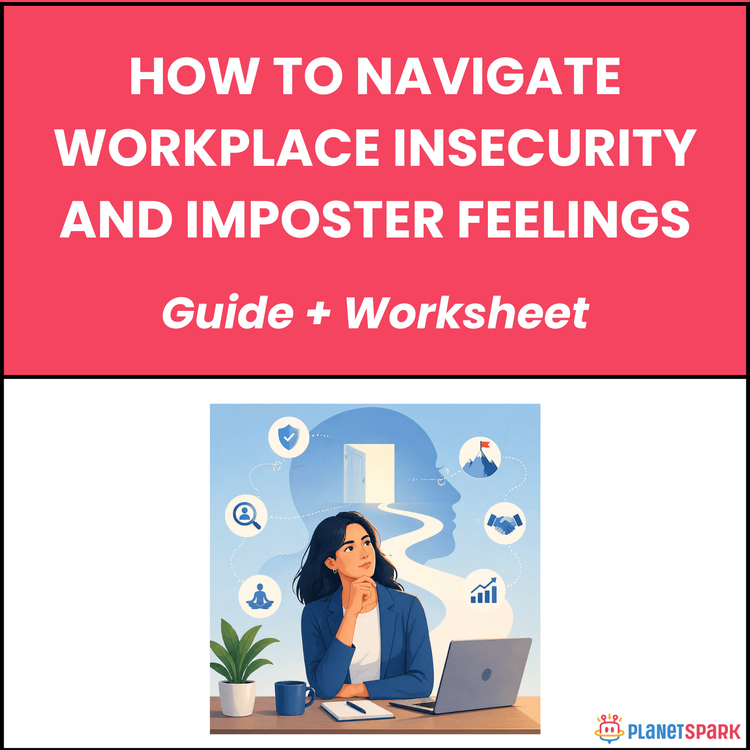
How to Navigate Workplace Insecurity and Imposter Feelings
Stop Self-Doubt from Sabotaging Your Career: A Practical Guide to Overcoming Workplace Insecurity and Imposter Feelings
If you’ve ever second-guessed yourself right before speaking in a meeting, felt undeserving of your achievements, or worried that others might “find you out”—you’re not alone. Many high-performing professionals silently struggle with a persistent inner voice that questions their competence, even when their track record proves otherwise.
This isn’t a lack of capability—it’s a pattern. One that shows up in subtle but career-limiting ways: holding back ideas, over-preparing to the point of exhaustion, avoiding opportunities, or downplaying your contributions.
That’s exactly why the resource “How to Navigate Workplace Insecurity & Imposter Feelings” exists. It’s designed to help working professionals break free from self-doubt, understand what’s really happening beneath the surface, and build a more confident, grounded professional identity—without pretending to be someone they’re not.
Who Is This Resource For?
This resource is especially valuable if you are:
- A working professional (0–15 years of experience) navigating growth or transitions
- A job seeker or career switcher struggling with confidence in new environments
- A manager or consultant facing high expectations and visibility
- Someone who feels “not good enough” despite consistent achievements
- A professional who over-prepares, overthinks, or avoids high-stakes opportunities
- Anyone looking to build confidence that is grounded in reality—not forced positivity
If you’re ambitious but often held back by self-doubt, this guide is built for you.
What Does This Resource Contain?
This is not a motivational read—it’s a structured, action-oriented guide designed for real workplace scenarios.
Inside the resource, you’ll find:
- A deep breakdown of the imposter cycle (trigger → self-doubt → overcompensation → temporary relief)
- A framework to identify your personal triggers and patterns
- A “Trigger Mapping” worksheet to build self-awareness
- The Evidence Audit method to challenge negative self-talk using facts
- A complete cognitive reframing process to rewrite limiting beliefs
- Behavioural strategies like speaking first in meetings, setting “good enough” standards, and asking for help
- The Confidence-Competence Loop to understand how confidence actually develops
- A “Win Log” system to track achievements and build internal evidence
- A self-compassion toolkit to replace harsh self-criticism with constructive thinking
- A guided “Inner Coach Letter” exercise for perspective and clarity
- Communication frameworks to eliminate self-diminishing language
- A support architecture model (mentors, peers, inner circle)
- A real-world case study showing transformation in action
- Common mistakes that keep professionals stuck—and how to fix them
- Identity anchoring techniques to build a stable professional self-concept
- A step-by-step “Imposter Response Playbook” for real-time situations
- A self-evaluation tool to assess where you are and what to focus on
Everything is designed for immediate application in your day-to-day work life.
Summary of the Resource
“How to Navigate Workplace Insecurity & Imposter Feelings” is a practical, psychology-backed guide that helps professionals understand and interrupt the patterns of self-doubt that limit their performance and growth.
Instead of trying to eliminate insecurity completely, it teaches you how to act with clarity and confidence despite it—using structured frameworks, behavioural tools, and real-world exercises.
If you’re looking for a resource that helps you think better, act faster, and show up more confidently at work, this guide delivers exactly that.
How Will This Resource Be Useful?
This resource helps you shift from hesitation to action.
You’ll gain:
- Awareness of what triggers your self-doubt and why
- Tools to challenge negative thoughts with real evidence
- Confidence built through action—not forced mindset shifts
- Stronger presence in meetings, discussions, and decision-making
- Healthier internal dialogue that supports performance
- Reduced overthinking and perfectionism
- The ability to take on opportunities you would have previously avoided
- A clearer, more stable sense of your professional identity
Most importantly, it helps you stop letting self-doubt make decisions for you.
How Should You Use This Resource?
To get the best results, follow a structured approach:
Start by reading the guide end-to-end to understand how the imposter cycle works and how the modules connect.
Next, complete the worksheets in sequence. Begin with identifying your triggers, then move into the Evidence Audit and reframing exercises. These build the foundation for everything else.
Once you’ve developed awareness, implement the behavioural strategies in real situations—meetings, presentations, and daily interactions.
Use the communication frameworks to improve how you express ideas and remove self-diminishing language.
Then, work on identity anchoring and support systems to create long-term stability and confidence.
Finally, keep the “Imposter Response Playbook” handy for quick use during high-pressure moments.
You can revisit this resource whenever you:
- Step into a new role or promotion
- Face high-stakes presentations or evaluations
- Experience recurring self-doubt
- Want to strengthen your confidence and professional presence
Action Steps
After accessing this resource, take these steps immediately:
1. Block 60–90 minutes for your first deep-dive session
2. Complete the Trigger Mapping worksheet honestly
3. Run one Evidence Audit on a current self-doubt situation
4. Identify one behavioural habit to change this week (e.g., speaking early in meetings)
5. Start a simple Win Log to track your achievements weekly
6. Replace at least 2 self-diminishing phrases in your communication
7. Write your first draft of a Professional Identity Anchor statement
Small, consistent actions here create powerful long-term shifts.
Your self-doubt doesn’t define you—but how you respond to it will shape your career. Confidence isn’t something you wait for; it’s something you build through awareness, action, and evidence.
This resource gives you the tools to take control of that process—so you can stop holding back and start showing up as the professional you already are.
Book your free session today!