
How to Present Yourself as a Subject-Matter Expert

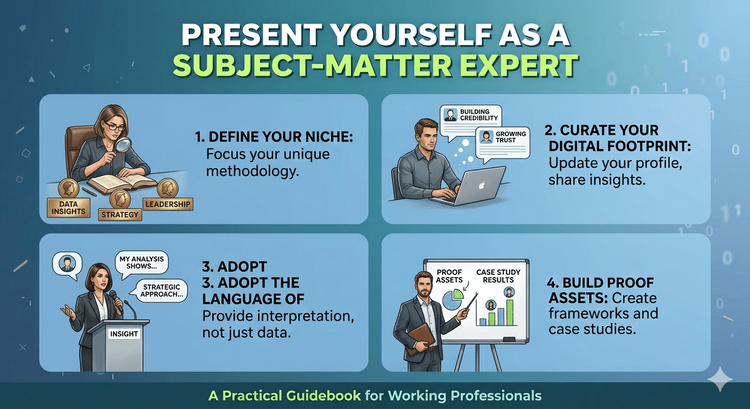
How to Present Yourself as a Subject-Matter Expert
How to Present Yourself as a Subject-Matter Expert: A Practical Guide for Professionals Who Want to Be Recognized for Their Expertise
The resource “How to Present Yourself as a Subject-Matter Expert” was created to solve this exact challenge. It provides working professionals with practical frameworks, worksheets, and communication tools that help transform hidden expertise into visible professional authority.
Rather than relying on vague claims or job titles, this guidebook shows you how to define your expertise, communicate it with clarity, demonstrate it in real-time interactions, and build a consistent reputation as a trusted authority.
Who Is This Resource For?
This guidebook is designed for professionals who want to build credibility and visibility for their expertise in a structured and practical way.
It is especially useful for:
Career changers who want to establish credibility in a new industry or role
Consultants and freelancers who need to position themselves as trusted experts to attract higher-value clients
Managers and team leaders who want to develop thought leadership and strategic influence
Early to mid-career professionals who want to be recognized as the go-to authority in their field
Professionals who feel their knowledge is underestimated or overlooked
Anyone who struggles to clearly explain their expertise beyond their job title
What Does This Resource Contain?
Inside the resource, you will find:
A clear explanation of why expert positioning matters for career growth and professional visibility
A detailed Expert Identity Worksheet to help clarify your domain of expertise
Guidance for writing a powerful expert statement that communicates exactly who you help and the outcomes you create
The Expert Narrative framework that helps structure your professional story using three components: Foundation, Evidence, and Perspective
Practical techniques for demonstrating expertise in real-time conversations, meetings, interviews, and presentations
A Pre-Meeting Expert Presence Checklist that prepares you for high-stakes professional interactions
Strategies for building a written expert presence through LinkedIn, emails, reports, and professional communication
Ready-to-use templates for LinkedIn headlines, LinkedIn post openings, email introductions, and professional bios
A visibility strategy framework that explains how consistent contribution builds professional credibility over time
A Visibility Audit exercise that helps you assess your current professional presence and identify improvement opportunities
Guidance for handling challenges to your expertise confidently using the CALM framework
A self-evaluation sheet that helps track your expert positioning progress over time
A practical 30-day expert positioning sprint designed to build momentum with small, focused actions
Together, these tools help professionals move from quiet competence to visible authority.
Summary of the Resource
This guidebook provides a complete system for building expert positioning in your professional life.
By the end of the guidebook, you will have:
A clearly defined expert identity
A structured narrative that explains your expertise convincingly
A framework for demonstrating expertise in meetings and professional conversations
Templates for communicating expertise in written formats like LinkedIn and email
A strategy for increasing your visibility in professional environments
Tools for handling challenges and questions with confidence
How Will This Resource Be Useful?
For many professionals, the biggest challenge is not learning new skills — it is ensuring their existing expertise is recognized.
This resource helps solve several common professional challenges.
You struggle to explain your expertise clearly
The guidebook provides structured frameworks and language templates that help you articulate exactly what you know and how it helps others.
You feel overlooked in important conversations
By learning how experts frame problems, ask better questions, and present insights confidently, you strengthen your presence in meetings and discussions.
Your LinkedIn or professional profile feels generic
The templates and narrative frameworks help you transform vague descriptions into clear, outcome-focused positioning.
You want to become a recognized authority in your field
The visibility strategy shows how consistent contribution builds credibility over time.
You find it difficult to respond to professional challenges confidently
The CALM framework gives you a structured way to handle disagreement while maintaining authority and composure.
The overall benefit is simple: your knowledge becomes easier for others to recognize, trust, and rely on.
How Should You Use This Resource?
The guidebook is designed to be both practical and flexible. You can work through it sequentially or focus on the sections most relevant to your current professional situation.
Step 1: Define your expert identity
Start with the Expert Identity Worksheet to clarify your area of expertise. Identify the intersection between your deep knowledge, repeated professional wins, and the problems people consistently seek your help with.
Step 2: Build your expert narrative
Use the three-part narrative structure — Foundation, Evidence, and Perspective — to craft a compelling story about your expertise.
Practice explaining your expertise clearly in two or three sentences.
Step 3: Strengthen your real-time presence
Before important meetings or presentations, use the Expert Presence Checklist. Prepare your key insight, supporting evidence, and responses to potential challenges.
Step 4: Develop your written expert presence
Update your LinkedIn headline and profile using the templates provided. Begin sharing insights, perspectives, or observations related to your expertise.
Step 5: Increase visibility strategically
Choose one professional visibility channel — such as internal meetings, LinkedIn content, or industry discussions — and contribute consistently.
Step 6: Practice responding to challenges
Use the CALM framework to handle professional pushback with clarity and confidence.
Step 7: Follow the 30-day positioning sprint
The final section of the guidebook provides a structured four-week action plan to begin implementing expert positioning habits immediately.
Action Steps
If you want to start building expert positioning today, begin with these practical steps:
Write a one-sentence expert statement describing who you help and the outcomes you create
List three recurring problems you have successfully solved in your career
Identify the specific evidence or results that demonstrate your expertise
Rewrite your LinkedIn headline to clearly communicate your expertise
Prepare a short expert narrative that you can use in introductions and meetings
Choose one channel where you will consistently share your insights or perspectives
Practice using the CALM framework when responding to professional challenges
Even small steps toward clearer positioning can dramatically improve how others perceive your expertise.
When your knowledge, experience, and perspective are communicated clearly, opportunities naturally follow. Your expertise becomes easier to trust, easier to reference, and easier for others to recommend.