
How to Rebuild Career Momentum after Long Transitions

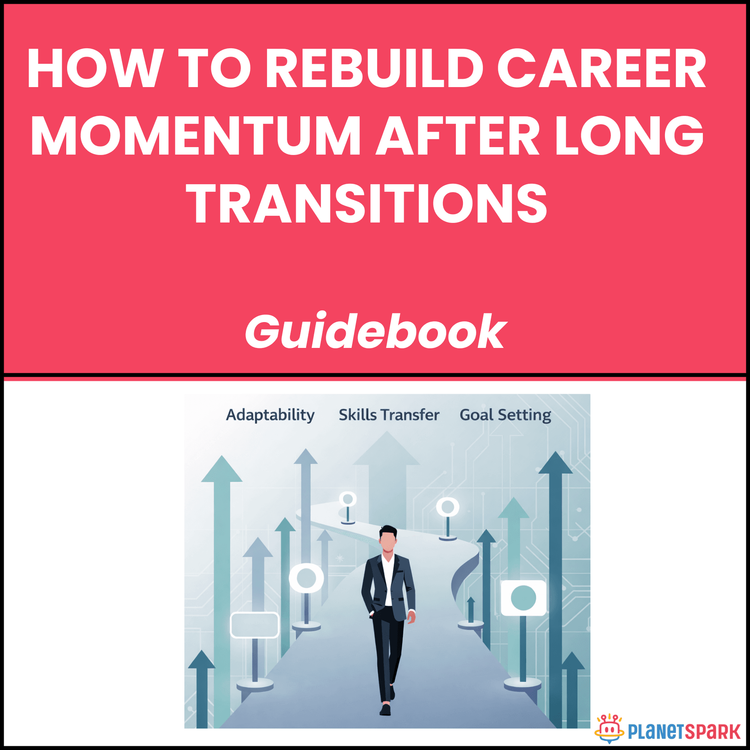
How to Rebuild Career Momentum after Long Transitions
How to Rebuild Career Momentum After a Long Transition: A Practical Guide for Working Professionals
Returning to your career after a long break can feel more overwhelming than the break itself. It’s not just about updating your resume or applying for jobs—it’s about figuring out who you are professionally now, how to explain your journey, and where you actually fit in a market that has moved on.
Many professionals find themselves stuck in this phase. You know you’re capable. You’ve had meaningful experience. But when it comes to taking the next step, there’s hesitation, confusion, and a lack of clear direction.
That’s exactly why the resource “How to Rebuild Career Momentum After Long Transitions” was created. It’s designed to help you move from feeling stuck to taking structured, confident action—so you can re-enter the market with clarity and purpose.
Who Is This Resource For?
This guide is especially valuable if you are:
- A professional returning after a long career break (sabbatical, caregiving, health, relocation)
- Someone who has experienced a layoff or unexpected career pause
- A professional exploring a career pivot but unsure how to position it
- Someone feeling disconnected from their professional identity
- A mid-career professional struggling to regain confidence and direction
- Anyone who feels “out of sync” with the current job market
If you’re not just looking for job search tips—but a way to rebuild clarity, confidence, and momentum—this resource is for you.
What Does This Resource Contain?
This is a structured guidebook that walks you through rebuilding your career step by step, both practically and psychologically.
Inside the resource, you’ll find:
- A deep breakdown of different types of career transitions and their impact
- A self-assessment tool to map your transition and current mindset
- A structured framework to re-anchor your professional identity
- A comprehensive skills audit covering hard, transferable, and transition-acquired skills
- A formula to craft your Professional Re-Positioning Statement (PRS)
- A step-by-step method to reconstruct your career story
- The STAR-P framework to confidently handle career gaps in interviews
- Worksheets to rebuild your narrative with clarity and direction
- A structured approach to re-engage your professional network
- Ready-to-use templates for reconnecting with contacts
- A strategic framework for re-entering the job market intentionally
- A targeted job application approach to avoid scattergun efforts
- A complete readiness checklist before applying to roles
- Real-world case studies showing successful career comebacks
- Common mistakes professionals make—and how to avoid them
Everything is designed to help you move forward with clarity, not confusion.
Summary of the Resource
“How to Rebuild Career Momentum After Long Transitions” is a practical, step-by-step guide that helps professionals restart their careers with intention.
It focuses on four key areas:
- Rebuilding your professional identity
- Reconstructing your career story
- Re-engaging your network
- Re-entering the job market strategically
If you’ve been feeling stuck or unsure about your next move, this resource gives you a clear roadmap to regain control and direction.
How Will This Resource Be Useful?
This resource helps you move from uncertainty to structured progress.
You’ll gain:
- Clarity on your current position and career direction
- Confidence in explaining your career gap or transition
- A strong professional narrative that resonates with recruiters
- Better understanding of your skills and transferable strengths
- A structured approach to networking and rebuilding connections
- A focused job search strategy that saves time and energy
- Improved interview readiness with clear, confident answers
Most importantly, it helps you rebuild momentum—not just activity.
How Should You Use This Resource?
To get the best results, use this guide in phases:
Start by reading the full guide once to understand the complete journey. This will help you see how each part connects.
Then, begin with the transition self-assessment. This step is critical—it helps you understand where you are before deciding where to go.
Next, focus on re-anchoring your identity. Complete the skills audit and draft your Professional Re-Positioning Statement.
Once you have clarity, move on to reconstructing your career story. Use the worksheets and frameworks to create a narrative that feels confident and forward-looking.
After that, start re-engaging your network using the templates provided. Focus on genuine reconnection rather than immediate outcomes.
Finally, prepare for market re-entry. Use the readiness checklist, target roles strategically, and approach applications with intention.
Revisit the guide regularly—it’s meant to support you through different stages of your comeback.
Action Steps
After accessing this resource, take these steps immediately:
1. Set aside 2–3 uninterrupted hours for focused reflection
2. Complete the transition self-assessment honestly
3. List your key skills across all three categories
4. Draft your Professional Re-Positioning Statement
5. Write your first version of your career story
6. Reach out to 3–5 people from your network this week
7. Identify 5 target roles or companies to focus on
8. Review your readiness checklist before applying
Momentum doesn’t come from doing everything at once—it comes from doing the right things consistently.
Rebuilding your career after a long transition is not about “catching up.” It’s about moving forward with greater clarity, self-awareness, and intention than before. When you approach this phase strategically, your transition becomes part of your strength—not a setback.
Use this resource to rebuild not just your career path, but your confidence in the value you bring. With the right structure and consistent action, momentum will follow.