
How to Reduce Overthinking in Everyday Work Decisions

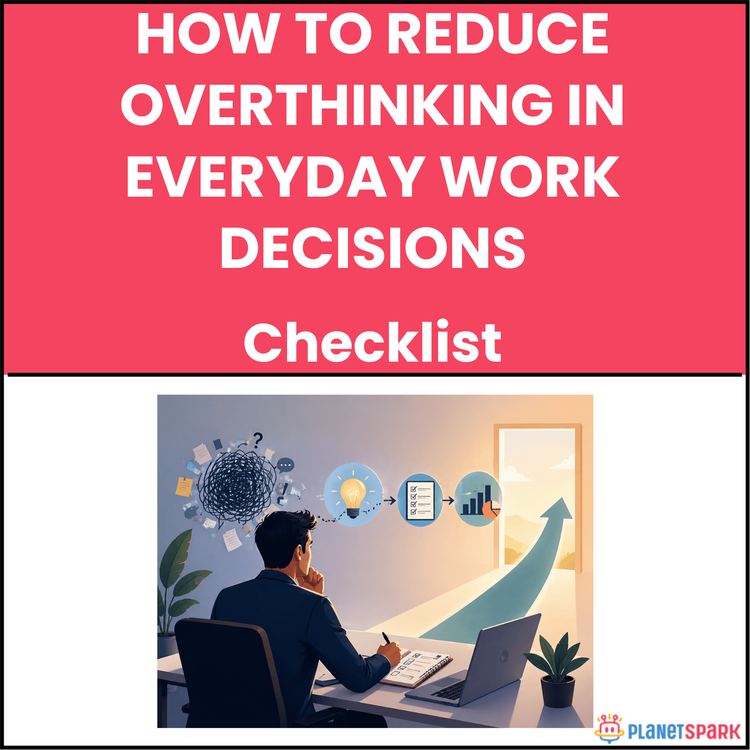
How to Reduce Overthinking in Everyday Work Decisions
A Practical Checklist to Overcome Overthinking in Daily Work Decisions
Overthinking decisions at work is something most professionals can relate to. Whether you're deciding on the best email tone to use with a senior stakeholder or figuring out how to handle an unexpected project delay, it’s easy to get caught in a cycle of doubt. Repeatedly going over the same options, seeking validation, and second-guessing yourself consumes valuable time and mental energy. This guide is here to help you break that cycle and make decisions faster and more confidently—without the mental drain.
Designed for busy professionals, this resource will provide you with a practical checklist to recognize when you’re overthinking, stop the cycle, and start making good-enough decisions swiftly. Whether you’re in management, consulting, or navigating your career, this guide will give you the tools to reduce overthinking and act with confidence.
Who Is This Resource For?
This guide is ideal for:
- Managers: Facing decisions like team prioritization, performance feedback, or stakeholder communications.
- Consultants: Making client recommendations and addressing potential pushback or scope changes.
- Career Changers: Overwhelmed by a variety of decisions about skill-building, networking, or job opportunities.
- Mid-Career Professionals: Those dealing with high-visibility, high-pressure decisions that require quick judgment.
- Time-Poor Professionals: Anyone who wants to make better decisions without wasting time in endless deliberation.
What Does This Resource Contain?
This resource includes:
- 5-Phase Anti-Overthinking Checklist: A step-by-step guide to help you interrupt overthinking, classify decisions, and take action.
- Practical Tools: Worksheets and frameworks like the Decision Audit Grid, Reflection Prompts, and 2×2 Stakes Classifier to streamline decision-making.
- Real-World Case Study: A case study showing how a professional overcame overthinking in a routine decision.
- Quick Reference Summary: A condensed, actionable summary to pin to your desk for easy access.
Summary of the Resource
This guide provides a structured approach to help you:
- Recognize when you’re overthinking: Understand the signs of overthinking and how to stop the spiral.
- Classify decisions: Quickly assess whether the decision is high-stakes or low-stakes to determine the appropriate level of effort.
- Constrain your options: Limit your choices to avoid paralysis by analysis.
- Commit to a decision: Make a “good enough” decision and take the first action immediately.
- Review briefly: Reflect on your decisions to build confidence and improve future decision-making.
By following these steps, you'll learn how to make smarter decisions faster, without the mental drain of overthinking.
How Will This Resource Be Useful?
Using this guide will help you:
- Save time: Stop wasting hours overthinking low-to-medium stakes decisions.
- Make faster decisions: By limiting options and setting a decision deadline, you’ll be able to make choices with confidence in less time.
- Improve decision quality: Learn how to make decisions with enough information, avoiding analysis paralysis.
- Boost your confidence: Build a repeatable system for decision-making that reduces mental fatigue and second-guessing.
How Should You Use This Resource?
- Step 1: Recognize the spiral of overthinking. Use the Notice the Spiral phase to identify when you're caught in a cycle.
- Step 2: Classify the decision. Ask yourself if it's reversible, what the stakes are, and whether you have enough information.
- Step 3: Constrain your options. Limit yourself to three options, set a clear deadline, and remove any "ideal conditions" you don’t have.
- Step 4: Commit and act. Make your decision, write it down, and take action within 15 minutes to prevent procrastination.
- Step 5: Review and recalibrate. After 48 hours, review the decision to assess if it was good enough and identify areas for improvement.
Action Steps
1. Complete the Decision Audit Grid: For your current decision, assess its impact, reversibility, and deadline.
2. Use Reflection Prompts: Answer one of the reflection questions to break your overthinking cycle and move forward.
3. Apply the 2×2 Stakes Classifier: Classify your decision based on its stakes and reversibility to decide whether it’s time to act quickly or gather more data.
4. Commit: Make your decision and take the first concrete action, whether it's sending an email or making a call.
5. Review: After making the decision, take a few minutes to review your process and learn for the future.
Book your free session today!