
How To Reposition Prior Experience During Career Pivots

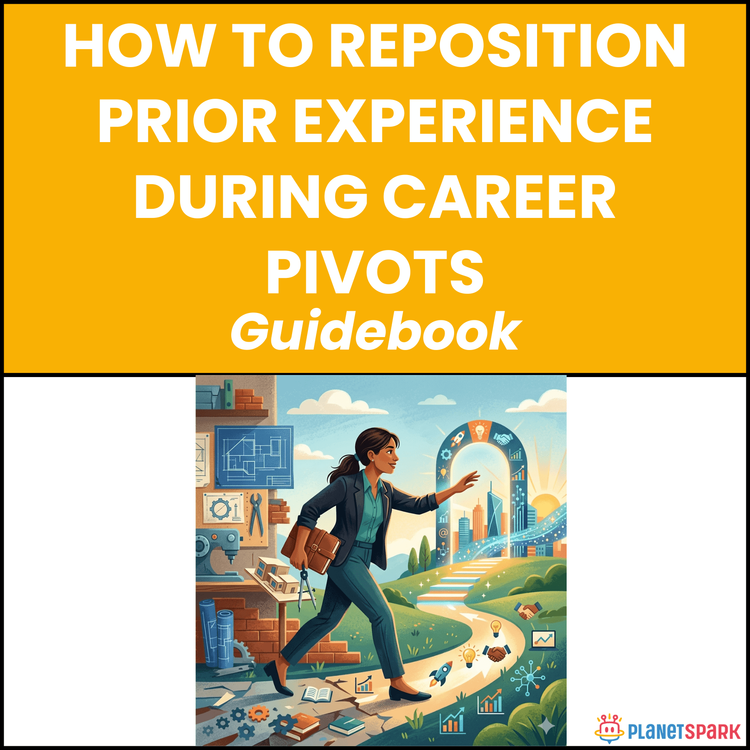
How To Reposition Prior Experience During Career Pivots
How to Reposition Your Experience for a Successful Career Pivot
If you’ve been trying to switch roles, industries, or career paths—but keep getting rejected or overlooked—the problem may not be your experience.
It’s how you’re presenting it.
Most working professionals approach career pivots by focusing on what they lack: a specific job title, industry exposure, or a “perfect” background. But hiring managers don’t just evaluate what you’ve done—they evaluate how relevant your experience appears in the context of their role.This is where most candidates struggle.
Your resume, LinkedIn profile, and interview answers are still speaking the language of your past, while recruiters are listening for signals aligned with your future. That disconnect creates what this guide calls the “repositioning gap.”
The resource “How to Reposition Prior Experience During Career Pivots” is designed to solve exactly this problem. It gives you a structured, practical system to translate your existing experience into a compelling narrative for your target role—without starting from scratch.
Who Is This Resource For?
This guide is especially valuable if you are:
- A working professional planning a career pivot into a new role or industry
- A job seeker struggling to get interview calls despite relevant experience
- A mid-career professional looking to reposition for growth or leadership roles
- A consultant or specialist transitioning into a different function or domain
- Someone who feels “stuck” because their background doesn’t seem to match job descriptions
- A professional who wants to confidently explain “Why this switch?” in interviews
If you already have meaningful experience but don’t know how to make it relevant for your next move, this resource is built for you.
What Does This Resource Contain?
This is a highly structured, action-oriented playbook—not generic career advice. It walks you through a complete repositioning system step by step.
Inside the guide, you’ll find:
- A clear explanation of the “repositioning gap” and why it blocks career transitions
- A 5-step framework to systematically reposition your experience
- A detailed experience audit process to uncover transferable skills and outcomes
- A method to decode job descriptions and understand target role expectations
- The “transferable skills bridge” framework to connect past experience with future roles
- A proven translation formula to convert your work into relevant, outcome-driven statements
- A pivot narrative framework (Anchor → Bridge → Direction) for interviews and profiles
- Worksheets to build your experience inventory and translation statements
- Templates to craft a compelling and authentic career transition story
- A complete activation strategy across resume, LinkedIn, cover letters, and interviews
- A real-world case study demonstrating successful repositioning
- Common mistakes that derail career pivots—and how to avoid them
- Reflection prompts to clarify your strengths and direction
- A 30-day action plan to execute your pivot step by step
- A quick-reference cheat sheet for ongoing use
Everything is designed for immediate application—so you can start repositioning your experience today.
Summary of the Resource
“How to Reposition Prior Experience During Career Pivots” is a practical, execution-focused guide that helps professionals translate their existing experience into relevant, credible value for a new role or industry.
Instead of starting over, it shows you how to reposition forward—by identifying transferable skills, aligning with target role expectations, and building a clear, compelling narrative that hiring managers understand.
If you’re navigating a career change, this resource helps you move from confusion to clarity—and from rejection to opportunity.
How Will This Resource Be Useful?
This guide helps you fundamentally change how you approach career transitions.
You’ll gain:
- Clarity on how your current experience maps to new opportunities
- A structured way to identify and articulate transferable skills
- Confidence in explaining your career pivot in interviews and conversations
- Strong, evidence-based statements that make your experience relevant
- A compelling career narrative that builds trust with recruiters
- Better alignment between your resume, LinkedIn, and interview messaging
- Increased chances of getting shortlisted and securing interviews
Most importantly, it helps you stop thinking of your past as a limitation—and start using it as a strategic advantage.
How Should You Use This Resource?
To get the best results, approach this guide in phases:
Start by reading the entire guide once to understand the full repositioning framework and how each step connects.
Next, begin with the Experience Inventory step. Capture everything you’ve done—skills, projects, outcomes—without filtering or judging. This becomes your raw material.
Then, move to decoding your target role. Study job descriptions, identify key competencies, and understand what success looks like in that domain.
Once you have both inputs, build your transferable skills bridge. Translate your experience into the language of your target role using the provided formula and worksheets.
After that, craft your pivot narrative using the Anchor → Bridge → Direction structure. Practice it until it sounds natural and confident.
Finally, apply your repositioning consistently across all touchpoints—your resume, LinkedIn profile, cover letters, networking conversations, and interviews.
Revisit this guide whenever you:
- Apply for a new role
- Prepare for interviews
- Update your professional profiles
- Plan your next career move
Action Steps
After accessing this resource, take these steps immediately:
1. Block 2–3 hours of uninterrupted time in your calendar
2. Complete a full experience inventory without editing or filtering
3. Identify 5–7 key competencies required for your target role
4. Build at least 8 transferable skills translation statements
5. Draft your pivot narrative using the provided template
6. Update your resume and LinkedIn using repositioned language
7. Apply the activation checklist before submitting applications
Consistent, focused action here can significantly accelerate your career pivot.
Your career pivot doesn’t require a completely new profile—it requires a clearer, more strategic presentation of the one you already have.
When you learn how to translate your experience effectively, you remove friction from the hiring process. You make it easier for decision-makers to understand your value, trust your capabilities, and see you as a strong fit—even in a new domain.
Use this resource not just to change roles, but to build a long-term skill: the ability to position yourself effectively in any career move you make.
Book your free session today!