
How To Respond To Emotional Outbursts Without Escalation

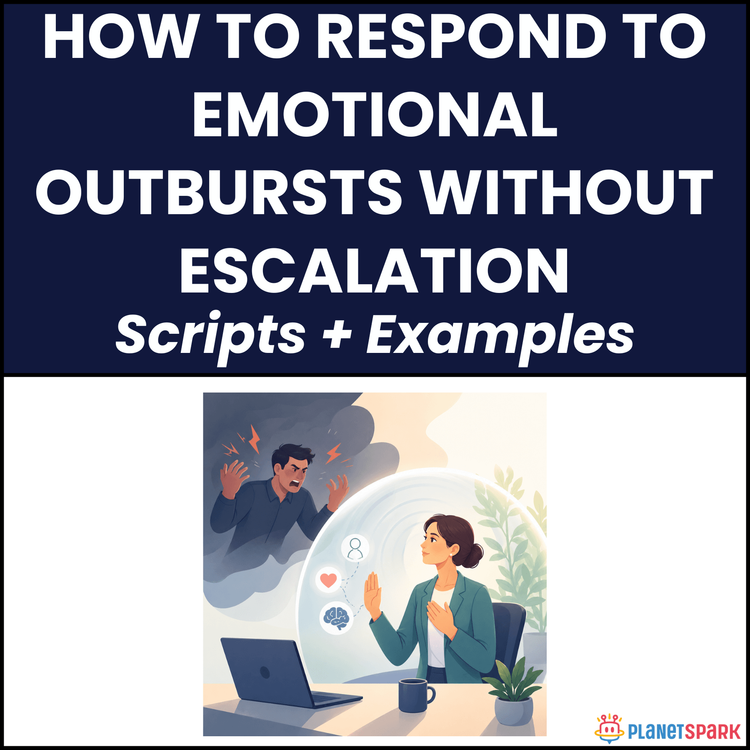
How To Respond To Emotional Outbursts Without Escalation
Managing Emotional Outbursts at Work: A Practical Guide for Professionals
You’re in a meeting, and suddenly someone raises their voice. A client sends a harsh email. A manager reacts sharply under pressure. In that moment, your instinct might be to defend yourself, stay silent, or react with the same intensity.
But here’s the reality: how you respond in these moments defines your professional reputation far more than your technical skills or presentations.
Most professionals are never trained for this. They are taught what to say — not how to respond when emotions are high. That’s where the resource “How to Respond to Emotional Outbursts Without Escalation” becomes critical — giving you practical frameworks, ready-to-use scripts, and real-world guidance to stay calm and in control.
Who Is This Resource For?
This guide is designed for:
- Working professionals dealing with difficult conversations at work
- Managers handling emotional team members or high-pressure situations
- Client-facing professionals managing escalations and complaints
- Individuals who struggle with reacting, freezing, or over-apologising
- Anyone who wants to build confidence in handling conflict calmly
If you’ve ever replayed a conversation thinking “I should have handled that better,” this resource is for you.
What Does This Resource Contain?
This resource is highly practical and structured for real-world use. It includes:
- A clear 3-phase de-escalation framework:
- Regulate (manage yourself first)
- Acknowledge (validate emotions without agreeing)
- Redirect (move the conversation forward)
- Step-by-step guidance on handling emotional situations in real time
- A self-regulation checklist with techniques like breathing, pausing, and body awareness
- Word-for-word scripts for different workplace scenarios:
- Angry colleague
- Upset client
- Critical manager
- Emotional team member
- The “Acknowledge → Bridge → Forward Move” communication structure
- A complete scripts bank for meetings, emails, and one-on-one situations
- A real-world case study showing escalation vs de-escalation in action
- Common mistakes professionals make and how to fix them
- A personal de-escalation planning worksheet
- A self-evaluation tool to track your improvement
Summary of the Resource
This guide gives you a repeatable system to handle emotionally charged situations without losing control or damaging relationships.
Instead of reacting impulsively, you learn how to:
- Stay calm under pressure
- Respond with clarity and control
- De-escalate tension quickly
- Guide conversations toward resolution
The result is stronger communication, better relationships, and higher professional credibility.
How Will This Resource Be Useful?
This resource directly improves how you handle real workplace situations.
You will be able to:
- Stay composed even when others lose control
- Avoid common mistakes like overreacting, shutting down, or over-apologising
- Reduce conflict escalation in meetings, emails, and client interactions
- Communicate with authority without sounding aggressive
- Build trust and respect in difficult situations
- Improve your emotional intelligence in practical, visible ways
It also helps you understand that most emotional outbursts are not about you — they are driven by stress, fear, or lack of control. Recognising this changes how you respond entirely.
How Should You Use This Resource?
To get real value, use this guide actively — not passively.
Step 1: Understand the Framework
Start by learning the 3-phase model: Regulate, Acknowledge, Redirect. This becomes your mental structure during difficult moments.
Step 2: Practise Self-Regulation
Use simple techniques like:
- Pausing for 3 seconds
- Slowing your voice
- Controlling body language
Step 3: Learn Key Scripts
Pick 2–3 acknowledgement and redirect scripts and practise them aloud. This reduces hesitation during real situations.
Step 4: Apply in Real Situations
Use the framework the next time you face:
- A tense meeting
- A difficult email
- A reactive colleague
Step 5: Reflect and Improve
After each situation, review:
- What worked
- What didn’t
- What you’ll do differently next time
Step 6: Create Your Personal Plan
Fill in the de-escalation worksheet to prepare for specific people or scenarios you regularly face.
Action Steps
Start applying this immediately:
- Choose one common situation you face (e.g., aggressive emails or meetings)
- Write one acknowledgement script you will use next time
- Practise saying it out loud today
- Next time a situation arises, pause for 3 seconds before responding
- Use the structure: Acknowledge → Bridge → Redirect
- After the interaction, reflect on your response
- Repeat consistently to build confidence
Handling emotional outbursts is not about being passive or avoiding conflict. It’s about staying in control when others are not.
When you master this skill, you become someone people trust in high-pressure situations. You communicate with clarity, maintain professionalism, and turn difficult moments into opportunities for leadership.
This is not an inborn trait — it is a learnable, practical skill. And once you develop it, it becomes one of your strongest professional advantages.