
How to Respond to Subtle Undermining Behaviors Professionally

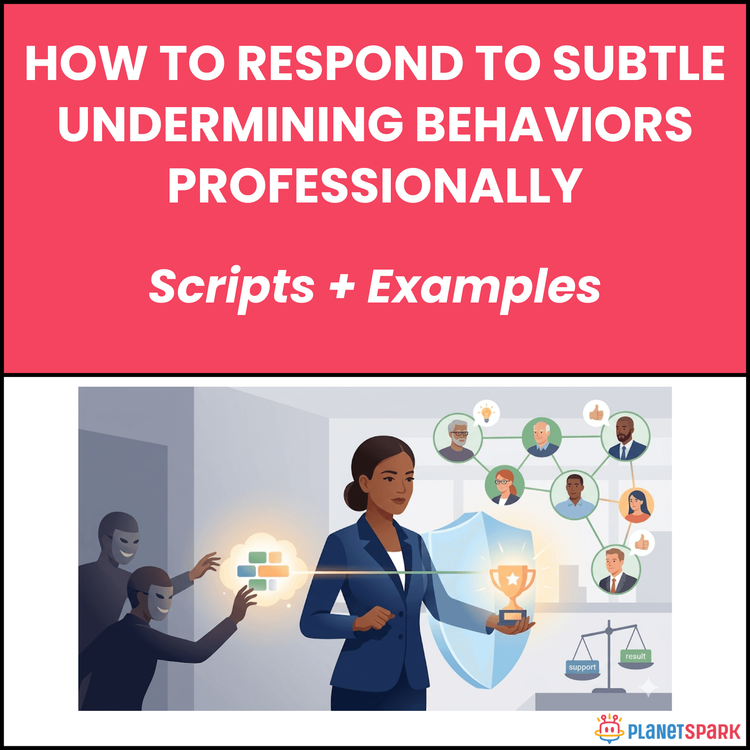
How to Respond to Subtle Undermining Behaviors Professionally
Recognising Hidden Workplace Power Plays Before They Damage Your Credibility
You know the feeling.
You share an idea in a meeting, and someone repeats it five minutes later—this time getting the credit.
You start speaking, and someone cuts you off.
You get left out of important email threads tied directly to your work.
Nothing looks dramatic on the surface. No one is openly hostile. No rules appear broken.
And yet, over time, these moments chip away at something critical—your confidence, your visibility, and your professional credibility.
That is exactly why the resource How to Respond to Subtle Undermining Behaviours Professionally was created. It gives working professionals the language, frameworks, and real-world scripts needed to respond calmly, protect their credibility, and reclaim their professional presence without becoming confrontational.
Who Is This Resource For?
This resource is designed for professionals who regularly navigate workplace politics, team dynamics, and high-stakes communication.
It is especially useful for:
• Early-career professionals learning how to establish credibility
• Career switchers adapting to new workplace cultures
• Mid-career professionals leading projects or influencing stakeholders
• Consultants managing client relationships and cross-functional teams
• Managers handling complex interpersonal dynamics
• Professionals who often feel overlooked, interrupted, excluded, or professionally minimized
If you have ever left a meeting thinking, “Something about that didn’t feel right,” this resource was built for you.
What Does This Resource Contain?
This is not another generic workplace communication guide.
It is a highly practical scripts-and-frameworks playbook built around real professional situations.
Inside the resource, you’ll find:
1. The Behaviour Map
The playbook first helps you identify six common forms of subtle undermining, including:
• Idea theft or lack of attribution
• Interrupting and talking over
• Condescending qualifiers
• Public dismissal
• Exclusion from key communications
• Gaslighting or making you feel oversensitive
This helps professionals move from emotional confusion to behavioural clarity. The visual behaviour map on page 3 makes these patterns easy to identify in real-world settings.
2. Real-Time Professional Scripts
One of the strongest parts of this resource is its ready-to-use scripts for difficult moments.
It covers how to respond when:
• You are interrupted mid-sentence
• Someone presents your idea as their own
• Your work is subtly minimized
• Your suggestions are publicly dismissed
• You are left out of important communication
• Your concerns are framed as “too sensitive”
Each script follows a simple communication architecture:
Acknowledge → Redirect → Reclaim
This structure allows you to stay professional while protecting your position.
3. The P.A.C.E. Framework
The resource introduces a powerful decision-making framework:
• Pause
• Assess
• Choose
• Execute
This helps you decide whether to:
• Address the issue immediately
• Address it privately
• Document it strategically
Instead of reacting emotionally, you learn how to respond with judgment.
4. Action Toolkit
The resource also includes practical implementation tools such as:
• Pre-response checklist
• Post-incident reflection questions
• Documentation templates
• 48-hour documentation rule
These tools help you build consistency, protect yourself professionally, and identify patterns before escalation becomes necessary.
5. Real-World Case Study
The case study of Priya shows how a professional moved from being overlooked and interrupted to becoming visibly respected and recognized—using calm, strategic communication instead of confrontation.
This section makes the frameworks feel practical, realistic, and immediately usable.
6. Personal Response Plan Worksheet
The final section includes a guided worksheet that helps you personalize your response strategy based on your real workplace situation.
You identify:
• Your specific challenge
• Your default reaction pattern
• Your P.A.C.E. assessment
• Your personalized script
• Your next action commitment
Summary of the Resource
If you only have one minute, here’s what this resource does:
It helps you stop absorbing subtle undermining behaviours silently.
Instead of freezing, overreacting, or second-guessing yourself, you learn how to identify patterns, choose the right response, and protect your professional identity with calm authority.
This is not about confrontation.
It is about clarity.
How Will This Resource Be Useful?
When applied consistently, this resource can help you:
• Speak up confidently in difficult situations
• Protect your ideas, contributions, and visibility
• Build stronger professional boundaries
• Improve how leadership and peers perceive your presence
• Reduce internal self-doubt after difficult interactions
• Navigate politics without becoming political
• Strengthen emotional intelligence under pressure
Over time, this doesn’t just change conversations.
It changes how people treat you.
How Should You Use This Resource?
To get maximum value, follow this process:
Step 1: Start with awareness
Review the Behaviour Map and identify patterns that feel familiar.
Step 2: Choose your scenario
Find the script that matches your most common workplace challenge.
Step 3: Practice the script
Read it aloud at least three times.
Adapt the language to sound natural in your voice.
Step 4: Apply the P.A.C.E. framework
Before your next difficult interaction, decide whether to address, discuss privately, or document.
Step 5: Reflect after each incident
Use the reflection and documentation tools to track patterns and improve your responses.
Step 6: Review monthly
Update your personal response plan every 30 days as your confidence grows.
Action Steps
If you’re accessing this resource today, do these five things immediately:
1. Identify one workplace interaction that has been bothering you
2. Name the exact behaviour instead of the emotion it created
3. Choose the most relevant script from the resource
4. Practice it aloud until it feels natural
5. Commit to using it in your next relevant conversation
Do not wait for the perfect moment.
Prepared professionals create their own.
In modern workplaces, your expertise matters—but your ability to protect your credibility matters just as much.
Subtle undermining behaviours can quietly shrink your presence if left unaddressed.
But with the right language, the right frameworks, and consistent practice, those same moments can become opportunities to strengthen your voice, reinforce your value, and reshape how others engage with you.
This resource gives you that edge.
Now it’s your move.