
How To Separate Signal From Noise In Decision Inputs

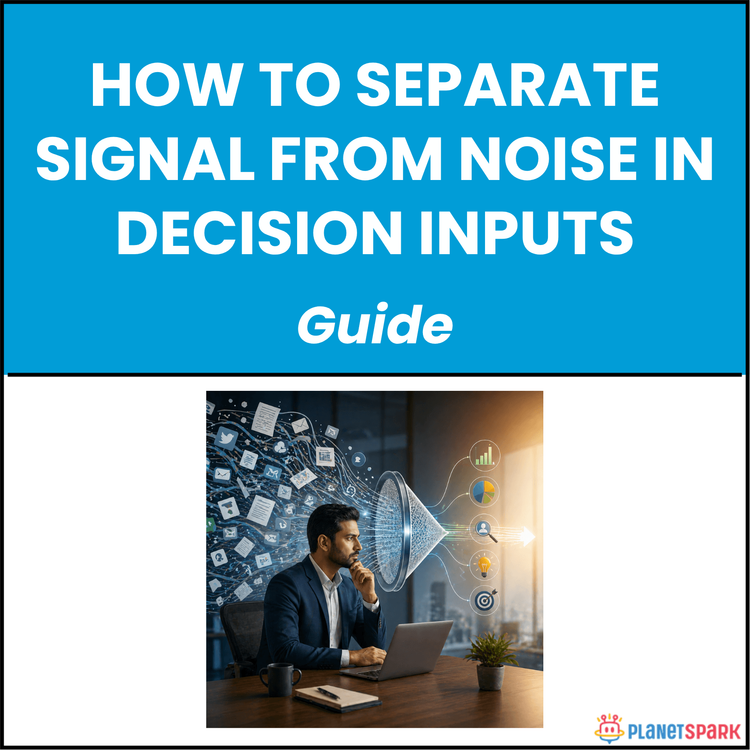
How To Separate Signal From Noise In Decision Inputs
How to Separate Signal From Noise in Decision-Making: A Practical Guide for Professionals Facing Information Overload
If you’ve ever felt overwhelmed by too much information while trying to make an important decision—you’re not alone.
Today’s professionals don’t struggle because they lack data. They struggle because they have too much of it.
Emails, opinions, reports, LinkedIn posts, advice from peers, industry trends—everything feels important. But very little actually helps you decide.
So what happens?
You overanalyse.
You delay decisions.
You get influenced by the loudest voice instead of the right input.
That’s exactly why the resource “How to Separate Signal From Noise in Decision Inputs” exists. It gives you a structured, repeatable system to filter information, focus on what truly matters, and make faster, smarter decisions with confidence.
Instead of drowning in inputs, you start filtering with clarity.
Who Is This Resource For?
This resource is especially valuable if you are:
- A working professional with 0–15 years of experience
- A manager or consultant handling complex decisions
- A career switcher evaluating multiple opportunities
- A professional dealing with information overload
- Someone who tends to overthink or delay decisions
- A professional who wants sharper judgment and faster execution
If you’ve ever thought, “I have too much information but still no clarity,” this guide is built for you.
What Does This Resource Contain?
This is not a generic decision-making guide—it is a complete filtering system for real-world use.
Inside the resource, you’ll find:
- A clear explanation of the “signal vs noise” problem and why it affects professionals (page 2)
- A precise definition of:
- Signal (relevant, credible, decision-impacting information)
- Noise (irrelevant or non-actionable inputs—even if accurate) (page 4)
- A step-by-step system to define signal before collecting inputs (page 5), including:
- Writing a clear decision statement
- Identifying 3–5 decision criteria
- Defining credible sources
- Setting a decision deadline
- The 4-Source Model (page 6), which classifies inputs into:
- Core Signal (act immediately)
- Provisional Signal (verify)
- Contextual Noise (store but don’t prioritise)
- Pure Noise (discard)
- The Signal Verification Protocol (page 7), with 3 key questions:
- Is it reproducible?
- Is it contextually relevant?
- Does it change your decision?
- The 7 Noise Traps (page 8), including:
- Loudest Voice Trap
- Trend Seduction Trap
- Expert Halo Trap
- Recency Bias
- Consensus Illusion
- Data Volume Trap
- A Decision Input Audit worksheet (page 9) to evaluate and categorise inputs
- The Signal Hierarchy (page 11), which prioritises inputs into:
- Tier 1: Decisive Signals
- Tier 2: Weighting Signals
- Tier 3: Contextual Signals
- Tier 4: Background Signals
- A real-world case study (page 12) showing how structured filtering leads to faster, better decisions
- A Signal Filter Checklist (page 13) for real-time decision validation
- A system to build your personal “Signal Intelligence” ecosystem (page 16)
Everything is designed for immediate application—not theory.
Summary of the Resource
“How to Separate Signal From Noise in Decision Inputs” is a practical decision-making framework that helps professionals filter irrelevant information, focus on high-quality inputs, and make confident decisions faster.
It transforms decision-making from a reactive, overwhelmed process into a structured, controlled system.
If you want to stop overthinking and start deciding with clarity, this resource gives you the system.
How Will This Resource Be Useful?
This resource helps you move from information overload to decision clarity.
You’ll gain:
- A clear method to filter useful vs irrelevant information
- Faster decision-making without sacrificing quality
- Reduced mental fatigue and overthinking
- Better ability to prioritise what truly matters
- Stronger confidence in your decisions
- Improved professional credibility and judgment
- A repeatable system you can apply across decisions
As explained in the introduction (page 2), the goal is not to gather more data—but to identify and act on the right data before the opportunity window closes.
Most importantly, it helps you stop reacting to noise—and start acting on signal.
How Should You Use This Resource?
To get the best results, follow a structured approach:
Start with clarity:
- Write your decision in one precise sentence
- Define 3–5 criteria that matter most
- Set a decision deadline
Filter inputs:
- Categorise every input using the 4-Source Model
- Avoid treating all inputs equally
Verify before trusting:
- Apply the Signal Verification Protocol
- Remove inputs that fail reproducibility or relevance
Watch for traps:
- Identify if you are influenced by loud voices, trends, or recent inputs
- Challenge your assumptions
Build hierarchy:
- Identify Tier 1 (non-negotiables)
- Prioritise Tier 2 signals
- Avoid over-focusing on Tier 3 and 4
Make the decision:
- Use only Core Signals to justify your choice
- Avoid unnecessary delay
Review and improve:
- Reflect on outcomes
- Identify which signals were useful
- Improve your filtering over time
As shown in the quick reference framework (page 18), the sequence—Define → Filter → Verify → Prioritise → Decide—creates a reliable decision system. :contentReference[oaicite:2]{index=2}
Action Steps
After accessing this resource, take these steps immediately:
1. Identify one decision you are currently facing
2. Write it clearly in one sentence
3. Define 3–5 decision criteria
4. List all current inputs (opinions, data, advice)
5. Categorise them using the 4-Source Model
6. Apply the Signal Verification Protocol to uncertain inputs
7. Identify your top 3 Core Signals
8. Build a simple signal hierarchy
9. Make the decision using only high-quality inputs
Clarity doesn’t come from more information—it comes from better filtering.
The most effective professionals are not those who consume the most data.
They are the ones who know what to ignore.
When you learn to separate signal from noise, your decisions become faster, your thinking sharper, and your outcomes more consistent.
And over time, that becomes a powerful professional advantage.
Book your free session today!