
How to Stay Consistent With Systems in Unpredictable Environments

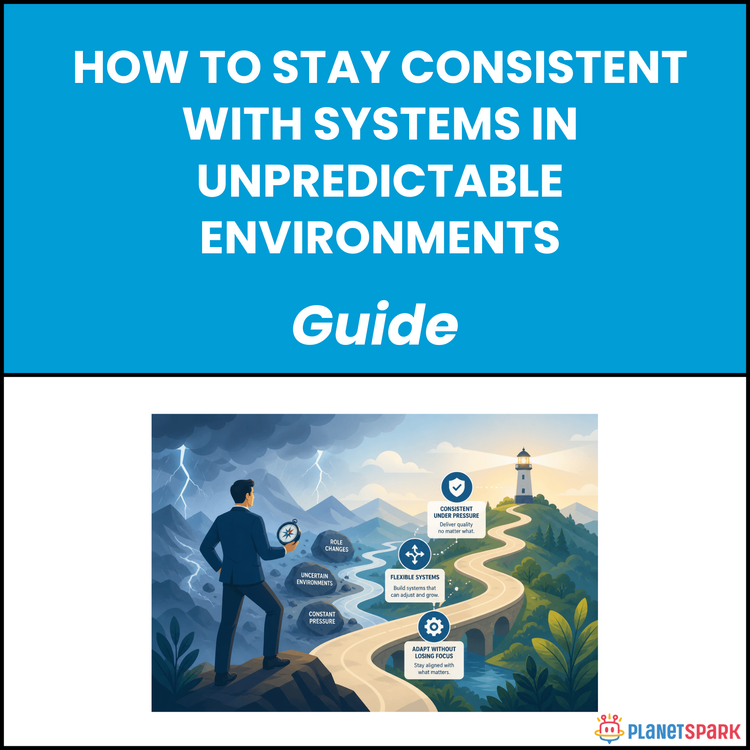
How to Stay Consistent With Systems in Unpredictable Environments
Consistency That Survives Chaos: A Practical System for Staying on Track Even When Your Schedule Isn’t
Most professionals don’t struggle with starting systems — they struggle with sustaining them.
You begin with a solid plan. A new routine. A structured workflow. And for a few days — sometimes even weeks — everything works. You feel organised, productive, and in control.
Then reality kicks in.
Meetings pile up. Deadlines shift. Travel disrupts your schedule. Energy drops. And slowly, almost quietly, your system starts to break. Not because you lack discipline — but because your system wasn’t designed for the environment you actually operate in.
This is exactly the problem the “How to Stay Consistent With Systems in Unpredictable Environments” resource is built to solve. It helps you design systems that don’t collapse under pressure — systems that bend, adapt, and recover so your progress never resets to zero.
Who Is This Resource For?
This playbook is designed for professionals who operate in dynamic, unpredictable environments and need systems that actually hold.
It is especially useful for:
- Early to mid-career professionals managing multiple priorities
- Managers and team leads dealing with shifting workloads
- Consultants working across clients, time zones, and travel schedules
- Career switchers building new routines in unfamiliar environments
- Professionals who feel “consistent for a few days, then off track again”
If your schedule rarely goes as planned, this resource is built specifically for your reality.
What Does This Resource Contain?
This is a structured, deeply practical system — not generic productivity advice. It combines frameworks, templates, and step-by-step exercises you can apply immediately.
Inside, you’ll find:
- The Adaptive Consistency Framework (6-Step System)
A complete model covering:
- System audit
- Designing for disruption
- Trigger-based execution
- Recovery protocols
- Environmental design
- Weekly structure
- System Audit Worksheet
A diagnostic tool to:
- List your current systems
- Score how well they survive chaotic weeks
- Identify exact breakpoints
- The Three-Version Framework
Design every system in three forms:
- Full version (ideal conditions)
- Reduced version (busy days)
- Minimum version (non-negotiable floor)
- Trigger Mapping Framework
Replace fragile time-based habits with:
- Action triggers
- Event triggers
- Location triggers
- Transition triggers
- Recovery Protocol Template
A pre-defined system to:
- Restart after disruption
- Avoid “one bad day → bad week” spirals
- Rebuild momentum gradually
- Environmental Architecture Strategies
Practical ways to:
- Reduce friction for good behaviours
- Increase friction for distractions
- Make consistency easier without relying on willpower
- Weekly Architecture Template
A flexible weekly structure including:
- Non-negotiable anchors
- Flexible work blocks
- Buffer zones (minimum 20%)
- Real-World Case Study
A consultant’s transformation from constantly restarting systems to maintaining consistency even during chaotic travel weeks.
- Common Mistakes + Fixes
Clear guidance on avoiding:
- Overly rigid systems
- All-or-nothing thinking
- Tool dependency instead of system design
- 7-Day Action Plan
A step-by-step plan to implement everything within one week.
Summary of the Resource
At its core, this resource teaches one powerful shift:
Consistency is not about discipline — it’s about design.
Instead of trying to “be more consistent,” you learn how to build systems that:
- Work even on your worst days
- Adapt to changing conditions
- Recover quickly when disrupted
- Continue generating progress without reset
It moves you from fragile routines to resilient systems.
How Will This Resource Be Useful?
The real value of this resource is that it removes the stop-start cycle most professionals are stuck in.
You will gain:
- Sustainable consistency
Systems that continue even during busy or chaotic periods.
- Reduced mental load
Less decision-making, less reliance on motivation.
- Faster recovery from disruptions
You don’t lose weeks — you reset within days.
- More predictable progress
Your output becomes stable, not dependent on perfect conditions.
- Stronger professional reliability
Others start seeing you as consistent, dependable, and structured.
In short, it helps you stay on track — even when everything around you isn’t.
How Should You Use This Resource?
To get maximum value, treat this as a system-building guide — not just something to read.
Step 1: Audit your current systems
Identify what you’re currently using and how it performs under pressure.
Step 2: Redesign one system first
Choose the most important system and apply the three-version framework.
Step 3: Anchor it to triggers
Replace time-based habits with reliable “if–then” triggers.
Step 4: Build your recovery protocol
Decide in advance how you will restart after disruption.
Step 5: Adjust your environment
Make small changes that make the right behaviour easier to execute.
Step 6: Design your weekly structure
Define 2–3 non-negotiable anchors and build buffer space.
Step 7: Implement using the 7-day plan
Focus on one step per day — don’t try to overhaul everything at once.
Action Steps
If you want to start immediately, follow this:
1. List your current systems (planning, tasks, reviews, learning, etc.)
2. Rate how each performs during a chaotic week (1–5)
3. Choose one system that breaks most often
4. Define its full, reduced, and minimum versions
5. Attach it to one reliable daily trigger
6. Write a simple recovery protocol for when it fails
7. Block 20% buffer time in your upcoming week
These steps alone can dramatically improve your consistency within days.
Most professionals assume consistency comes from discipline. So when their systems break, they blame themselves.
But the truth is simpler — and more useful.
Your systems didn’t fail because you’re inconsistent. They failed because they were built for a version of your life that doesn’t exist.
Once you start designing for reality — for disruption, variability, and pressure — everything changes.
Consistency stops feeling like a struggle. It becomes something your systems naturally support.
Book your free session today!