
How to Stay Neutral in Political Conflicts

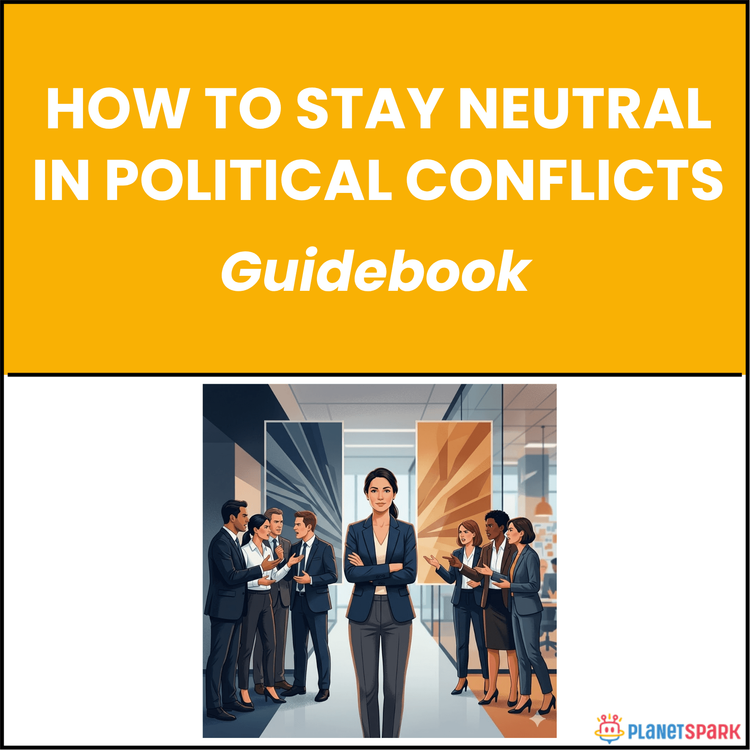
How to Stay Neutral in Political Conflicts
How to Stay Neutral in Workplace Political Conflicts: A Practical Framework for Professionals
You don’t have to be in a leadership role to get pulled into workplace politics. It happens quietly—two senior stakeholders disagree, a colleague seeks your “honest opinion,” or your team is divided on a sensitive issue. Suddenly, you’re expected to take a side.
And that’s where most professionals make a costly mistake.
They react too quickly, speak too freely, or try to stay silent without a strategy. The result? Damaged relationships, lost credibility, and unnecessary stress.
This is exactly why the “How to Stay Neutral in Political Conflicts” guide exists. It is designed to help working professionals navigate politically charged situations with clarity, confidence, and control—without compromising their integrity or career growth.
Who Is This Resource For?
This resource is especially valuable for:
- Early to mid-career professionals who are experiencing workplace politics for the first time
- Managers and team leads handling cross-functional conflicts
- Consultants and client-facing professionals balancing multiple stakeholders
- Job seekers or career switchers entering complex organizational environments
- Professionals working in high-visibility or high-stakes roles
If your work involves people, influence, or decision-making, this resource is directly relevant to you.
What Does This Resource Contain?
This guidebook is structured as a practical, step-by-step playbook with actionable tools you can apply immediately.
Here’s what you’ll find inside:
- A clear understanding of workplace political conflicts
Learn how to identify when a situation is truly political (power, influence, or identity-driven) and the different types of conflicts you may encounter.
- The Neutrality Navigator (3-Phase Framework)
A structured approach covering:
- Prepare: Build awareness, relationships, and boundaries before conflict arises
- Navigate: Maintain neutrality using language, listening, and positioning
- Rebuild: Restore trust and strengthen your reputation after the conflict
- Step-by-step tactical guidance (Steps 1–9)
From reading the room and mapping power dynamics to managing visibility and rebuilding relationships.
- Communication frameworks
Including:
- Neutral language examples (what to say and what to avoid)
- The CALM Listening Protocol (Clarify, Acknowledge, Limit, Move Forward)
- Decision-making tools
The NEUTRAL model—a quick mental checklist for handling politically sensitive moments in real time.
- Checklists and worksheets
- Weekly neutrality checklist
- Post-conflict reflection worksheet
- Boundary-setting prompts
- Real-world case example
A practical scenario showing how to handle conflicts between senior stakeholders without damaging your position.
- Common mistakes and fixes
Learn the most frequent neutrality failures—and exactly how to avoid them.
Summary of the Resource
This is not a theoretical guide. It is a practical system that helps you stay neutral before, during, and after workplace conflicts.
By using this resource, you will learn how to:
- Understand the true dynamics behind conflicts
- Communicate without unintentionally taking sides
- Maintain trust with multiple stakeholders
- Protect your professional reputation in high-stakes situations
In short, it helps you become someone who is trusted by everyone—even in difficult environments.
How Will This Resource Be Useful?
The real value of this guide lies in the outcomes it helps you achieve.
You will be able to:
- Make better decisions under pressure
Instead of reacting emotionally, you will respond with clarity and structure.
- Protect and strengthen professional relationships
Maintain credibility with all parties, even when tensions are high.
- Build a reputation for maturity and integrity
Become known as someone who de-escalates situations rather than amplifies them.
- Reduce stress and mental overload
With clear frameworks, you won’t feel stuck or unsure in politically charged moments.
- Increase long-term career growth
Neutral professionals are often trusted with bigger responsibilities and cross-functional roles.
How Should You Use This Resource?
To get the most value, approach this guide as a working tool—not just a one-time read.
Step 1: Read the entire guide once
Understand the full framework and how all parts connect.
Step 2: Apply Phase 1 immediately
- Map your workplace relationships
- Identify power dynamics
- Define your personal boundaries
Step 3: Use Phase 2 in real situations
- Practice neutral language
- Apply the CALM listening framework
- Be intentional about your visibility and interactions
Step 4: Use checklists regularly
Run the neutrality checklist weekly or after key interactions to stay on track.
Step 5: Reflect after every conflict
Complete the post-conflict worksheet within 48 hours to identify what worked and what didn’t.
Step 6: Revisit and refine
Return to specific sections as needed. Over time, this becomes a habit, not a conscious effort.
Action Steps
If you want to start using this resource immediately, follow these steps:
1. Identify one current or recent workplace conflict
2. Map all stakeholders and their interests
3. Define your non-negotiable and judgment boundaries
4. Replace agreement-based responses with neutral language
5. Use the CALM protocol in your next difficult conversation
6. Run the NEUTRAL checklist before any high-stakes interaction
7. Complete a post-conflict reflection within 48 hours
These small, consistent actions will help you build neutrality as a skill—not just an intention.
Workplace politics are not going away. But your response to them can completely change your career trajectory. The professionals who grow consistently are not the loudest or the most opinionated—they are the most trusted. By applying the frameworks in this guide, you position yourself as someone who can navigate complexity with calm, think clearly under pressure, and maintain relationships across divides. That is not just a soft skill. It is a long-term career advantage. Start using this resource in your next real situation. The more you practice, the more natural it becomes—and the more valuable you become in any organization.
Book your free session today!