
How to Transition From Informal Leadership to Official Roles Strategically

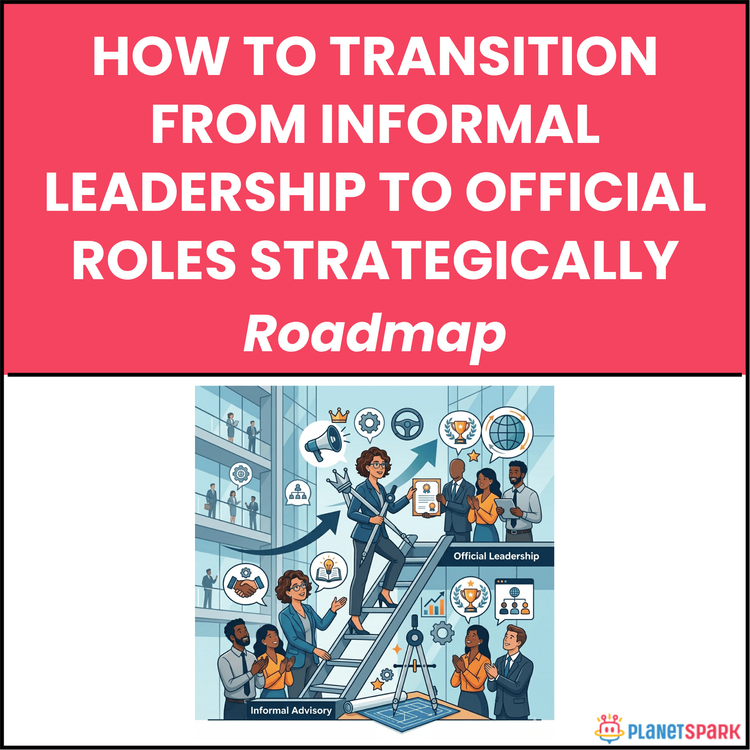
How to Transition From Informal Leadership to Official Roles Strategically
A Strategic Guide to Transition from Informal Leadership to a Formal Leadership Role
If you’ve ever been “the go-to person” on your team—but never received the title, recognition, or promotion to match—you’re not alone. Many professionals consistently step up, solve problems, guide others, and drive outcomes… yet remain unofficial leaders.
The frustrating part? It’s rarely a capability issue. More often, it’s a visibility, positioning, and strategy gap. While some professionals wait to be recognised, others deliberately build a case for leadership—and get ahead.
That’s exactly why the resource “How To Transition From Informal Leadership to Official Roles Strategically” exists. It’s designed to help you convert the leadership you’re already demonstrating into formal authority, recognition, and career progression.
Who Is This Resource For?
This resource is especially valuable if you are:
- A working professional with 0–15 years of experience
- Someone already taking initiative beyond your job role
- A team member informally guiding others without a leadership title
- A mid-career professional aiming for promotion into management or leadership roles
- A high performer who feels overlooked despite strong contributions
- A professional unsure how to position yourself for leadership opportunities
If you’re already acting like a leader but not being recognised as one—this guide is built for you.
What Does This Resource Contain?
This is not generic leadership advice. It’s a structured roadmap that helps you move from informal influence to formal authority step by step.
Inside the resource, you’ll find:
- A clear explanation of why informal leaders often get overlooked
- A structured audit framework to identify your existing leadership contributions
- Methods to map influence, stakeholders, and leadership impact
- A system to quantify and articulate your leadership outcomes
- A visibility strategy to ensure the right people recognise your work
- Practical actions to increase presence in senior conversations and cross-functional work
- A framework to craft a compelling leadership narrative (past, present, future)
- Real examples of strong leadership positioning statements
- A guide to understanding and activating sponsorship (not just mentorship)
- A step-by-step approach to building relationships with senior leaders
- A leadership portfolio system to document and track your impact
- A structured evidence framework across decision-making, people development, and problem-solving
- A 90-day transition plan for stepping into a formal leadership role successfully
- A real-world case study showing how deliberate strategy leads to promotion
- A final action plan to start immediately
Everything is designed to help you act with intention—not wait for recognition.
Summary of the Resource
“How To Transition From Informal Leadership to Official Roles Strategically” is a practical playbook that helps professionals turn invisible leadership into visible, credible, and promotable impact.
It gives you a clear system to audit your current contributions, build visibility, position your leadership identity, and create the evidence needed to move into formal roles.
If you apply this consistently, you stop hoping for promotion—and start becoming the obvious choice.
How Will This Resource Be Useful?
This resource helps you move from being overlooked to being recognised.
You’ll gain:
- Clarity on the leadership impact you’re already creating
- Confidence in articulating your readiness for formal roles
- A structured approach to increasing visibility without feeling self-promotional
- Strong positioning in promotion discussions and performance reviews
- Better relationships with decision-makers and senior stakeholders
- A clear system to document and prove your leadership contributions
- Higher chances of moving into official leadership roles faster
Most importantly, it helps you stop waiting for validation—and start building it strategically.
How Should You Use This Resource?
To get the best results, follow a phased approach:
Start with the Informal Leadership Audit. Identify and document the leadership actions you’ve already taken over the past 6–12 months.
Next, map your stakeholders and influence network. Understand who relies on your input and where your impact is strongest.
Then, build your visibility strategy. Start contributing in meetings, sharing outcome-focused updates, and participating in cross-functional work.
Once your visibility improves, craft your leadership narrative. Create a clear, concise story that connects your past impact to your future leadership potential.
At the same time, begin building relationships with potential sponsors. Focus on adding value before seeking support.
Parallelly, create your Leadership Portfolio. Document your impact consistently—this becomes your strongest proof during promotion discussions.
Finally, when you transition into a formal role, follow the 90-day plan to establish credibility, build trust, and lead effectively from the start.
You can revisit this resource whenever you:
- Prepare for a promotion or role transition
- Have performance or career growth discussions
- Feel your leadership is not being recognised
- Step into a new leadership role
Action Steps
After accessing this resource, take these steps immediately:
1. List 8–10 leadership moments from the past 12 months
2. Identify where you’ve influenced decisions, people, or outcomes
3. Quantify at least 3 of these contributions with clear results
4. Draft your 3–5 sentence leadership narrative
5. Identify one senior stakeholder or potential sponsor
6. Find one opportunity to increase your visibility this week
7. Start your Leadership Portfolio with at least 3 documented examples
These small but focused actions can significantly accelerate your leadership transition.
Leadership is not just about what you do—it’s about how clearly others can see, understand, and trust your impact. The professionals who move ahead are not always the most capable—they are the most deliberate in how they position themselves.
Use this resource not just to get promoted, but to take control of your leadership journey with clarity, confidence, and strategy.