
Identifying Biases That Distort Your Decision Process

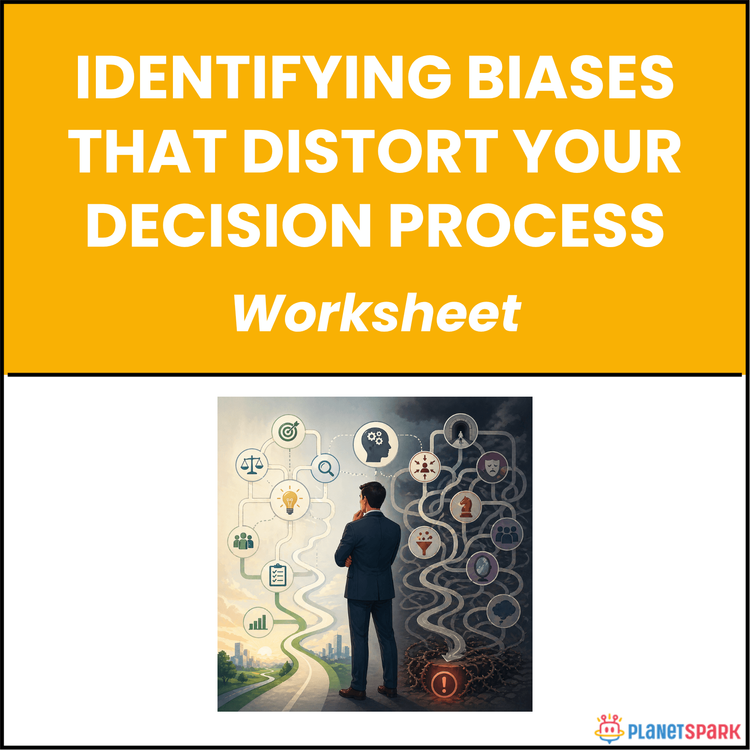
Identifying Biases That Distort Your Decision Process
Identifying Biases That Distort Your Decision Process: A Practical Guide to Making Sharper, Fairer, and More Confident Decisions
If you’ve ever made a decision that felt right in the moment—but turned out to be flawed later—you’re not alone.
Most professionals believe they are rational, data-driven thinkers. But in reality, every decision you make is influenced by hidden cognitive biases—mental shortcuts that quietly distort how you interpret information, evaluate options, and choose outcomes.
The problem is not that bias exists. The problem is that it operates invisibly.
That’s exactly why the resource “Identifying Biases That Distort Your Decision Process” exists. It helps you uncover the hidden patterns influencing your thinking—and gives you a practical system to interrupt them before they affect your decisions.
Instead of relying on instinct, you start thinking deliberately.
Who Is This Resource For?
This resource is especially valuable if you are:
- A working professional with 0–15 years of experience
- A manager or leader making people, hiring, or strategy decisions
- A consultant evaluating data, recommendations, or client options
- A career switcher navigating complex choices
- A professional who wants to improve judgment and decision quality
- Someone who wants to reduce mistakes caused by overconfidence or assumptions
If you want to make decisions that are not just fast—but fair, accurate, and well-reasoned—this resource is built for you.
What Does This Resource Contain?
This is not a theoretical psychology guide—it is a hands-on decision-improvement toolkit.
Inside the resource, you’ll find:
- A clear explanation of how cognitive biases silently distort decisions (page 2)
- Real-world examples showing how bias affects hiring, strategy, and business decisions
- A breakdown of the most common decision-distorting biases (page 3), including:
- Confirmation Bias (seeking supporting evidence only)
- Anchoring Bias (over-relying on first information)
- Availability Heuristic (overweighting recent or vivid data)
- Overconfidence Bias (overestimating your accuracy)
- Affinity Bias (favouring people similar to you)
- Sunk Cost Fallacy (continuing because of past investment)
- A structured Self-Audit checklist (page 4) to identify your personal bias patterns
- The PAUSE Framework (page 5)—a 5-step system to interrupt bias in real time:
- Pause before concluding
- Ask what’s missing
- Unpack assumptions
- Seek a disconfirming voice
- Evaluate with fresh eyes
- Real-world professional scenarios (page 6) demonstrating bias in action
- A Decision Debrief Worksheet (page 7) to analyse past decisions and improve future ones
- Daily debiasing habits (page 8) such as:
- Pre-mortem thinking
- Weekly bias logs
- Devil’s advocate roles
- Pre-decision scorecards
Common mistakes professionals make while trying to avoid bias—and how to fix them (page 9)
- A 30-day structured debiasing plan (page 11) to build long-term decision discipline
Everything is designed for immediate, real-world use—not passive reading.
Summary of the Resource
“Identifying Biases That Distort Your Decision Process” is a practical self-awareness and decision-improvement toolkit.
It helps you:
- Recognise hidden biases influencing your thinking
- Identify your personal decision blind spots
- Apply structured methods to reduce bias
- Improve fairness, accuracy, and clarity in decisions
- Build long-term decision-making discipline
If you want to make better decisions consistently—not occasionally—this resource gives you the system.
How Will This Resource Be Useful?
This resource helps you move from unconscious bias to deliberate thinking.
You’ll gain:
- Awareness of how your thinking gets distorted
- A structured way to challenge your own assumptions
- Better judgment in hiring, strategy, and daily decisions
- Reduced errors caused by overconfidence or incomplete data
- Stronger credibility and fairness in professional decisions
- A repeatable system to improve decision quality over time
As explained in the introduction (page 2), biases don’t feel like errors—they feel like intuition. This resource helps you distinguish between the two.
Most importantly, it helps you make decisions you can justify—not just defend.
How Should You Use This Resource?
To get the best results, use this as a working tool—not just reading material.
Start with awareness:
- Read the bias overview (page 3)
- Identify which biases you relate to most
Then self-audit:
- Complete the reflection checklist (page 4) honestly
- Identify your top 1–2 bias patterns
Apply in real-time:
- Use the PAUSE Framework before important decisions
- Slow down when you feel overly confident
Reflect and improve:
- Use the Decision Debrief Worksheet after key decisions
- Identify what influenced your thinking
Build habits:
- Maintain a weekly bias log
- Introduce structured tools like scorecards and devil’s advocate roles
Follow the 30-day plan (page 11) to turn awareness into consistent practice.
As highlighted in the guide, awareness alone is not enough—structure is what actually improves decisions.
Action Steps
After accessing this resource, take these steps immediately:
1. Identify one recent decision where bias may have influenced you
2. Name the specific bias (e.g., confirmation, anchoring, overconfidence)
3. Apply the PAUSE framework before your next important decision
4. Ask one person to challenge your thinking on a current choice
5. Use the Decision Debrief Worksheet for your next major decision
6. Start a simple weekly bias log
Small changes in awareness can create major improvements in outcomes.
You don’t need to eliminate bias—you need to manage it.
The most effective professionals are not the ones who think they are always right—they are the ones who question their own thinking before committing to a decision.
When you learn to see your blind spots, your decisions become clearer, fairer, and far more effective.
Book your free session today!