
Identifying Financial Blind Spots That Impact Long-Term Growth

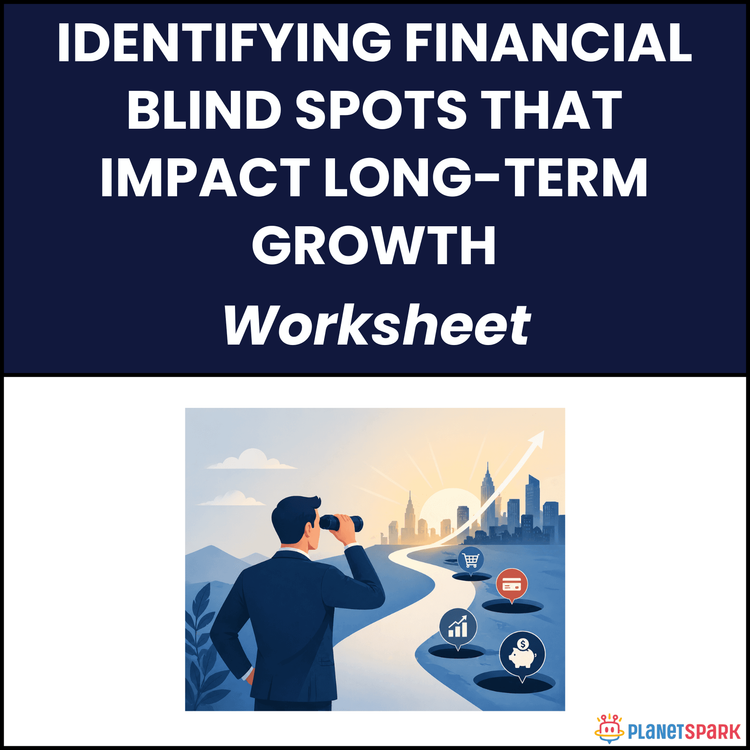
Identifying Financial Blind Spots That Impact Long-Term Growth
Common Financial Blind Spots and How to Fix Them: A Practical Self-Audit Worksheet for Working Professionals
If you’re earning well but still feel like your money isn’t growing the way it should, you’re not alone. Many working professionals hit a point where income increases—but clarity doesn’t. Savings feel inconsistent, investments feel scattered, and financial decisions are often delayed or made on assumptions.
The real issue isn’t always income. It’s awareness.
Most professionals don’t have a structured way to evaluate their financial decisions. As a result, small gaps—unnoticed and unaddressed—quietly compound over time. These are financial blind spots, and they can significantly impact your long-term growth without you even realising it.
That’s exactly why the resource “Identifying Financial Blind Spots That Impact Long-Term Growth” exists. It’s a practical, structured worksheet designed to help you pause, reflect, and take control of your financial reality with clarity and intention.
Who Is This Resource For?
This worksheet is especially valuable if you are:
- A working professional (0–15 years of experience) managing your own finances
- Someone earning well but unsure where your money is actually going
- A mid-career professional feeling financially “stuck” despite career growth
- A busy individual who hasn’t reviewed finances in a structured way
- Someone who delays financial planning due to lack of clarity or time
- A professional looking to optimise savings, investments, and financial decisions
Whether you earn ₹6 LPA or ₹60 LPA, this resource is designed to help you identify what’s missing—not just what’s working.
What Does This Resource Contain?
This is not a theoretical finance guide or investment tutorial. It’s a hands-on, self-audit worksheet that walks you through your financial reality step by step.
Inside the resource, you’ll find:
- A clear explanation of what financial blind spots are and why they matter
- A comprehensive awareness checklist covering income, expenses, assets, and liabilities
- The 6 most common financial blind spots affecting working professionals, including:
- Delayed investing
- Lifestyle inflation
- Underinsurance
- Tax inefficiency
- Lack of emergency funds
- Goal-less investing
- A personal blind spot scorecard to assess your current financial position
- A structured rating system with 30-day action planning for each gap
- Deep reflection questions to uncover hidden financial behaviours and beliefs
- A real-world case study showing how small changes can unlock major financial improvements
- A list of common financial mistakes and clear, actionable fixes
- A 90-day financial clarity action plan broken into stabilise, optimise, and systematise phases
- A prioritised checklist to help you focus on what matters most first
Everything is designed for active participation—not passive reading.
Summary of the Resource
“Identifying Financial Blind Spots That Impact Long-Term Growth” is a structured financial self-audit worksheet that helps you uncover hidden gaps in your financial life, prioritise what needs attention, and take clear, time-bound action.
Instead of giving generic advice, it helps you build a personalised financial clarity roadmap based on your current reality.
If you invest just 45–60 minutes in this resource, you’ll walk away with a clearer understanding of where you stand—and what to do next.
How Will This Resource Be Useful?
This resource helps you move from financial ambiguity to clarity and control.
You’ll gain:
- A clear, honest view of your financial health
- Awareness of gaps you may have been overlooking for years
- Better decision-making around spending, saving, and investing
- A structured way to prioritise financial actions
- Increased confidence in handling money-related decisions
- Reduced financial stress caused by uncertainty or avoidance
Most importantly, it helps you stop operating on assumptions—and start making informed, intentional financial choices.
How Should You Use This Resource?
To get maximum value, approach this worksheet in three phases:
First, read through the entire document once to understand the structure and key concepts. This builds context before action.
Next, switch to worksheet mode. Complete each section honestly:
- Fill out the awareness checklist without guessing
- Rate yourself in the blind spot scorecard
- Answer reflection questions thoughtfully, not quickly
Then, move into action:
- Identify your top financial blind spots
- Assign specific 30-day actions
- Build your 90-day plan across stabilisation, optimisation, and system-building
Finally, revisit the worksheet quarterly. Your financial situation evolves—and so should your awareness.
How you use this resource matters more than how quickly you complete it.
Action Steps
After accessing this resource, take these steps immediately:
1. Block 45–60 minutes of uninterrupted time
2. Complete the Awareness Checklist with real data (not estimates)
3. Identify which of the 6 blind spots apply to you
4. Fill out your personal scorecard honestly
5. Write down at least 3 concrete actions for the next 30 days
6. Create your 90-day financial clarity plan
7. Share your plan with someone for accountability
Even one completed action today can significantly improve your financial trajectory.
Financial growth doesn’t just come from earning more—it comes from seeing clearly, deciding intentionally, and acting consistently. Most professionals don’t struggle because they lack discipline; they struggle because they lack a structured way to evaluate their financial life.
This worksheet gives you that structure.
Use it to pause, reflect, and realign your financial decisions with your long-term goals. Because the cost of ignoring blind spots is always higher than the effort required to fix them.
Book your free session today!