

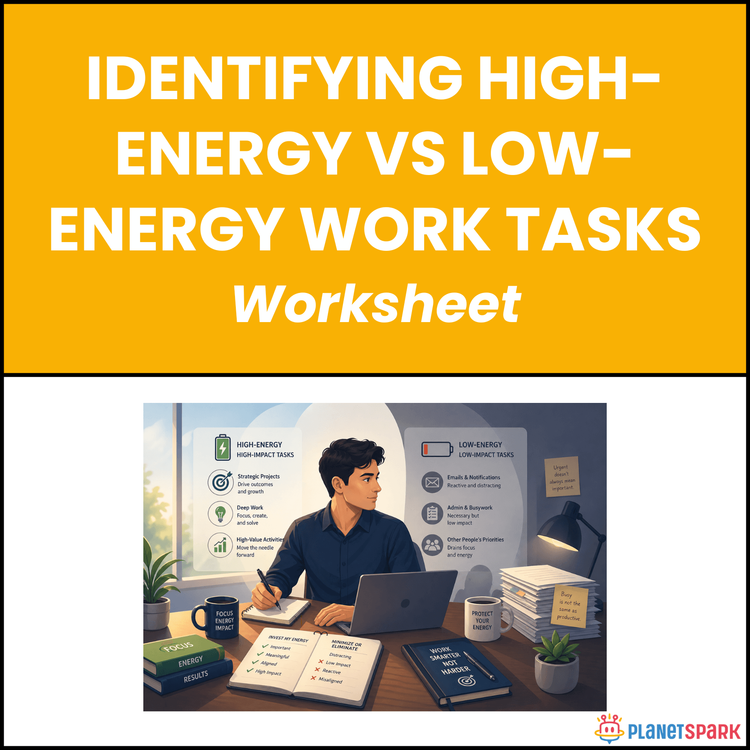
Identifying High-Energy Vs Low-Energy Work Tasks
Identify High-Energy vs Low-Energy Work Tasks: A Practical Worksheet to Boost Productivity and Work Smarter
You finish a full day of work feeling exhausted—but not satisfied. Tasks got done, meetings were attended, emails were cleared… yet your most important work barely moved forward.
This isn’t a time management problem. It’s an energy misalignment problem.
Most professionals unknowingly spend their peak mental energy on low-value tasks, and their lowest energy on high-impact work. The result? Burnout, inconsistent performance, and a constant feeling of being busy but not effective.
That’s exactly why the resource “Identifying High-Energy vs Low-Energy Work Tasks” exists. It helps you understand how different tasks affect your energy—and shows you how to redesign your workday for maximum performance, clarity, and impact.
Who Is This Resource For?
This resource is especially valuable if you are:
- A working professional with 0–15 years of experience
- A career switcher trying to align strengths with new role demands
- A manager juggling multiple responsibilities and constant decision-making
- A consultant or freelancer balancing deep work and client demands
- Someone who feels drained despite being productive
- A professional struggling to find focus or enter flow during the workday
If you want to stop working reactively and start working strategically, this worksheet is built for you.
What Does This Resource Contain?
This is not just a reflection exercise—it’s a structured system to help you map, analyse, and optimise your work based on energy.
Inside the resource, you’ll find:
- A clear explanation of what “high-energy” and “low-energy” tasks actually mean
- A practical framework to differentiate between energising, draining, and neutral tasks
- A detailed Task Energy Audit worksheet to evaluate your daily responsibilities
- A simple scoring system based on engagement, aftermath, and willingness
- An Energy-Impact Matrix to categorise tasks into four zones:
- Amplify (high energy, high impact)
- Manage (low energy, high impact)
- Enjoy (high energy, low impact)
- Eliminate (low energy, low impact)
- Reflection questions to uncover patterns in your work habits
- A structured 3-part action plan to redesign your workday
- Strategies for scheduling tasks based on peak energy windows
- Guidance on delegation, batching, and elimination of low-value tasks
- A weekly energy review system for continuous improvement
- A real-world case example showing measurable career impact
- Common mistakes professionals make when managing work energy—and how to fix them
Everything is designed to help you move from awareness to action quickly.
Summary of the Resource
“Identifying High-Energy vs Low-Energy Work Tasks” is a practical worksheet that helps you understand how your work affects your energy—and how your energy affects your performance.
Instead of treating all tasks equally, it teaches you how to prioritise based on both energy and impact, helping you focus on what truly matters.
In a short amount of time, you’ll gain clarity on where your effort is going—and how to redirect it for better results.
How Will This Resource Be Useful?
This resource helps you move from constant busyness to intentional productivity.
You’ll gain:
- Clear visibility into which tasks energise vs drain you
- Better alignment between your strengths and daily work
- Higher-quality output on high-impact tasks
- Reduced burnout and end-of-day exhaustion
- Improved focus and ability to enter deep work states
- A smarter approach to scheduling, delegation, and prioritisation
- Greater control over your workday and career direction
Most importantly, it helps you stop wasting your best energy on the wrong work.
How Should You Use This Resource?
To get the most value, follow a step-by-step approach:
Start by understanding the energy spectrum—what truly counts as high-energy, low-energy, and neutral work for you personally.
Next, complete the Task Energy Audit. List your regular tasks and score them honestly across engagement, aftermath, and willingness.
Once your scores are ready, map your tasks into the Energy-Impact Matrix. This is where the biggest insights emerge.
Then, reflect on the patterns. Identify what drives your best performance and what consistently drains you.
After that, build your 3-part action plan:
- Redesign your day around peak energy windows
- Reduce, delegate, or batch draining tasks
- Set up a weekly review system to refine continuously
Finally, start small. Even one change—like protecting your peak hours—can create immediate improvements.
Action Steps
After accessing this resource, take these steps immediately:
1. Block 30–45 minutes for focused reflection
2. List at least 10–15 recurring work tasks
3. Score each task using the energy audit framework
4. Categorise tasks into the four energy-impact zones
5. Identify your top 3 high-energy, high-impact tasks
6. Block time for these tasks during your peak energy hours
7. Choose 2–3 low-energy tasks to reduce, delegate, or batch
8. Schedule a weekly 15-minute energy review
These small shifts can dramatically improve how you work—and how you feel at the end of each day.
Productivity isn’t about doing more—it’s about doing the right work at the right time, with the right energy.
When you align your tasks with your natural energy patterns, work becomes more focused, more effective, and far less exhausting.
Use this resource to design a workday that actually supports your performance—not one that drains it.
Book your free session today!