
Identifying Identity Conflicts Between Your Role and Personal Values

Identifying Identity Conflicts Between Your Role and Personal Values
Identifying Identity Conflicts Between Your Role and Personal Values: A Self-Assessment Guide for Professionals
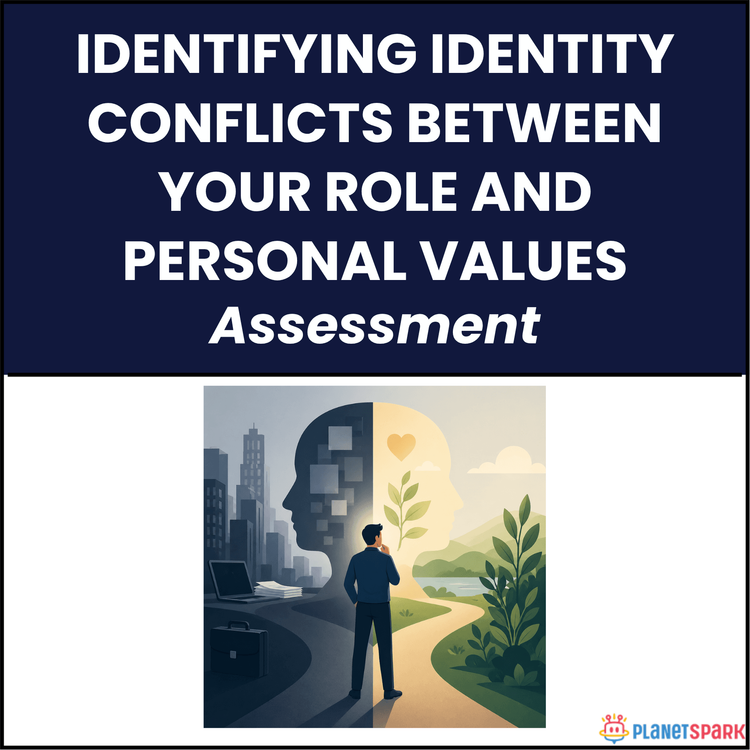
Have you ever felt like something was off at work, even though you were performing well and hitting your targets? The kind of fatigue that no amount of rest seems to fix? If you’ve ever found yourself feeling hollow after achievements or dreading Mondays, you may be dealing with an identity conflict. This quiet, often invisible tension occurs when the demands of your role clash with your personal values and ethics. This guide will help you identify these conflicts, understand what’s driving them, and take action to resolve them. It’s time to stop working in a way that feels misaligned and start making decisions that truly reflect who you are.
Who Is This Resource For?
- High achievers: If you’re excelling at your job but still feel unsatisfied or directionless after achieving success, this guide will help you reconnect with your core values.
- Professionals seeking fulfillment: If you're feeling hollow despite career milestones, this resource will help you shift focus from external rewards to your authentic professional identity.
- Consultants and managers: If you’re managing multiple roles or projects and struggle to find meaning, this guide will provide a method to realign your career decisions with your true self.
- Mid-career professionals: If you’re facing a crossroads in your career and unsure of the next step, this guide offers clarity to make decisions based on your true values, not external pressures.
What Does This Resource Contain?
This guide helps you identify and understand identity conflicts in your professional life. It is structured into six modules designed to lead you through a self-assessment process:
1. Understanding Identity Conflict: Learn the key forms of identity conflict — value-behaviour conflict, identity-role conflict, and aspiration-reality conflict — and how to distinguish between them.
2. Mapping Your Core Values: Define your core values with precision and clarity, so you know exactly what you stand for.
3. Auditing Your Role: Conduct an honest audit of what your role actually requires from you, uncovering the unwritten rules, cultural expectations, and ethical demands.
4. Using the Conflict Identification Matrix: Compare your values and role demands to visually identify where conflicts and misalignments exist.
5. Understanding the Root Causes: Diagnose why the conflict exists and whether it is a result of role evolution, personal growth, or a cultural mismatch.
6. Action Planning: Based on the results, decide how to address your conflict, whether through role crafting, advocacy, or a career transition.
Summary of the Resource
This guide helps you identify the subtle but powerful identity conflicts that may be at the root of your dissatisfaction. By mapping your core values and auditing the demands of your role, you’ll uncover where tensions exist. The Conflict Identification Matrix provides a visual tool to pinpoint these issues, and the final modules help you understand the root cause and decide on an action plan. Whether it’s making small adjustments to your role or considering a larger career shift, this guide empowers you to take control of your professional journey and align your work with your true self.
How Will This Resource Be Useful?
This resource provides a step-by-step process to uncover and address identity conflicts in your career. By understanding the tension between your personal values and professional role, you can make informed decisions that restore alignment. Whether you need to negotiate changes in your current role, advocate for systemic changes, or plan a career transition, this guide gives you the tools to take action. It provides clarity in decision-making and helps you build a career that feels authentic and fulfilling.
How Should You Use This Resource?
Module 1 - Understanding Identity Conflict: Start by identifying the type of conflict you’re experiencing: value-behaviour, identity-role, or aspiration-reality. This will help you understand what kind of conflict you are dealing with.
Module 2 - Mapping Your Core Values: Take the time to define your core values with precision. Complete the exercises to rank your values and define them behaviourally, so you know exactly what you stand for in your professional life.
Module 3 - Auditing Your Role: Conduct an honest audit of your role. Reflect on the decision demands, identity demands, cultural demands, and ethical demands of your position.
Module 4 - Using the Conflict Identification Matrix: Compare the results of your values audit and role audit in the Conflict Identification Matrix. Identify where alignment exists, where there is tension, and where there is a full conflict.
Module 5 - Understanding the Root Causes: Diagnose the root cause of your primary conflict. Is it due to role evolution, personal growth, cultural drift, or hiring mismatch? Understanding this will guide your next steps.
Module 6 - Action Planning: Develop your action plan based on the type and severity of your conflict. Decide whether role crafting, advocacy, or a career transition is the most appropriate response.
Action Steps
1. Complete your Core Values Mapping (Module 2) and Role Audit (Module 3).
2. Fill in the Conflict Identification Matrix and rate the alignment between your values and role demands.
3. Reflect on your results and determine the root cause of your primary conflict (Module 6).
4. Create an action plan based on your diagnosis, considering role crafting, advocacy, or transition.
5. If necessary, schedule a conversation with your manager or mentor to discuss potential changes.
Outro / Closing
By taking the time to understand and address identity conflicts, you are not only improving your career satisfaction but also taking the first step toward a more authentic and fulfilling professional life. This guide gives you the clarity and tools to make career decisions that are aligned with your core values, helping you take control of your career trajectory. The process of aligning your role with your true self may take time, but the result will be a career that feels meaningful and truly yours.
Book your free session today!