
Identifying Informal Leadership Leverage Points in Your Team

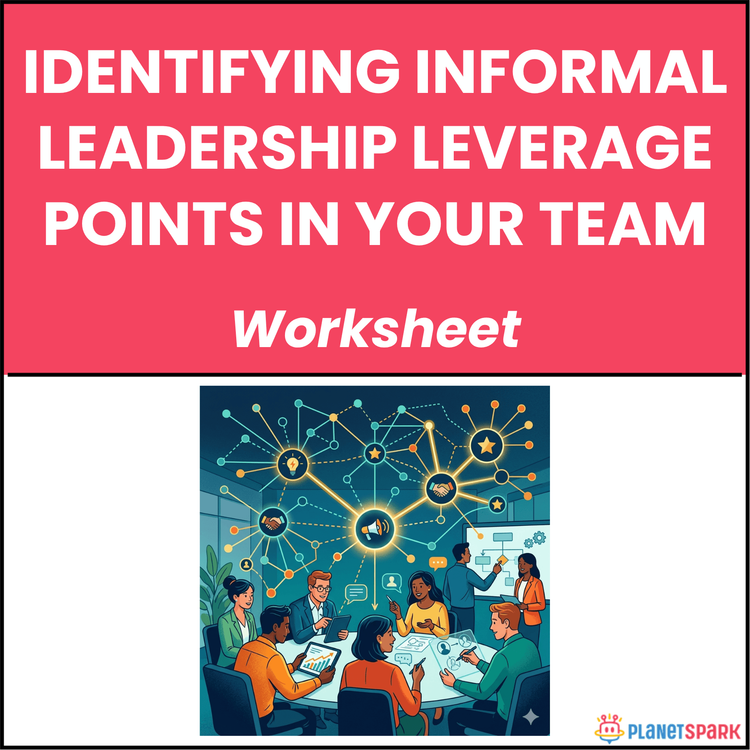
Identifying Informal Leadership Leverage Points in Your Team
How to Identify Informal Leaders in Your Team and Unlock Hidden Influence for Better Performance
Most teams don’t struggle because of lack of talent—they struggle because influence is misunderstood. You might have the right people, the right strategy, and even clear goals, but progress still feels slower than it should. Decisions take longer, change adoption is inconsistent, and team energy fluctuates without clear reasons. What’s often missing is visibility into how influence actually works inside your team.
That’s exactly why the resource “Identifying Informal Leadership Leverage Points in Your Team” exists. It helps you move beyond formal hierarchies and uncover the hidden network of trust, influence, and informal leadership that truly drives team performance.
Instead of guessing who holds influence, this worksheet gives you a structured way to map it, understand it, and use it effectively—so you can lead with clarity, not assumption.
Who Is This Resource For?
This resource is especially useful if you are:
- A manager leading a team and struggling with slow execution or resistance to change
- A consultant working with teams and trying to understand stakeholder dynamics
- An early to mid-career professional aiming to increase influence without formal authority
- A team lead or project owner navigating cross-functional collaboration
- Someone responsible for driving alignment, engagement, or performance within a team
If you’ve ever felt that “something unseen” is affecting your team’s effectiveness, this resource will help you make that invisible layer visible and actionable.
What Does This Resource Contain?
This is a structured, action-oriented worksheet designed to help you move from observation to influence in a clear, step-by-step way.
Inside the resource, you’ll find:
- A clear explanation of informal leadership and why it matters in real teams
- A four-step framework: Observe → Map → Engage → Sustain
- A detailed breakdown of four key influence signals:
- Social magnetism
- Information brokerage
- Conflict mediation
- Morale stewardship
- An Observation Log worksheet to capture real behavioural patterns in your team
- An Influence Map builder to visually chart who influences whom
- A system to identify key “hubs” and “bridges” within your team
- Three engagement strategies for informal leaders:
- Amplifier
- Converter
- Collaborator
- An Engagement Planning template to turn insights into action
- A quarterly review system to keep your understanding of team dynamics current
- A real-world case example showing how these concepts work in practice
- Common pitfalls and how to avoid them when mapping influence
- A concise set of key takeaways for quick reference
Everything is designed to help you apply immediately—not just understand conceptually.
Summary of the Resource
“Identifying Informal Leadership Leverage Points in Your Team” is a practical worksheet that helps you uncover who truly influences your team—and how to work with that influence effectively.
It gives you a repeatable system to:
- Identify informal leaders
- Understand team dynamics
- Activate key influence points
- Improve team alignment and execution
If you invest just 60–90 focused minutes, you can walk away with a clear influence map and a targeted plan to improve how your team operates.
How Will This Resource Be Useful?
This resource helps you shift from reactive management to intentional leadership.
You’ll gain:
- A clear understanding of the hidden influence structure within your team
- The ability to identify who actually drives decisions and behaviour
- Better alignment during change initiatives and new implementations
- Faster adoption of ideas and processes
- Improved team morale and psychological safety
- More effective collaboration across sub-groups or functions
- A repeatable system to continuously refine your leadership approach
Most importantly, it helps you stop relying on assumptions—and start leading based on real behavioural insight.
How Should You Use This Resource?
To get the most value, approach this worksheet in phases:
Start by reading through the entire guide once. This will give you a complete picture of how the four-step framework works together.
Next, begin with the observation phase. Spend one to two weeks noting real behaviours in your team using the Observation Log. Focus on what you actually see and hear—not your interpretations.
Once you have enough data, move to mapping. Create your influence map by identifying patterns of trust, advice-seeking, and behavioural impact. Look for hubs (high influence individuals) and bridges (connectors across groups).
Then, shift to engagement. Select your top two or three informal leaders and apply the appropriate strategy—Amplifier, Converter, or Collaborator—based on their mindset and role.
Finally, build a habit of sustaining your insights. Use the quarterly review checklist to update your influence map and adjust your engagement approach as your team evolves.
You can revisit this resource whenever:
- Your team structure changes
- You take on a new leadership role
- You face resistance to change
- You want to improve team dynamics and performance
Action Steps
After accessing this resource, take these steps immediately:
1. Block 60–90 minutes of uninterrupted time
2. Choose a specific team (4–20 people) to focus on
3. Start your Observation Log for the next 1–2 weeks
4. Identify at least 2–3 potential informal leaders based on patterns
5. Create your first influence map (even if imperfect)
6. Plan one targeted engagement action with a key informal leader
7. Schedule a quarterly calendar reminder to revisit your map
Small, consistent actions here can significantly improve how your team functions.
Every team has an invisible layer that determines how work actually gets done. The most effective leaders don’t ignore it—they learn to see it, understand it, and work with it.
This resource gives you a practical way to do exactly that. Not by adding complexity, but by sharpening your awareness and making your actions more intentional.
When you align formal authority with informal influence, you don’t just manage better—you lead smarter, faster, and with greater impact.