
Identifying Toxic Workplace Behaviors Checklist

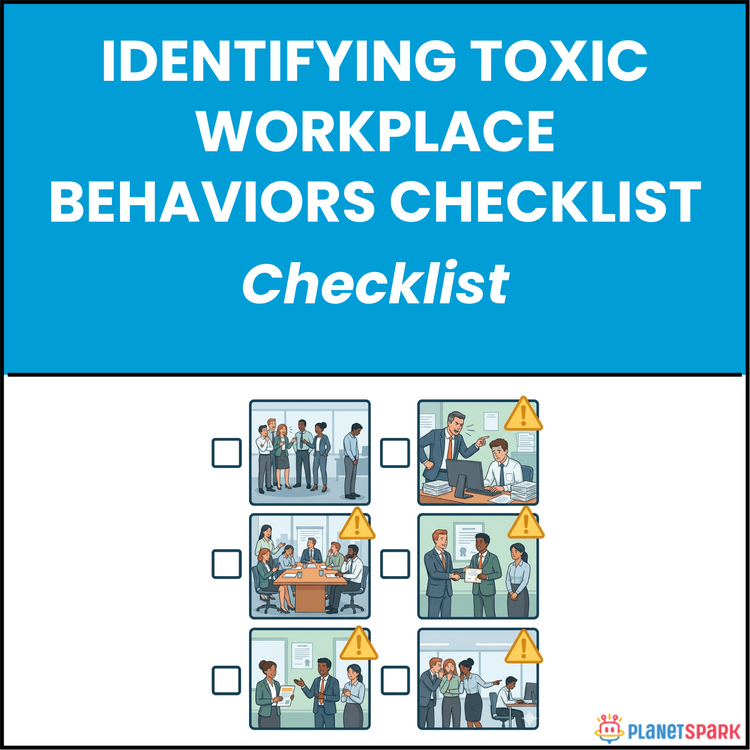
Identifying Toxic Workplace Behaviors Checklist
How to Identify Toxic Workplace Behaviors: A Practical Checklist for Professionals to Protect Their Career and Wellbeing
Most professionals don’t leave jobs because of the work—they leave because of the environment.
Subtle behaviors like constant interruptions, unclear expectations, withheld information, or late-night demands often go unnoticed at first. You might feel something is “off,” but struggle to explain it clearly—or worse, question your own judgment.
This is exactly where the Identifying Toxic Workplace Behaviors Checklist becomes invaluable. It helps you move from confusion to clarity by giving you a structured, practical way to spot, document, and respond to toxic patterns before they impact your performance, confidence, or career growth.
If you’ve ever wondered whether you’re dealing with a tough situation or a toxic one, this resource is designed for you.
Who Is This Resource For?
This checklist is especially useful for:
- Early to mid-career professionals navigating team dynamics
- Managers and team leads responsible for maintaining healthy work environments
- Consultants and client-facing professionals dealing with external stakeholders
- Job seekers evaluating workplace culture during interviews
- Career switchers trying to avoid repeating past toxic experiences
- High performers experiencing burnout, confusion, or lack of recognition
If you’re working in a fast-paced environment and don’t have time to overanalyze situations, this resource gives you quick, actionable clarity.
What Does This Resource Contain?
The resource is structured to be highly practical, skimmable, and immediately usable. It includes:
- The 5 Lenses of Toxicity Framework
A powerful classification system to quickly identify toxic behaviors:
- Personal Disrespect (e.g., public shaming, belittling)
- Psychological Undermining (e.g., credit-stealing, withholding information)
- Boundary Violations (e.g., after-hours pressure, scope creep)
- Exclusion and Bias (e.g., lack of access, unequal treatment)
- Process Abuse (e.g., shifting goals, unfair evaluations)
- Step-by-Step Action Framework
A clear progression from identifying a problem to taking action:
- Observe objectively
- Classify using the 5 lenses
- Document evidence
- Calibrate response level
- Act with minimal risk
- Weekly Toxicity Scan Checklist
A quick diagnostic tool to identify patterns across behaviors and determine when intervention is needed
- Worksheets and Templates
Ready-to-use tools including:
- Incident Log (ESS-W Model: Event, Setting, Signals, Witnesses, Impact)
- Decision Ladder (Low–Mid–High escalation strategy)
- Boundary Script (structured communication for setting limits)
- Real-World Case Example
A practical scenario showing how multiple toxic behaviors were identified and resolved using the framework
- Common Mistakes and Fixes
Guidance on avoiding common errors like over-escalation or emotional reactions
- Toxic vs. Tough Culture Guide
A simple way to differentiate between high-performance environments and genuinely harmful ones
Summary of the Resource
This checklist transforms vague discomfort into structured action.
Instead of second-guessing your experience, it helps you:
- Identify patterns quickly
- Document situations clearly
- Respond with confidence and professionalism
- Protect your time, energy, and career trajectory
It is not just a diagnostic tool—it is a decision-making system for real workplace situations.
How Will This Resource Be Useful?
Using this resource can significantly improve how you navigate challenging work environments.
Here’s how it helps in real terms:
- Clarity in Ambiguous Situations
You stop wondering “Is it just me?” and start recognizing clear behavioral patterns.
- Stronger Professional Boundaries
You learn how to communicate limits without conflict or guilt.
- Better Decision-Making
You know when to address, escalate, or step back from a situation.
- Increased Confidence
You rely on facts and documented patterns instead of emotions.
- Protection Against Burnout
Early detection prevents prolonged exposure to toxic environments.
- Improved Workplace Communication
Structured scripts and documentation make your communication more effective and credible.
How Should You Use This Resource?
To get maximum value, use the resource in a structured way:
Step 1: Read Through Once
Understand the 5 Lenses and overall framework to build awareness.
Step 2: Start Weekly Scans
Use the checklist once a week to assess your environment objectively.
Step 3: Document Specific Incidents
When something feels off, use the Incident Log to capture facts—not interpretations.
Step 4: Classify the Behavior
Map the situation to one or more of the 5 lenses to identify patterns.
Step 5: Choose Your Response Level
Use the Decision Ladder to decide whether to:
- Set a boundary
- Have a direct conversation
- Escalate to a manager
- Consider HR or structural changes
Step 6: Apply the Boundary Script
Communicate clearly and professionally without emotional escalation.
Step 7: Revisit and Adjust
Track patterns over time and adjust your approach based on outcomes.
Consistency is key. This is not a one-time tool—it’s a system you build into your weekly routine.
Action Steps
If you want to start using this immediately, follow these steps:
1. Read the checklist end-to-end once (10–15 minutes)
2. Run your first weekly toxicity scan
3. Identify at least one behavior that stands out
4. Log one real incident using the Incident Log format
5. Classify it using the 5 Lenses
6. Decide your response level using the Decision Ladder
7. Draft a simple, fact-based response or boundary message
8. Review your environment again after one week
Small, consistent actions will give you clarity and control over time. You don’t need to fix everything at once—just start with one pattern.
In today’s fast-moving professional world, your ability to identify and respond to toxic behaviors is not just a soft skill—it’s a career survival skill. The professionals who grow consistently are not the ones who tolerate everything, but the ones who recognize patterns early, act with clarity, and protect their energy. This resource gives you that edge.
Use it not just to react, but to build a healthier, more sustainable way of working—whether you stay, fix, or move on.
Book your free session today!